




The Lawson well in central Saskatchewan returned hydrogen concentrations of up to 286,000 parts per million when results were confirmed in January 2026, establishing Canada’s first verified subsurface natural hydrogen system through drilling validated by three independent laboratories.
That single data point placed MAX Power Mining Corp. among a small and growing cohort of companies globally that have moved natural hydrogen from theoretical resource to confirmed subsurface occurrence. What happens next is considerably more uncertain, and the company’s latest drilling campaign is the mechanism through which that uncertainty either narrows or expands.
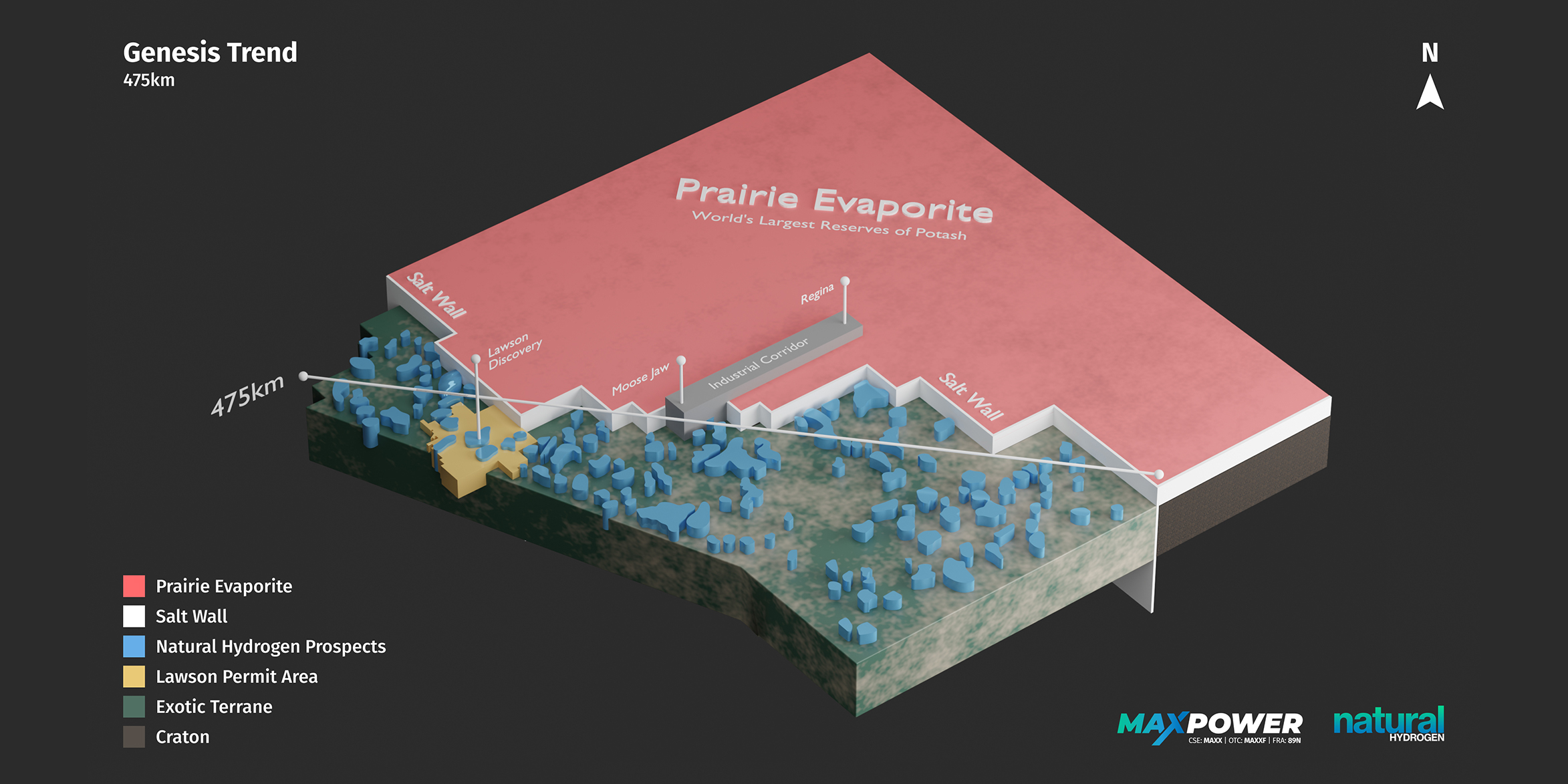
MAX Power’s announcement on May 22, 2026, details the definition of the first series of follow-up drill targets within the 28 square kilometer Lawson Complex, supported by interpretation of a 3D seismic survey that delineated a structural closure with an aerial extent of approximately 14.2 square kilometers. Six proposed well locations have been surveyed, with the first three targets finalized at the apex and flanks of the structure. The company is also running a parallel 2D seismic acquisition program across the 475-kilometer Genesis Trend to assess broader prospectivity. A $25 million strategic investment by Eric Sprott, announced the previous day, provides the capital base for this expanded program.
The geological setting at Lawson carries some characteristics that distinguish it from many other natural hydrogen prospects being drilled globally. The Genesis Trend’s eastern flank adjoins the Prairie Evaporite, a salt formation hosting the world’s largest potash reserves. That salt barrier is structurally significant in natural hydrogen geology: evaporite seals reduce the permeability through which hydrogen, a highly mobile molecule, can migrate and escape upward. The preservation of hydrogen accumulations over geological time is one of the central technical questions facing the entire sector, and the presence of a competent salt seal at Lawson is a favorable indicator, though confirmation of seal integrity requires drilling rather than seismic interpretation alone.
The purity of the hydrogen encountered at Lawson is also commercially relevant. At concentrations up to 286,000 parts per million, the system approaches the high-purity threshold that reduces downstream separation and purification costs materially. For comparison, the Mali well at Bourakébougou, the only producing natural hydrogen well in the world, delivers hydrogen at roughly 98% purity. Whether Lawson’s apex, which the 3D seismic identifies as the likely zone of highest concentration, delivers comparable purity at commercial flow rates is one of the specific parameters the follow-up drilling program is designed to test. The others are reservoir continuity, pressure response, and volume, all variables that seismic data can constrain but not resolve.
The Sprott investment, structured as a private placement expected to close on or around May 28, 2026, adds financial credibility to the program. Eric Sprott has a track record of early-stage resource investment in Canada’s junior mining and energy sector, and his participation at this stage signals a degree of geological conviction about the Lawson system that the January discovery results alone did not fully command from institutional capital. The company intends to use the proceeds for follow-up drilling at the Lawson Complex, resource modelling and estimation, additional seismic acquisition, near-term well completion at its Bracken prospect, and continued development of its proprietary AI-driven exploration platform, which it calls the MAXX LEMI system.
The helium dimension of the Lawson Complex adds a secondary commercial layer that warrants attention independently of the hydrogen thesis. Saskatchewan currently supplies approximately 3% of the global helium market and is implementing a provincial Helium Action Plan targeting a 10% global market share by 2030, which would roughly triple current production levels. Helium production investment in the province has reached an estimated $700 million. The ongoing Middle East crisis has further disrupted global helium supply chains, with the Hormuz closure threatening a fifth global helium supply shortage in recent decades. If Lawson delivers commercially viable co-production of hydrogen and helium from the same reservoir system, the economics of each improve the other: shared well costs, shared surface infrastructure, and dual revenue streams against a single capital program.
This is, however, where the optimism embedded in junior exploration announcements requires calibration against sector-level context. The natural hydrogen sector globally has attracted significant capital in recent years, with US-based Koloma raising over $300 million, Australia’s Gold Hydrogen and HyTerra advancing drilling programs, and France’s Mantle8 closing a €31 million Series A in May 2026. Yet the scientific community maintains that the sector remains at an early stage, with the Mali well the only producing system and most active drilling programs still at the confirmation rather than commercial stage. A 2025 peer-reviewed techno-economic analysis modeled 32,000 scenarios for natural hydrogen extraction and placed production costs in a range of $0.14 to $5.33 per kilogram, with the lower bound achievable only under conditions of high purity, favorable reservoir geometry, and shallow well depth. Lawson’s costs will be determined by the drilling results, not by analogies to the optimistic end of that range.
MAX Power’s land position in Saskatchewan is substantive: 1.3 million acres of permitted ground, with a further 5.7 million acres under application. That acreage, combined with the Genesis Trend’s 475-kilometer extent stretching into Montana and the Dakotas, provides the scale required for a meaningful resource base if the geology proves out. The company’s approach of using Lawson as a geological calibration point for the broader trend, rather than treating it as an isolated occurrence, reflects technically sound practice. The risk is that Lawson, like many first wells in an emerging play, is anomalous rather than representative, a structurally unique accumulation that does not replicate with sufficient consistency along trend to support basin-scale development.
The MOU signed with the City of Moose Jaw in May 2026, positioning the Genesis Trend in proximity to Saskatchewan’s largest industrial corridor, introduces a demand-side pathway that most natural hydrogen projects globally have not yet engaged. The Industrial Corridor includes a proposed large-scale data center development by Bell Canada, among other energy-intensive operations. If commercial hydrogen flow can be established at Lawson, the corridor’s proximity means that initial off-take could be structured around local industrial supply rather than requiring the long-distance transmission infrastructure that makes hydrogen economics difficult elsewhere. That localization of the value chain is a practical advantage that reduces the capital required to reach a commercial milestone, even if it limits the initial scale.


