


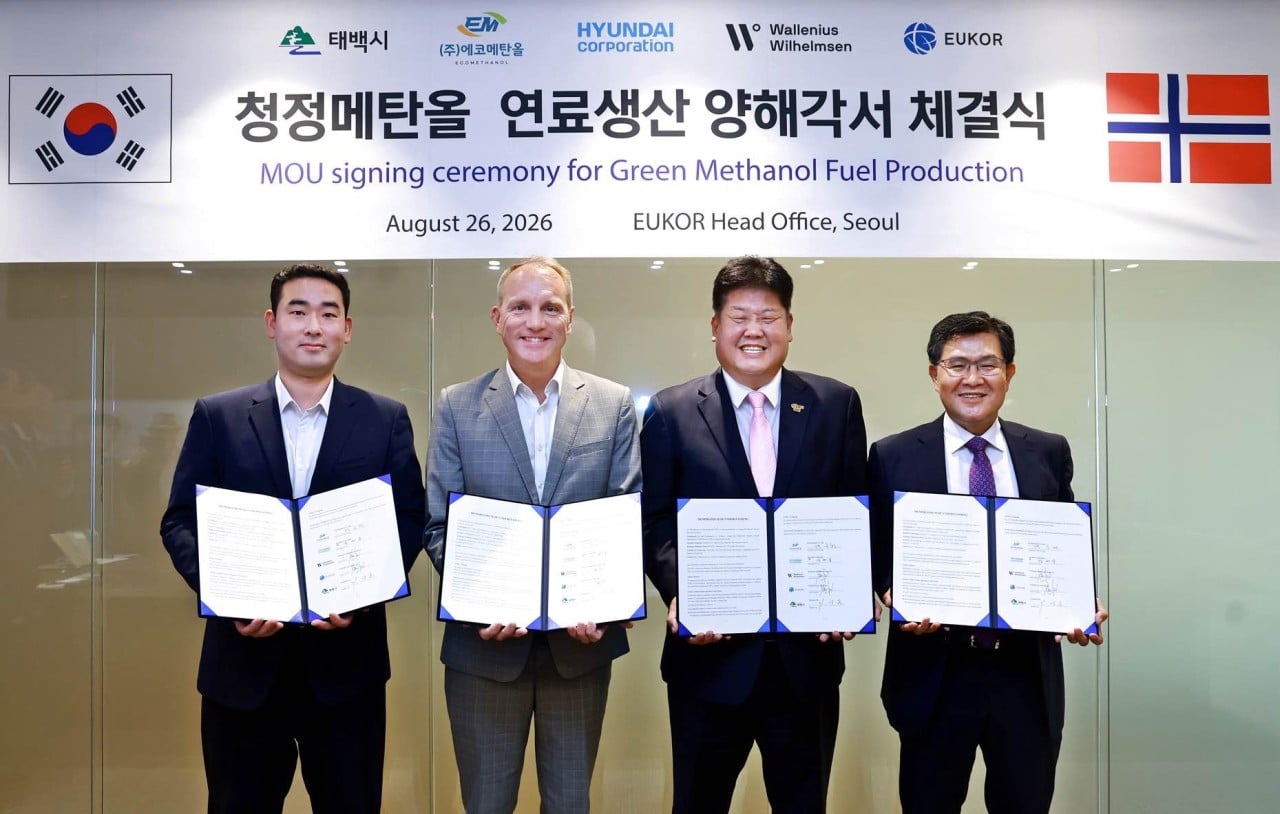


South Korea is moving to establish its first domestic source of green methanol for shipping, with a planned facility in Taebaek, Gangwon State, designed to produce 15,000 tons annually from forestry residues.
EcoMethanol, a special-purpose company established by Korean clean energy developer Plagen, signed a memorandum of understanding with Taebaek City, Hyundai Corporation, Wallenius Wilhelmsen Ocean and EUKOR Car Carriers. Under the agreement, Hyundai Corporation would purchase the methanol and supply it to the two shipping companies for use in their fleets.
The KRW 120 billion project is scheduled to begin construction in December 2026, with commercial production targeted for January 2029. EcoMethanol has secured the site, obtained an integrated environmental permit and completed basic design.
The significance of the project lies less in its initial volume than in the supply chain it is attempting to establish. Production, trading and maritime consumption are being linked before construction begins, providing a potential offtake structure for the plant.
South Korean shipping companies are already operating methanol-fueled vessels, but the fuel is imported. EUKOR’s car carrier Arctic Tern loaded about 2,800 tons of methanol in Shanghai in July 2026 before entering commercial service on the Asia-Europe route. Korean container shipping company HMM has also bunkered methanol-fueled vessels in Shanghai. According to EcoMethanol, the fuel used in these operations was produced in China.
Ulsan became the first port globally to bunker green methanol to a vessel in 2023, but that fuel was also imported. South Korea consumes approximately 2 million tons of methanol annually, most of it produced from fossil feedstocks.
The Taebaek facility would therefore address an upstream gap rather than immediately transform the country’s fuel market. Its planned output represents less than 1% of Korea’s annual methanol consumption.
The EU Emissions Trading System has covered maritime transport since 2024, while FuelEU Maritime imposes progressively tighter limits on the greenhouse gas intensity of energy used by ships operating in EU waters. The IMO is also developing a global Net-Zero Framework based on lifecycle greenhouse gas intensity and an economic mechanism for emissions.
These measures increase the value of lower-carbon fuels, but they do not eliminate the cost disadvantage of green methanol.
For biomass-based methanol, lifecycle emissions will also depend on feedstock sourcing, transport, processing energy and certification. Forestry residues can provide a low-carbon feedstock, but the environmental value of the fuel ultimately depends on how those emissions are accounted for under applicable regulatory frameworks.
EcoMethanol says green methanol currently carries a premium over fossil-derived methanol and argues that temporary policy support will be needed until carbon costs narrow the gap.
South Korea is developing implementing rules for its Special Act on Support for the Establishment of Green Shipping Corridors, including proposals for financial mechanisms such as a Carbon Contract for Difference for green methanol.
The Taebaek project will therefore test more than gasification technology. It will test whether a domestic supply chain can secure sustainable biomass, produce certified low-carbon fuel, obtain long-term shipping demand and compete economically against conventional methanol.
At 15,000 tons per year, the facility is too small to materially change Korea’s marine-fuel balance. Its importance will depend on whether it can establish a commercially viable model that can be replicated across former coal-mining regions and scaled without creating excessive dependence on subsidies or unsustainable biomass supply.
For South Korea, the immediate challenge is no longer demonstrating that ships can run on methanol. It is building enough domestic low-carbon methanol at a competitive cost to make the fuel a meaningful part of the country’s shipping decarbonization strategy.


