


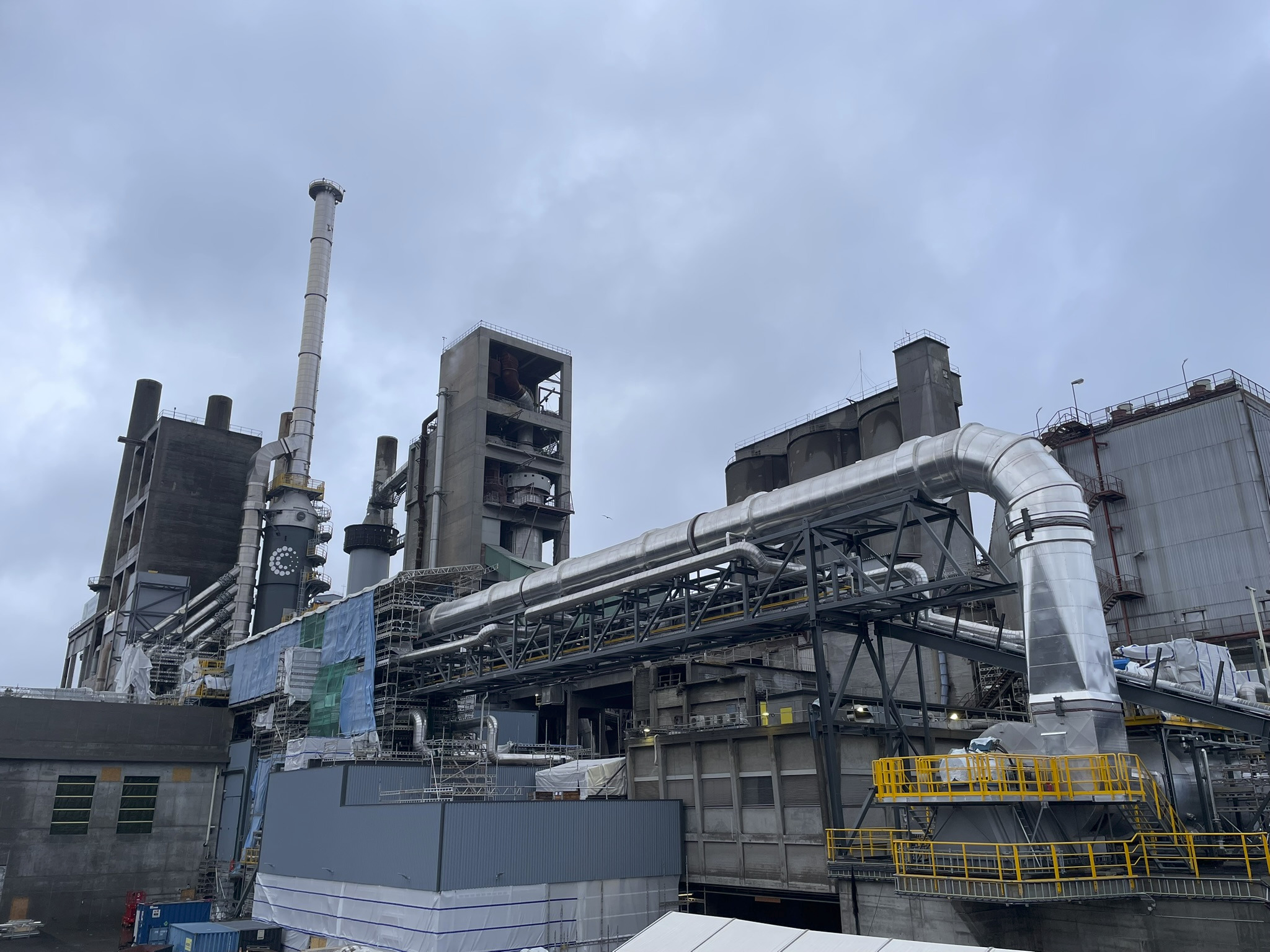


Polish industry emitted 42.2 Mt CO2 in 2024, and national assessments put the country’s effective CO2 storage resource at 10 to 15 Gt. Yet the European Commission’s review of the EU injection target, dated 28 May 2026, lists one Polish storage project: HuCCSar, expected in 2028, with injection capacity of 0.005 Mt per year. That is about 0.012% of the 2024 industrial figure. The Global CCS Institute, a non-profit think tank, put the numbers side by side in its Poland status report of 30 September 2026. Resource is plentiful. Permitted injection capacity is not.
Poland CO2 storage resource versus readiness
The report cites national static volumetric assessments of about 10 to 15 Gt effective storage resource, plus its own probabilistic basin-scale estimate of about 20 Gt. Against 42.2 Mt per year, the lower national figure covers about 237 years (10,000 Mt divided by 42.2 Mt per year) and the upper about 355 years. Geology is not the binding constraint.
Maturity is. A 2025 peer reviewed review in the International Journal of Greenhouse Gas Control catalogues 73 Polish prospects: 45 deep saline aquifers and 28 hydrocarbon fields. It reports that the EU-funded CCUS ZEN project classed the identified sites at storage readiness level 2 to 3, which indicates early-stage suitability, and the authors state that the tentative capacity figures are insufficient for definitive business decisions. At that stage a resource number describes rock volume, not a licensed injection rate.
Poland CO2 storage licences and national strategy
In June 2026 Poland designated 18 areas for storage exploration, 17 onshore and one offshore in its exclusive economic zone. The Institute’s report mentions no storage licence or permit for any of them. It also states that the national CCS strategy was still under development as of September 2026, and that CO2 transport still needs connection procedures, technical standards and appointed network operators.
The Commission’s review adds that Poland had not submitted an updated national energy and climate plan, and that its legal framework for publishing geological data from hydrocarbon operators was still in progress. Exploration designations come before storage permits under the licensing structure the 2011 CCS Act created, so the 18 areas are the first step of a longer sequence.
EU CO2 injection capacity versus the 50 Mt target
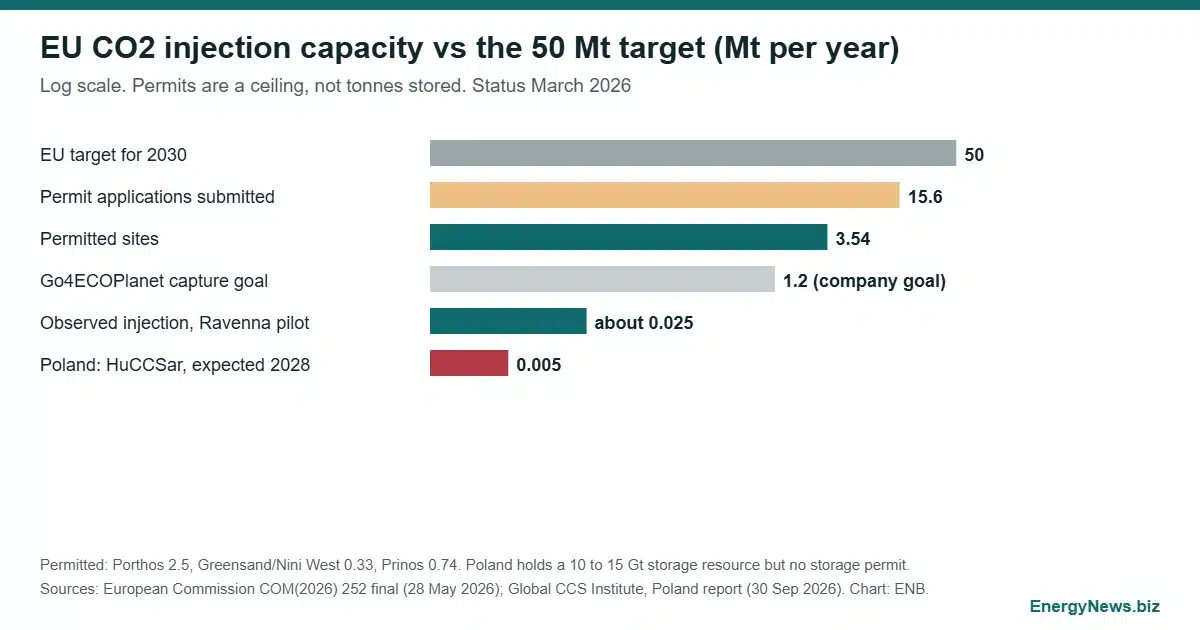
The Commission data, with a cut-off of March 2026, give the context in which Poland’s figures sit. Shares are calculated against the 50 Mt per year target for 2030.
| Category (status March 2026) | Mt CO2 per year | Share of 50 Mt target |
|---|---|---|
| Permitted: Porthos 2.5, Greensand/Nini West 0.33, Prinos 0.74 | 3.54 | 7.1% |
| Seven projects with permit applications submitted | 15.6 | 31.2% |
| Permitted plus applied | 19.14 | 38.3% |
| Observed injection: Ravenna pilot, since 2024 | about 0.025 | 0.05% |
| Poland: HuCCSar, expected 2028 | 0.005 | 0.01% |
A permit is a ceiling, not stored tonnes. The only injection the Commission records at the cut-off is the Ravenna pilot at roughly 25,000 t per year. On the demand side, the 33 capture projects funded by the Innovation Fund would need 25.3 Mt per year of injection capacity, about seven times the permitted total (25.3 divided by 3.54). For one of the permitted sites, see ENB’s coverage of the Prinos CO2 storage project moving to FEED.
Go4ECOPlanet CO2 transport to the North Sea
The Institute lists Go4ECOPlanet, a cement capture project at Kujawy, at 1 to 1.2 Mt per year, with a 2027 start and a €228 million Innovation Fund grant awarded in 2022. The company states that it aims to capture around 1.2 Mt per year by the end of the decade and to ship liquefied CO2 to the North Sea for storage in depleted oil and gas reservoirs. The two start dates do not match, and the company statement names no storage site.
The scale is the issue. At 1.2 Mt per year, one Polish cement plant would need the equivalent of 34% of all EU capacity permitted in March (1.2 divided by 3.54), or 48% of Porthos alone (1.2 divided by 2.5). ORLEN entities carry a stated obligation of 4.26 Mt per year toward the EU target, 8.5% of 50 Mt and roughly 850 times the only Polish injection capacity on the Commission’s list.
Checking the Poland numbers
One cross-check holds. The Institute gives HuCCSar a lifetime volume of over 51,000 t, and the Commission lists 0.005 Mt per year, or 5,000 t per year. The two imply about 10 years of operation, which is consistent. One does not hold cleanly: a separate Polish facility-level database reports 58.1 Mt for 2024 across 1,025 industrial sites, so the 42.2 Mt denominator depends on scope. On 58.1 Mt, the HuCCSar share falls to about 0.009%.
The next signals are concrete: whether the national CCS strategy is published, whether any of the 18 exploration areas leads to a storage permit application, and which start year Go4ECOPlanet confirms for capture. Until a Polish or foreign storage permit is tied to it, 2027 versus the end of the decade remains an open technical and permitting risk, not a schedule.
Add EnergyNews.biz as a preferred source on Google


