




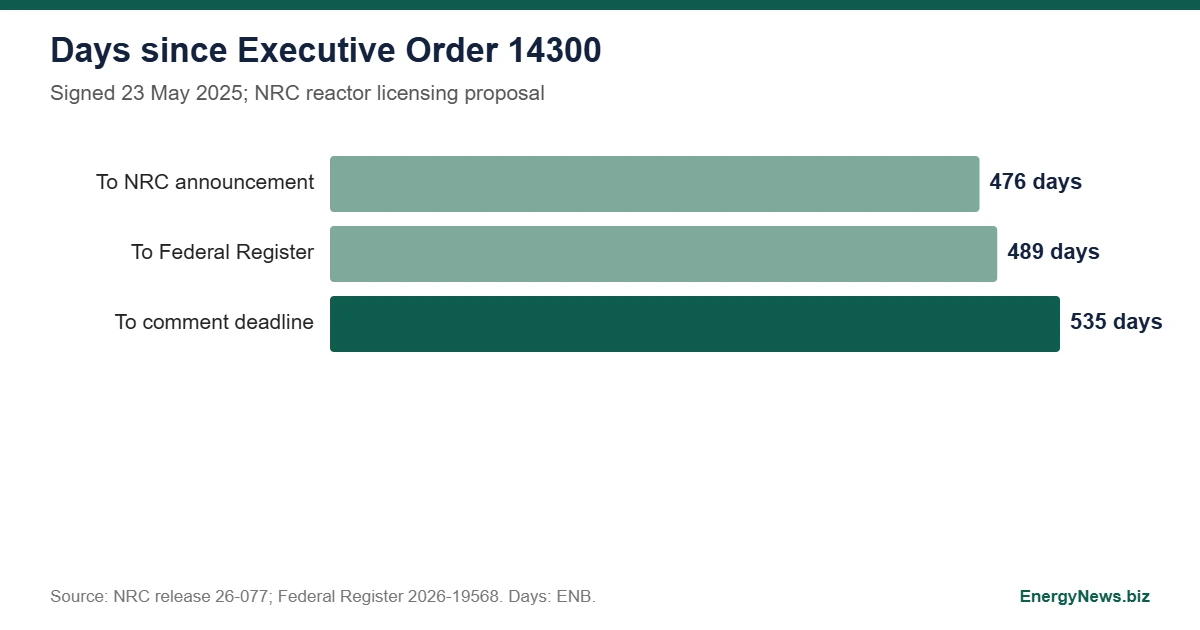
The US Nuclear Regulatory Commission has proposed a broad overhaul of reactor licensing, decommissioning and operational oversight, and public comments are due by 11:59 p.m. Eastern on 9 November 2026. The NRC announced the proposal on 11 September (release 26-077) and the Federal Register notice 2026-19568 followed on 24 September. It is the agency’s response to Executive Order 14300, signed on 23 May 2025. The comment window is 46 days from publication, an ENB count.
What the proposal covers
The package touches nine parts of Title 10 of the Code of Federal Regulations: 20, 21, 50, 52, 53, 55, 70, 72 and 75. Those parts span radiation protection, defect reporting, the main licensing routes for power reactors, operator licensing and spent fuel storage. Among the major provisions listed in the notice are:
- Clarifications to Part 21 on reporting defects and noncompliance.
- Changes to nonemergency event reporting.
- New licensing steps for decommissioning.
- Financial qualification rules and use of the decommissioning trust fund.
- Risk informed seismic design.
- Requirements for probabilistic risk assessment.
- Rules on backfitting and issue finality.
The notice lists further changes. The full text is on the Federal Register page and in Docket NRC-2025-1138 on regulations.gov.
Timeline
| Date | Step | Days after EO 14300 |
|---|---|---|
| 23 May 2025 | Executive Order 14300 signed | 0 |
| 11 September 2026 | NRC announces the proposed overhaul | 476 |
| 24 September 2026 | Federal Register notice published | 489 |
| 8 and 14 October 2026 | NRC public webinars | 503 and 509 |
| 9 November 2026 | Comments due, 11:59 p.m. ET | 535 |
Day counts are ENB calculations from the stated dates. The NRC advisory of 1 October sets the webinars for 8 October from 2 to 3:30 p.m. Eastern and 14 October from 9 to 10:30 a.m. Eastern, both on Microsoft Teams.
Why two items matter for developers
Backfitting and issue finality decide how easily the agency can impose new requirements on a design that has already been approved. A tighter finality rule gives a designer more certainty on cost and schedule. A looser one keeps the regulator’s flexibility. The probabilistic risk assessment and seismic changes bear on how much of a plant’s safety case can rest on risk insights rather than prescriptive limits, which is the lever that advanced reactor developers have long asked about.
The effect on schedule is already visible in the agency’s work. ENB reported that the Clinch River SMR construction permit came four months ahead of the NRC schedule. A rule that fixes the same discipline in regulation would make such outcomes less dependent on one review team.
What to watch
This is a proposal, not a final rule. The notice does not end the debate over how far risk informed methods should go, and comments from utilities, developers, safety groups and states will shape the text. ENB did not verify a date for a final rule, and none is assumed here. The open points to track are the final wording on backfitting and finality, how decommissioning trust funds can be used, and whether the NRC extends the comment window after the October webinars.
Add EnergyNews.biz as a preferred source on Google


