





The Pennsylvania Public Utility Commission voted 4 to 0 on 1 October 2026 for a Tentative Order (Docket M-2026-3064961) that would curtail large new loads without sufficient new capacity before other customers when PJM calls an Interim Resource Adequacy Service event. Data centers that are not classed as critical load get no exemption. The order is not final: comments and replies come first, and a Final Order is targeted for the 28 January 2027 public meeting.
What the Tentative Order says
Under the order, utilities would identify large loads in their territories and set procedures for curtailing them during PJM events. The priority rule is the core of it: a new large load that has not brought its own new capacity is interrupted ahead of ordinary customers. The Commission is seeking comment before it fixes the definitions, so the thresholds and the critical load list can still move.
Why the Commission acted
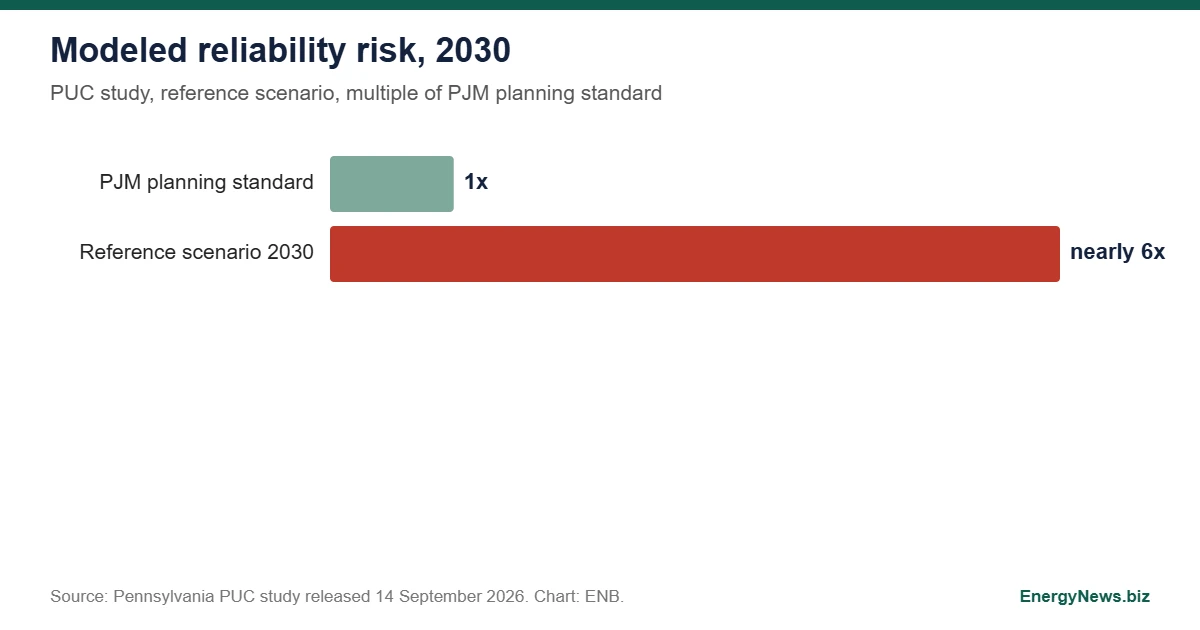
The vote follows a motion on 10 September by Vice Chair Barrow and a study the PUC commissioned, released on 14 September. The study found that its reference scenario fails the PJM reliability planning standard from 2027 to 2030, with modeled risk by 2030 nearly six times the standard. Separately, the Commission issued a final order in May 2026 on a model tariff for large loads of 50 MW or more, which governs how those customers are connected and billed.
Timeline
| Date | Step |
|---|---|
| May 2026 | Final order on a model large load tariff for loads of 50 MW or more |
| 10 September 2026 | Motion by Vice Chair Barrow |
| 14 September 2026 | PUC study on data center growth and reliability released |
| 1 October 2026 | Tentative Order adopted 4 to 0 |
| After Pennsylvania Bulletin publication | 30 days for comments, then 15 days for replies |
| 28 January 2027 | Target for the Final Order |
How tight the calendar is
From 1 October 2026 to 28 January 2027 is 119 days. The comment and reply windows take 45 days from the date the notice appears in the Pennsylvania Bulletin. If publication came immediately, that would leave about 74 days to read filings and write the order. Every week of delay in publication comes straight out of that margin, an ENB calculation from the stated dates.
Where this sits in the PJM picture
The curtailment rule links to the Interim Resource Adequacy Service that PJM has proposed, so its force depends on PJM’s design. ENB reported earlier on the PJM backstop procurement delay and a 6.8 GW gap. A state rule that interrupts new large loads first is one way to hold the line while procurement catches up, but it does not add a megawatt of supply.
What to watch
The open questions are the Bulletin publication date, who qualifies as critical load, and how utilities will verify that a load brought sufficient new capacity. The order text will decide the last point, and developers of large loads will have an incentive to argue it in their comments.
Add EnergyNews.biz as a preferred source on Google


