




On 29 September FERC accepted PJM’s one-time Reliability Backstop Procurement and in the same order suspended it for five months, to 28 February 2027. The procurement window that was due to open on 30 September did not open. The target is 6,831.3 MW of new capacity, which is exactly the shortfall against PJM’s reliability requirement in the 2028/29 capacity auction, an auction that cleared only 525 MW of new generation. The grid operator’s board says new large loads should bear the costs they cause. The order shows that the cost allocation behind that sentence is still unresolved.
What FERC decided on 29 September
The order accepts the tariff filing in docket ER26-3380 but sets the effective date at 28 February 2027, subject to refund and to the outcome of further proceedings. FERC identified three discrete issues that need more work. They concern cost allocation, the treatment of transmission owners that exit during the commitment term, and the collateral that load-serving entities must post. PJM states that it welcomes the acceptance and will use an administrative update at its Market Implementation Committee on 7 October to set out next steps. No revised timeline has been published.
The delay matters because the original plan was compressed. PJM’s board decision of 27 July set a procurement window from 30 September to 21 October, with results in early December. That sequence is now gone, and nothing in the order sets a deadline for PJM to cure the three issues.
PJM capacity shortfall in numbers
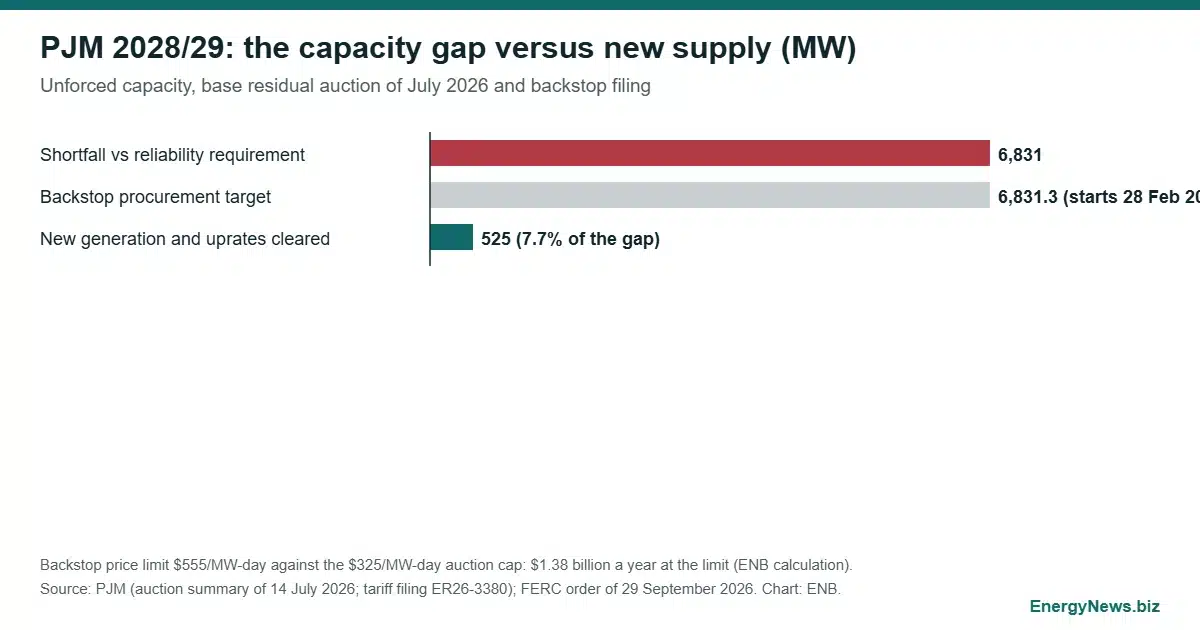
The size of the gap is not in dispute. PJM’s own auction summary for delivery year 2028/29 reports that procured capacity plus Fixed Resource Requirement resources fell short of the reliability requirement by 6,831 MW. The previous auction was short by roughly 6,500 MW. The auction cleared 138,318 MW of unforced capacity at $325 per MW-day, the cap of the price collar, for a total of $16.4 billion, with a reserve margin of 14.7%.
| Item | Value | Basis |
|---|---|---|
| Capacity procured, 2028/29 | 138,318 MW UCAP | Base Residual Auction, July 2026 |
| Clearing price | $325/MW-day (at cap) | Same auction |
| Shortfall vs reliability requirement | 6,831 MW | Same auction |
| New generation and uprates cleared | 525 MW UCAP | Same auction |
| Backstop target | 6,831.3 MW UCAP | Tariff filing, 31 July 2026 |
| Backstop price limit | $555/MW-day, MW-weighted average of levelized cost | Tariff filing |
| Commitment term | Up to 15 delivery years, 2028/29 to 2042/43 | Tariff filing |
Set the two headline numbers against each other. The market delivered 525 MW of new supply against a 6,831 MW hole, or 7.7% of what was missing. That is the case for a central procurement, and it is also the reason a five-month suspension is more than a calendar item.
Backstop procurement cost calculation
PJM reported $16.4 billion for the auction. Multiplying the published quantities reproduces it: 138,318 MW x $325 per MW-day x 365 days gives $16.41 billion, so the auction figures are internally consistent. Applying the same arithmetic to the backstop gives a ceiling that the filing itself does not state.
| Case | Inputs | Result |
|---|---|---|
| 2028/29 auction, one delivery year | 138,318 MW x $325 x 365 | $16.41 billion |
| Backstop at the price limit, one delivery year | 6,831.3 MW x $555 x 365 | $1.38 billion |
| Backstop at the price limit, 15 years, flat and undiscounted | $1.38 billion x 15 | $20.8 billion |
| Any 100 MW obligation, one year, at $555 versus $325 | 100 x price x 365 | $20.3 million versus $11.9 million |
The backstop adds 4.9% to procured MW and about 8.4% to the annual bill, because the price limit is 71% above the auction cap. Treat the 15-year figure as an upper bound: the limit applies to the MW-weighted average of levelized offers, so actual commitments could cost less, and the filing does not set a flat nominal payment. The order of magnitude is the point. A cost of this size has to land somewhere, and FERC has just flagged that the proposed allocation may not be just and reasonable.
Who pays for large load capacity
Under the filing, PJM allocates wholesale backstop costs to zones in proportion to their expected large load additions. States then decide how to split the charge among retail customers, including data centres. PJM therefore guarantees a wholesale signal but not a retail outcome. The board decision says new large loads should bear the costs they cause, while leaving final rate application to states and load-serving entities.
The independent Market Monitor argues in its 3 September protest, filed against the companion Interim Resource Adequacy Service (IRAS) proposal, that the design pushes costs onto existing customers. Its filing states that data centre load has added $29.4 billion to the cost of capacity, a cumulative figure whose auction years it does not specify. It also objects that curtailed data centres would be compensated at 50% of the non-performance charge rate, paid by other customers. These are the Monitor’s positions, not findings, but they sit on top of the same question FERC flagged on 29 September.
Data centre load forecast behind the gap
PJM’s tariff filing states that peak load is forecast to grow by 32 GW from 2024 to 2030, of which 30 GW is data centres. The board decision cites about 70 GW of new large load by 2038 against 15 GW of generation retired since 2022. The Monitor’s table of July peak data centre load shows 5,036.9 MW in 2023, 6,135.6 MW in 2024 and 8,167.2 MW in 2025, an increase of 62%. The Monitor also lists 93,916.3 MW of data centre peak load expected to be operating by 1 June 2031.
One caution on that filing: its running text gives the 2025 figure as 7,735 MW, which does not match its own table or the 62% growth rate. Only the table value reconciles, so that is the one used here. The scale of the forecast is clear either way. The Monitor’s measured rise of about 3.1 GW between 2023 and 2025 and PJM’s forecast increment of 30 GW over 2024 to 2030 are on different bases, but they show that most of the growth driving the shortfall is load that has not yet connected. For the national picture, see ENB’s analysis of how the AI grid mismatch is getting worse each year.
PJM reliability backstop timeline
| Date | Event |
|---|---|
| 14 July 2026 | 2028/29 auction results: 6,831 MW short, 525 MW new generation cleared |
| 27 July 2026 | PJM board decision: backstop procurement and connect and manage approach |
| 31 July 2026 | Backstop tariff filed, ER26-3380 |
| 13 August 2026 | Interim Resource Adequacy Service filed, ER26-3515 |
| 3 September 2026 | Market Monitor protest |
| 29 September 2026 | FERC accepts and suspends backstop; 30 September opening cancelled |
| 7 October 2026 | PJM administrative update, Market Implementation Committee |
| 12 October 2026 | Sixty days after the IRAS filing, the decision date PJM requested |
| 28 February 2027 | Backstop effective date set by FERC |
| 1 June 2027 | Planned start of IRAS curtailment priority for new large loads |
| 1 June 2032 | Deadline for backstop resources to reach commercial operation |
Why the delay compresses the build window
From the new effective date of 28 February 2027 to the start of the 2028/29 delivery year on 1 June 2028 is 15 months, and PJM has not yet filed fixes for the three open issues. The filing allows resources to enter service as late as 1 June 2032, so the tariff does not guarantee that new plant is in service for the 2028/29 delivery year it is meant to cover. The filing lists new builds, uprates, fuel conversions, repowered plant, demand resources and aggregated distributed resources as eligible, and it does not split the 6,831 MW between them.
The interaction with the other track matters. IRAS would put new loads of 50 MW or more that bring no new capacity first in line for curtailment from the 2027/28 delivery year, and exclude them from capacity procurement targets from 2029/30. If the backstop slips while IRAS proceeds, developers who cannot self-supply carry the curtailment risk first, and existing customers carry the price risk if the Monitor’s reading of IRAS is right.
Two dates open the next phase. PJM gives its administrative update on 7 October, and the 60 day mark for FERC action on IRAS falls on 12 October. After that, the open question is whether PJM refiles the cost allocation, exit and collateral provisions fast enough for a procurement to run before the 2028/29 delivery year begins on 1 June 2028.
Add EnergyNews.biz as a preferred source on Google


