


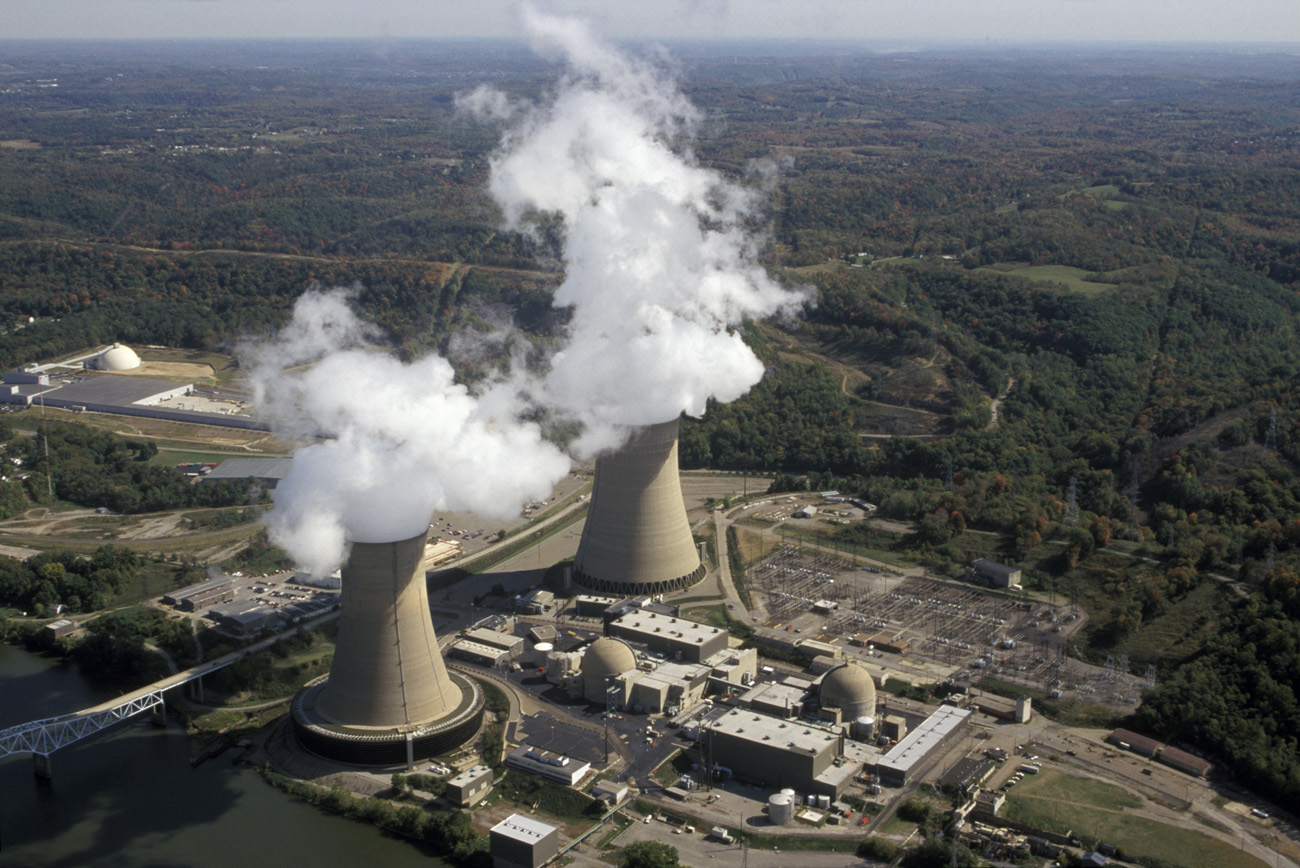


The Department of Energy’s Office of Energy Dominance Financing announced on 5 October 2026 a conditional loan commitment of up to $4.2 billion for nuclear uprates and modernization across Vistra’s fleet in Pennsylvania and Ohio. By DOE’s own figures the money buys 433 megawatts of new nuclear capacity and keeps nearly 4 gigawatts of existing output running.
Those two numbers describe different products, and the headline treats them as one. The arithmetic says the loan is mainly a financing package for keeping reactors that already exist, with a small addition on top, and the release does not disclose the split that would settle it.
Two ways to divide $4.2 billion
If every dollar went to the 433 MW of new capacity, the loan would equal about $9,700 per kW ($4.2 billion divided by 433,000 kW). Nothing in the release suggests that reading is intended. If the same $4.2 billion is spread over the 433 MW plus the nearly 4 GW preserved, about 4,433 MW in total, the figure falls to roughly $947 per kW, and a little higher because “nearly 4 GW” is below 4,000 MW.
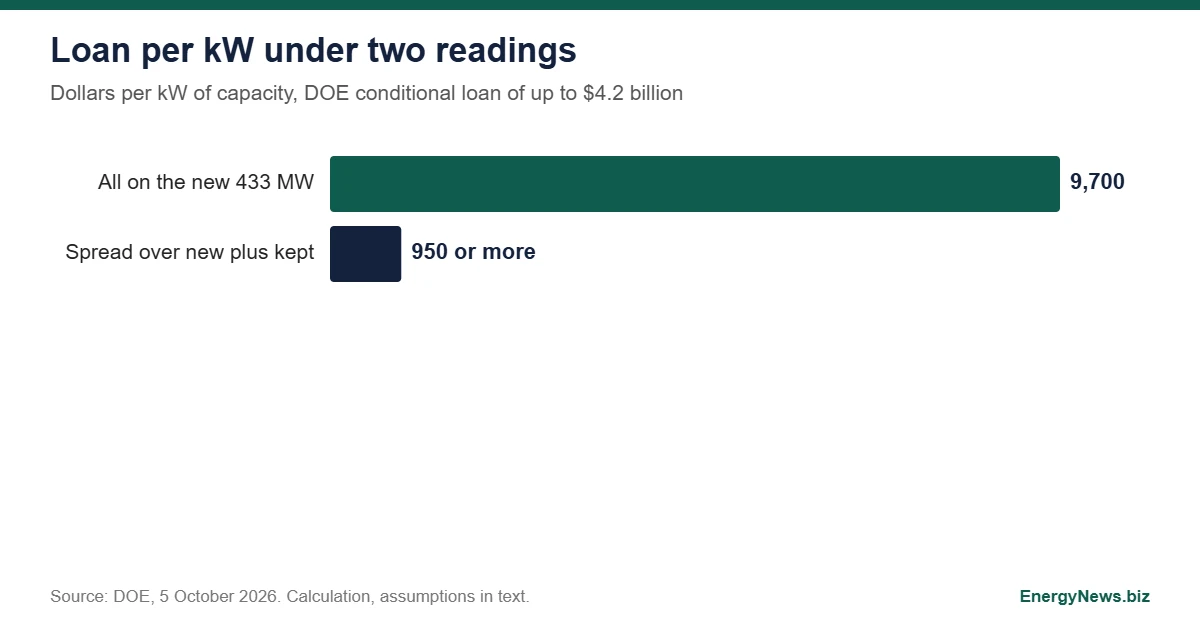
The truth sits between the two, and where depends on what share of the spending is uprate hardware and what share is life extension and modernization. DOE says the projects are at Beaver Valley in Pennsylvania and at Davis-Besse and Perry in Ohio, and that they support operation for an additional 20 years beyond existing licenses. It gives no megawatt figure per plant, no split between uprate and modernization, no loan term and no interest rate.
What the release leaves out
A loan covers some share of a project’s total capital cost, and the release states no Vistra capex figure, so the loan cannot be turned into a cost per kW of new capacity. It also gives no schedule for when the 433 MW would arrive. The only dated element is the announcement itself.
The release says the work will produce more electricity from existing plants without new transmission corridors or equivalent new generation resources, across the 13 state PJM Interconnection region. That is a claim about avoided infrastructure, and no figure for the avoided cost is given. It also reports approximately 3,000 project related jobs in engineering, construction and planned outage work.
The homes figure
DOE says the preserved output is enough to power more than 3 million homes. The claim holds under stated assumptions. Take 4 GW at a 90 percent capacity factor (an assumption, not from the release): that is about 31.5 TWh a year, or roughly 10.5 MWh per home across 3 million homes. That is a plausible household figure, so the claim passes the arithmetic, but it moves with the capacity factor chosen.
Conditions before any dollar moves
This is a conditional commitment. DOE states that Vistra must satisfy technical, legal, environmental and financial conditions before the department enters definitive financing documents and funds the loan. The commitment also includes an option to finance possible future uprates at Comanche Peak in Texas, which has no capacity figure attached.
Licensing of new reactors is a separate track, as in the Clinch River permit schedule. The test for this loan is concrete: the definitive financing documents must state the amount drawn, the uprate megawatts per plant and the date each unit returns at higher output. Until those three numbers are published, the $4.2 billion cannot be compared with any other nuclear project on a per kW basis. Source: DOE announcement, 5 October 2026.
Add EnergyNews.biz as a preferred source on Google


