


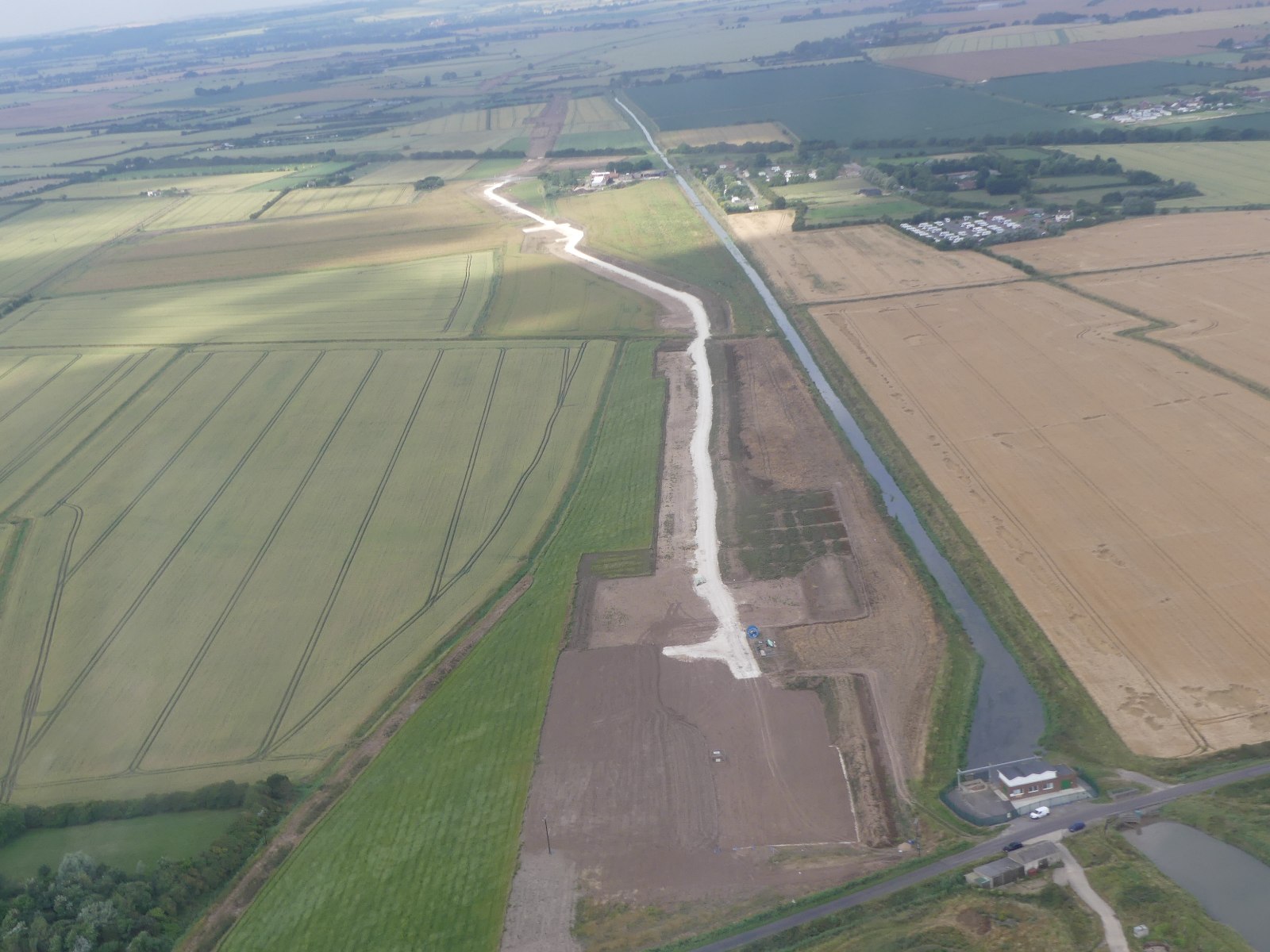


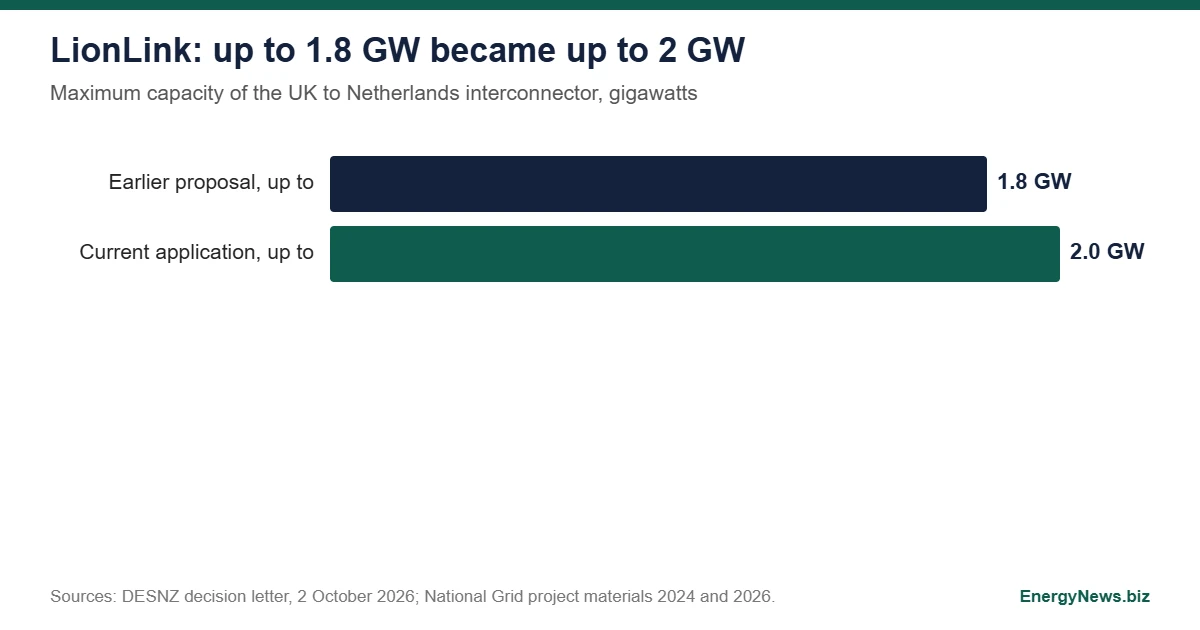
Up to 1.8 GW became up to 2 GW, an increase of 0.2 GW or 11 percent on a cable that has not been built. On 2 October 2026 the Secretary of State for Energy Security and Net Zero ruled that this change, together with a new name and a revised approach to the onshore substation, is too small to require a variation of the planning direction that governs LionLink, the UK to Netherlands interconnector developed by National Grid Ventures. The department published the decision on 7 October.
The ruling is sound on its own terms. A section 35 direction decides whether a project is handled as nationally significant infrastructure, and the department’s project record lists the maximum output as not applicable, so the direction was never a megawatt ceiling. The more useful reading is about what the planning step does not test. The benefit figures attached to LionLink were written for the smaller design, and the application due this quarter will have to restate them for the larger one.
What the direction covers and what the department weighed
The decision letter, dated 2 October 2026 and issued under Planning Inspectorate reference EN020033, answers a request from National Grid Lion Link Limited dated 22 September 2026 to vary the direction of 23 August 2022. The Secretary of State considered the change of name from EuroLink to LionLink and updates to the proposed infrastructure, export capacity, regulatory position and policy context.
The letter reaches three findings. The name change does not alter the identity or nature of the project. The export capacity moving from up to 1.8 GW to up to 2 GW does not alter the physical nature of the development. The revised substation approach does not materially alter the project described in the existing direction. The conclusion is that no variation is necessary, because the updates remain within the scope of the 2022 direction.
The homes figure that did not move
National Grid’s April 2024 project update presented up to 1.8 GW as enough to power approximately 2.5 million homes. The same slide said LionLink was expected to save UK consumers almost £300 million in its first ten years, and that first year carbon savings would equal 600,000 fewer cars on the road. The July 2026 targeted consultation webinar lists supply of up to 2 GW as a benefit and carries no homes figure.
Scaling the 2024 ratio in a straight line would put 2 GW at roughly 2.8 million homes, but National Grid has not published that number in the materials reviewed, and the savings estimate depends on price differences between the two markets, so it does not scale in a straight line. Until the application documents restate the figures, the 2024 claims describe a smaller project than the one now before the planning system.
The 2 GW figure is not a surprise. A National Grid webinar from March 2025 already described LionLink connecting to 2 GW of offshore wind, and the project is built around a link to the Dutch offshore wind farm Nederwiek 3, which National Grid calls first of its kind technology. An export rating matched to the wind farm connection is a plausible reason for the change, though the decision letter does not give one.
894 responses and a Walberswick landfall
The statutory consultation ran from 13 January to 10 March 2026 and drew 894 feedback responses and 686 attendees at events and webinars. The main themes were alternative landfall locations, the effect of construction on residents, and traffic and access. The onshore works shown in the January 2026 drawings include an extension to the Kiln Lane 400 kV substation and a converter station at Saxmundham.
A targeted consultation from 7 July to 5 August 2026 then put forward an alternative landfall at Walberswick, changes at Lymballs Lane and the inclusion of Benhall Railway Bridge in the project boundary, plus refinements to access points and draft order limits. Suffolk County Council’s cabinet paper for its meeting of 24 February 2026 sets out an objection to the scheme in response to the statutory consultation, so the local authority position was already negative before the landfall options changed.
Connection dates have slipped elsewhere too: Tata Steel’s grid connection, contracted for 2027 and now not due until 2029.
The dates that now matter
National Grid’s June 2026 programme document for the Planning Inspectorate shows the adequacy of consultation milestone in the third and fourth quarters of 2026 and submission of the development consent order application in the fourth quarter of 2026. The document gives quarters, not dates. The test for the application is concrete: the capacity, homes, savings and carbon figures must be restated against the 2 GW design. If the 2.5 million homes and £300 million figures reappear unchanged, they describe the 1.8 GW project.
Sources: DESNZ decision on the LionLink Section 35 direction variation, published 7 October 2026; Planning Inspectorate case EN020033, section 46 notification of 12 January 2026; Suffolk County Council cabinet report, 24 February 2026; East Suffolk Council LionLink page.
Add EnergyNews.biz as a preferred source on Google


