




The European Commission opened applications on 6 October 2026 for up to 30 seats on a new Energy Transition Investment Council, an expert group meant to close part of an energy investment need that the Commission puts at €660 billion a year until 2030. The two public sums attached to that need cover a small slice of it: the European Investment Bank Group’s pledge works out at about €25 billion a year, and the proposed Connecting Europe Facility energy budget at about €4.3 billion a year, together roughly 4.5 percent.
The arithmetic sets the council’s job. It cannot fund the gap, and the Commission does not say it will. Its stated purpose is to give the investment community a channel into policy, so that rules and funding instruments are shaped by what private capital needs. The test is whether the seat allocation and the agenda reflect that.
Who gets a seat
The call runs four weeks, to 4 November 2026. The council will have up to 30 members from organisations with substantial expertise in EU energy investment and financing. The Commission lists four groups: private capital, including institutional investors, infrastructure managers, private equity, venture capital and asset managers; commercial debt and finance, including commercial and investment banks and financial sector associations; public de-risking partners, meaning national promotional banks and international financial institutions; and energy industry associations, covering utilities, grids, independent power producers and clean technology manufacturers.
Three members are invited directly: the EIB Group, made up of the EIB and the European Investment Fund, the European Bank for Reconstruction and Development, and the EU Agency for the Cooperation of Energy Regulators, ACER. A sub-group of national promotional banks and international financial institutions will coordinate public lenders and report directly to the council. The body builds on the 2022 to 2026 Investors Dialogue on Energy, and Energy Commissioner Dan Jørgensen said public funding can catalyse but mobilising private capital is essential.
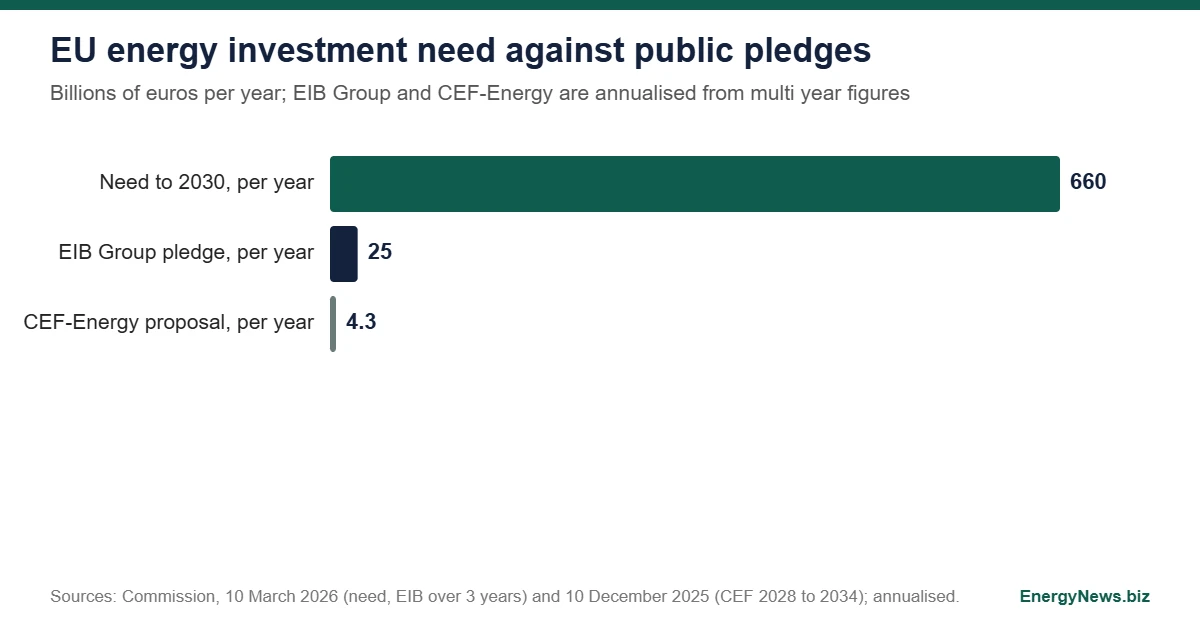
€660 billion, €25 billion and €4.3 billion
The Clean Energy Investment Strategy adopted on 10 March 2026 (COM/2026/116) says delivering the transition needs €660 billion of investment a year to 2030, rising to €695 billion a year between 2031 and 2040. In the same announcement the EIB Group said it intends to deliver over €75 billion of financing over the next three years, which is €25 billion a year, or about 3.8 percent of the annual need. The Commission’s December 2025 grids package proposed raising the CEF energy budget from €5.84 billion to €29.91 billion in the 2028 to 2034 budget, about €4.3 billion a year over seven years, or about 0.65 percent.
The two public figures are not like for like. The EIB number is a pledge of financing over three years, and the CEF number is a budget proposal for 2028 to 2034 that member states and Parliament have not yet agreed. Neither measures how much private capital will follow. What they show is the size of the public contribution the Commission itself describes as a catalyst.
The price tag in the same week
The investment case sits against the price shock described in the Commission President’s 6 October speech to the European Parliament: gas prices up 140 percent since the end of February, diesel doubled, and an extra €100 billion spent on imported fossil fuels. The speech argued that electrification could cut fossil fuel imports by €260 billion a year. The investor council is the Commission’s answer to who pays for that shift, and the call gives no number for how much private money it expects to mobilise.
The speech was given ahead of the European Council meeting of 15 to 16 October 2026, which is the first dated check. The second is the application deadline of 4 November 2026. The third is the one the call does not set: the date of the council’s first meeting. For the grid side of the same investment gap, see the EU’s grid queue of 480 GW. Sources: European Commission, DG Energy, call for applications of 6 October 2026; European Commission, Clean Energy Investment Strategy announcement of 10 March 2026; European Commission press release IP/25/2945 of 10 December 2025; speech by President von der Leyen, 6 October 2026.
Add EnergyNews.biz as a preferred source on Google


