




The average daily price spread in the UK, the gap between the highest and lowest priced hours in a day, rose 80 percent from a year earlier to about £123 per MWh in September, and the swings are expected to widen over the coming months. That is the headline for the battery operators who have spent about $40 billion in Europe since the 2022 energy crisis, and it sets up a winter that will show whether the expanded fleet can profit from volatility without eroding it.
Price spread: gas up, wind and solar pushing prices down
Two forces are widening the spread. Gas prices are near their highest in four years because of the war in Iran, which makes electricity expensive when gas fired plants are needed to meet demand. At the same time, Europe’s growing fleet of wind and solar farms pushes prices sharply lower when renewable output is abundant. A battery earns from the difference, charging in cheap hours and discharging in expensive ones.
A UK generator that is expanding in storage said cooler weather and unpredictable wind are already driving bigger daily swings, which create a much better environment for batteries. Some operators are already seeing it: Harmony Energy, which manages 10 battery sites in the UK, reported fleet earnings of about £4 million in September, its highest ever and 62 percent above its average for the year so far. The 62 percent figure implies a year to date monthly average of roughly £2.5 million.
Capacity has multiplied, and so has exposure
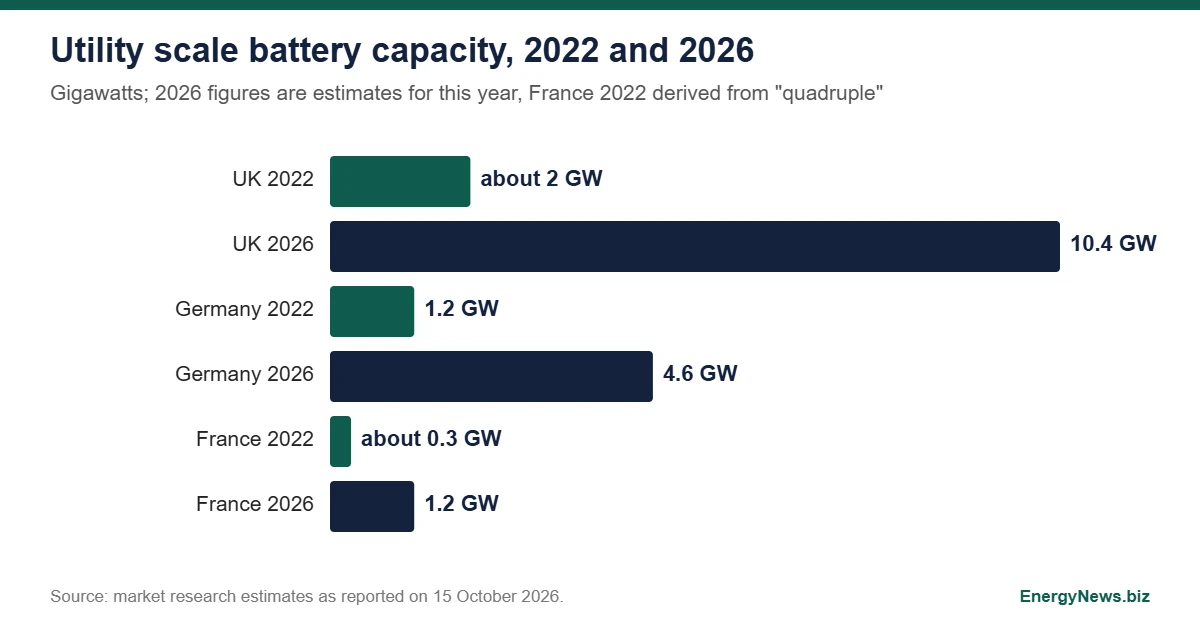
The UK is Europe’s biggest battery market, and its utility scale capacity is estimated to rise to 10.4 GW this year from about 2 GW in 2022, a factor of 5.2. German capacity is estimated at about 4.6 GW from 1.2 GW, a factor of 3.8, and French capacity will quadruple to 1.2 GW. The three countries have added about 12.7 GW between them, from about 8.4 GW in the UK, 3.4 GW in Germany and 0.9 GW in France, using the derived French figure of about 0.3 GW in 2022.
From grid services to wholesale trading
The revenue mix has changed as fast as the fleet. Historically batteries earned most of their money from ancillary services, in which they are paid to help balance the grid and hold frequency, but that market has become saturated as capacity grew. According to an industry consultant, wholesale trading made up almost 73 percent of the UK industry’s revenue in the 12 months through August, against less than 20 percent in 2022. A battery that earns mainly from price swings is more exposed to them, and the same swings are now shared among many more batteries.
That is the cannibalisation the industry worries about: as more batteries enter, each can earn less from the same spread. Harmony’s founder said the UK market has become more crowded and revenue per battery is under pressure, but that it remains large enough to absorb significantly more storage. A rough ceiling shows the scale at stake. A two hour battery that captured the whole September spread once a day would earn £123 times 2 MWh, about £246 per MW a day, or about £90,000 per MW a year. That is an upper bound before conversion losses, fees and imbalance costs, and it assumes the spread persists, so it measures the opportunity and not a forecast.
What the winter will show
The same consultant raised its forecast for 2027 revenue for a two hour German battery by about 20 percent this month compared with July, mostly because of higher gas prices. The outlook depends partly on the Middle East conflict, on Europe’s ability to refill its low gas stores and on the severity of cold snaps. Harmony’s founder added that the UK and the rest of Europe will be more susceptible to volatility.
The test is whether a vastly expanded fleet curbs price spikes and ultimately lowers costs for consumers, which is the promise batteries carry, or only competes the spread down. Both outcomes are plausible, and both can be checked against the daily spread data over the coming months. For another market where the stated spread underpins the business case, see Romania’s Dumbrava battery, and for the supply side of the same story, why new cells beat second-life batteries. Source: report on Europe’s battery winter outlook, 15 October 2026, citing market research estimates and operator statements.
Add EnergyNews.biz as a preferred source on Google


