




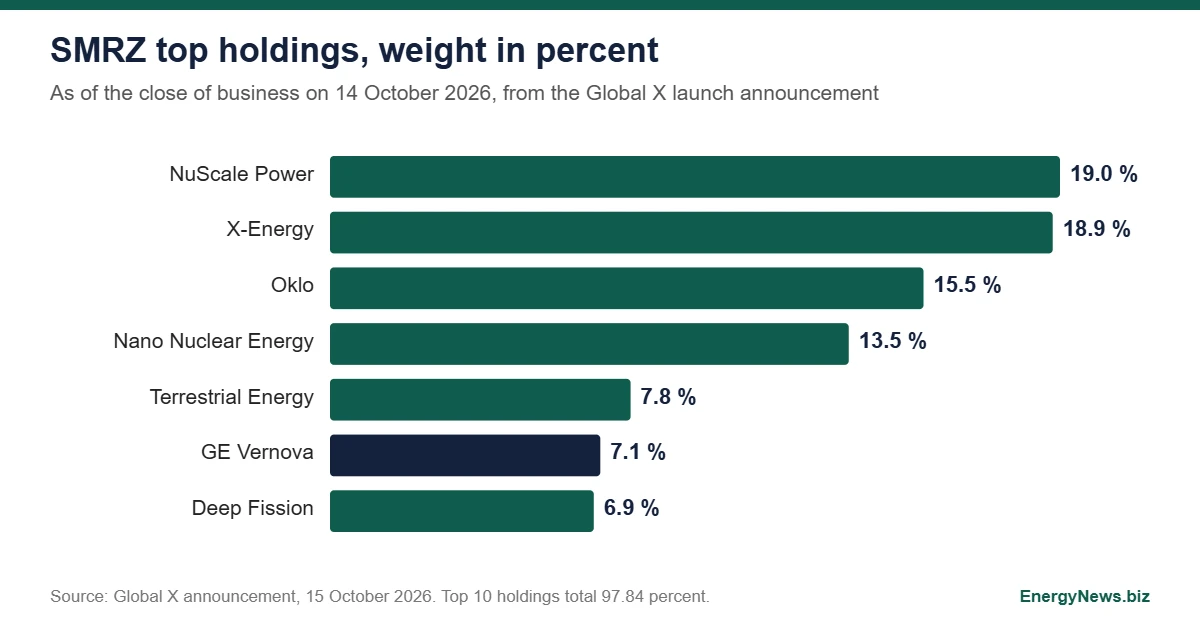
Ten companies hold 97.84 percent of the weight of a new SMR ETF that is meant to cover about 15 small modular reactor companies. Global X launched the Global X Small Modular Reactor ETF, ticker SMRZ, on 15 October 2026, and its own holdings table makes the sector’s structure plain: a few reactor developers carry most of the fund, and the physical fleet they are meant to build has barely begun.
The fund is not assessed here as an investment, and nothing in this article is investment advice. The question is what the launch and the numbers attached to it say about the SMR market, and what would have to be true for the scenario that justifies the product.
The fund in numbers
SMRZ is actively managed and targets about 15 global companies designing, building and fuelling small modular reactors. To be included, a company generally has to derive at least 50 percent of its revenue from SMRs or the fuel and service agreements tied to them, or qualify as a development stage company. The gross expense ratio is 0.75 percent a year, which is $75 on each $10,000 held.
The top five holdings, NuScale Power, X-Energy, Oklo, Nano Nuclear Energy and Terrestrial Energy, weigh 74.74 percent together, and the top three account for 53.37 percent. The top 10, adding GE Vernova, Deep Fission, KEPCO Engineering and Construction, BWX Technologies and Standard Nuclear, reach 97.84 percent, which leaves about 2.2 percent for the remaining holdings if the fund holds 15 names. Three of the top 10 are established industrial companies, GE Vernova, KEPCO Engineering and Construction and BWX Technologies, and they total 13.7 percent.
The scenario behind the launch
The announcement leans on the International Energy Agency’s January 2025 report on the path to a new era for nuclear energy. In the agency’s most modest scenario, annual nuclear investment rises from $65 billion to $70 billion while global nuclear capacity grows by more than 50 percent to nearly 650 GW by 2050. In its centrist estimate, investment reaches $120 billion in 2030 and capacity more than doubles by mid century. With stronger government support, that centrist case delivers more than 1,000 SMRs by 2050 with a total capacity of 120 GW, taking SMR investment from about $5 billion today to more than $25 billion in 2030 and a cumulative $670 billion by 2050.
Two numbers follow from those figures. One thousand SMRs and 120 GW means an average unit of about 120 MW, and $670 billion over 120 GW is about $5.6 per watt, or $5,580 per kW, which sets the cost the scenario assumes. Reaching 1,000 units by 2050 means building about 40 a year on average over 25 years, from a start in which one commercial unit in the United States has just received approval to build.
What has actually happened
The announcement cites the US Nuclear Regulatory Commission’s approval of construction of the first commercial SMR in the United States, dated 29 September 2026. That is the Clinch River permit covered earlier, and it is a real milestone. It is also one reactor. The same week, filings for another three small reactors and four large AP1000 units sat at very different stages, as the three NRC filings showed, and a heat only design in Europe had just received its first public bank loan, as the EIB’s loan to Steady Energy showed.
The release also links the market to demand for reliable, around the clock power, and quotes Global X’s head of product research on the engineering heritage: the US Navy has run small reactors since the USS Nautilus in 1954. That argument is sound for the technology and says little about commercial cost, which is the variable the IEA scenario assumes falls.
What would have to be true
Four conditions have to hold for the centrist scenario: licences that arrive on schedule, factory built costs that approach the $5.6 per watt the scenario implies, government support that stays in place, and customers who sign contracts before the first units prove their cost. The first can be tracked in regulator decisions, the second only when plants are built. A fund that concentrates 74.74 percent of its weight in five companies carries that uncertainty directly. The dated item is the 29 September 2026 permit; the next measurable items are the construction milestones that follow it. Sources: Global X launch announcement, 15 October 2026, citing the International Energy Agency, The Path to a New Era for Nuclear Energy, 16 January 2025, and the US Nuclear Regulatory Commission.
Add EnergyNews.biz as a preferred source on Google


