





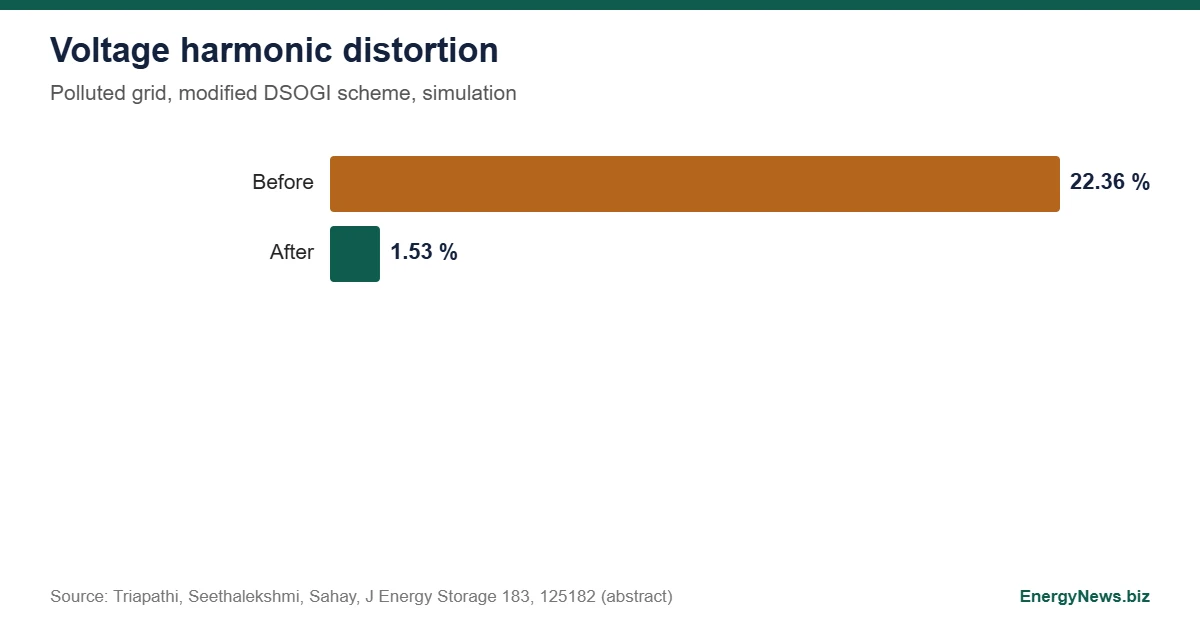
A paper in the Journal of Energy Storage (volume 183, part A, article 125182) reports that a modified double second-order generalized integrator (DSOGI) cuts voltage harmonic distortion from 22.36% to 1.53% under polluted grid conditions in a grid-connected solar PV and battery system. Only the abstract and introduction were available for this report.
What the control scheme does
Mritunjaiya Mani Triapathi, Seethalekshmi K. and Kuldeep Sahay coordinate the voltage source inverter, the battery and the boost converter to ride through low voltage faults. A supervisory battery controller sends surplus PV power to the battery until maximum state of charge, then injects the remainder into the grid. The battery also regulates the DC link during faults, and the inverter supplies reactive power support.
Results the authors report
The coordinated battery control limits DC link overvoltage by 16% during grid disturbances. The authors report that the scheme meets IEEE 519 for harmonic mitigation and IEEE 1547 for ride-through. They test varying solar irradiance, nonlinear loads, and symmetrical and asymmetrical faults, with simulations validated on an OPAL-RT real-time simulator and compared with an off-MPPT ride-through strategy.
Limits of the evidence
The evidence is simulation and a real-time digital simulator, not a field installation. The abstract does not state the fault depth, system rating or the size of the battery. The paper is here: doi 10.1016/j.est.2026.125182. Related storage coverage: microgrid battery optimisation and cost.
Add EnergyNews.biz as a preferred source on Google


