


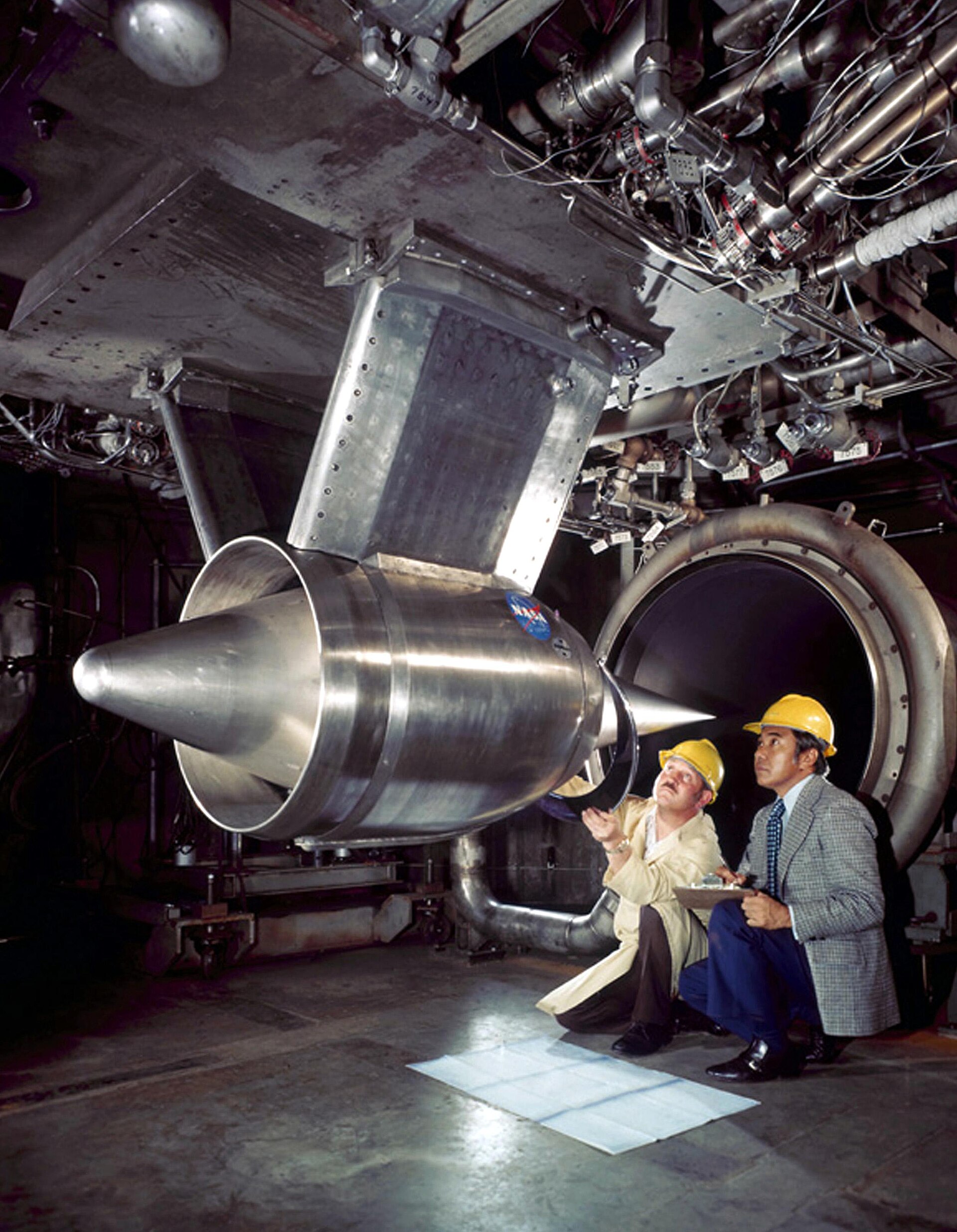


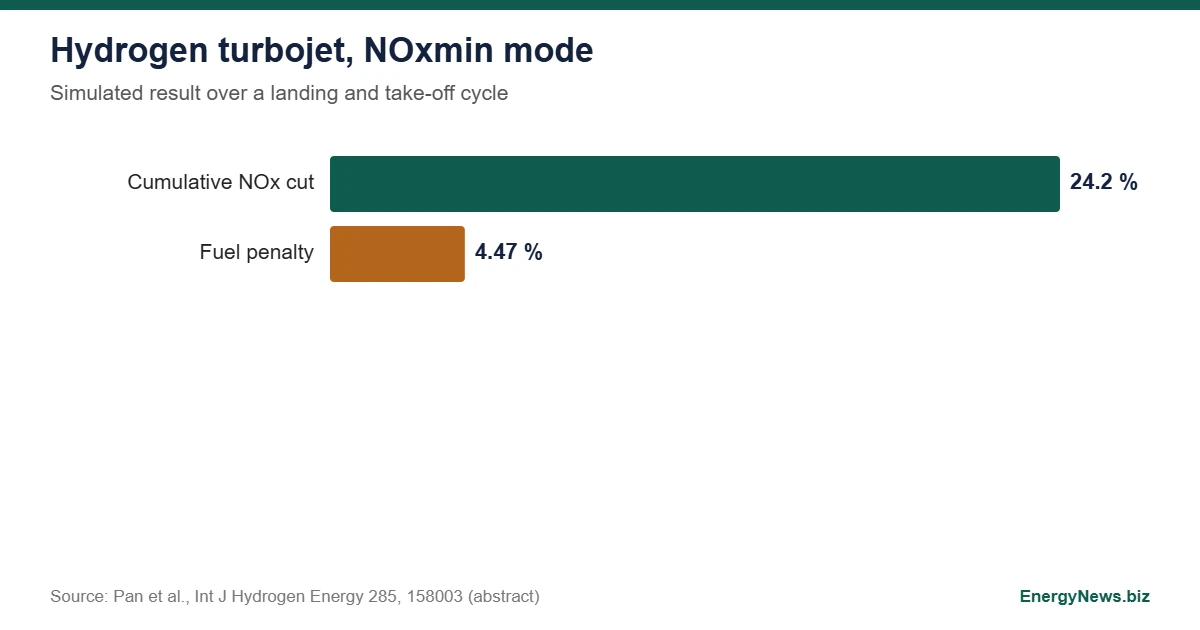
A paper in the International Journal of Hydrogen Energy (volume 285, article 158003) reports that a two layer controller for a liquid hydrogen turbojet cuts cumulative NOx by 24.2% at a fuel penalty of 4.47% over a landing and take-off cycle. The result comes from closed loop simulation, and the full text sits behind a paywall, so this report rests on the abstract and highlights.
An engine whose fuel supply sets the safety limits
Mengni Pan, Ai He, Jiashuai Liu and Zhongzhi Hu model a hydrogen fuelled turbojet coupled to its supply system, in which liquid hydrogen is vaporised against engine air. The authors say that coupling shifts the safety boundaries: icing on the heat exchanger and NOx emissions both narrow the region in which thrust can be optimised, and hydrogen injection temperature and bleed ratio are co-optimised rather than preset.
Planning layer and predictive layer
The upper layer plans thrust offline in two modes, eco mode for minimum fuel burn and NOxmin mode for minimum NOx, using a semi-empirical thermal NOx model. The lower layer is an adaptive model predictive controller with feed-forward constraint tightening that holds the icing limit during transients. Against three benchmark controllers, the authors report that only the adaptive controller keeps all constraints through the transients.
Both modes stay below an ICAO derived comparative benchmark for Dp/Foo, and the controller is described as robust under the tested conditions. The NOxmin figures are predictions from a model, not engine test data.
What the abstract leaves open
The abstract does not give the reference case for the 24.2% and 4.47% figures beyond the landing and take-off cycle, the NOx values in absolute terms, or any test of a physical engine. Those details sit in the full paper: doi 10.1016/j.ijhydene.2026.158003. For aviation fuel context on ENB: e-SAF can fly a plane, it cannot yet fuel an industry.
Add EnergyNews.biz as a preferred source on Google


