




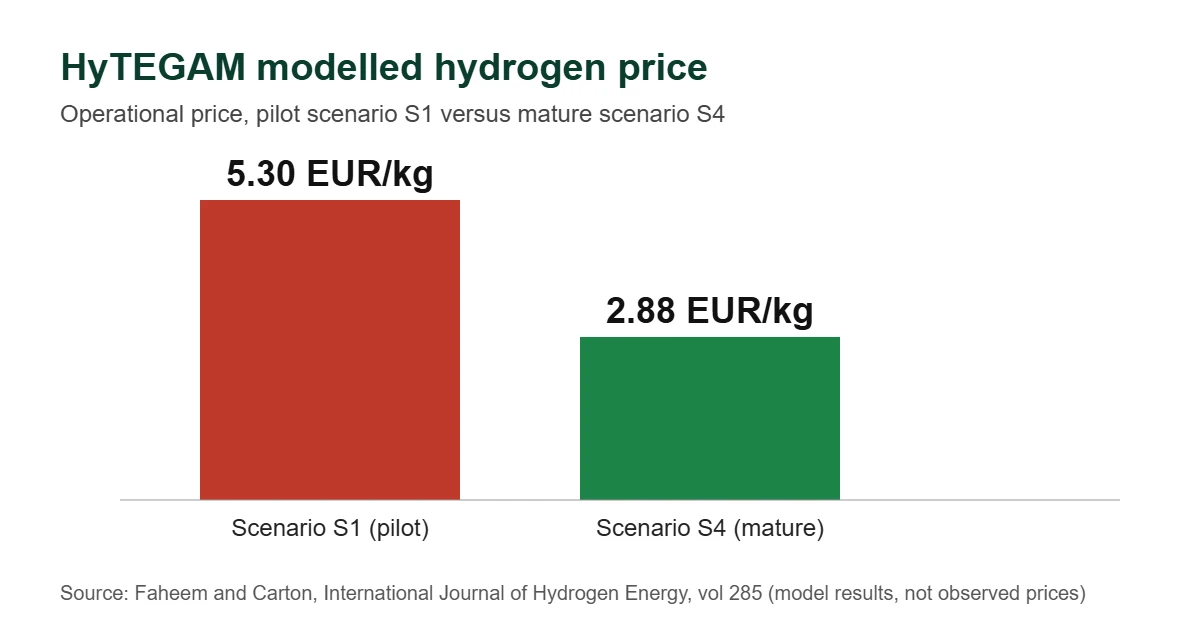
HyTEGAM, a new agent based model of a tradable hydrogen market, shows the modelled hydrogen price falling from €5.30 to €2.88 per kilogram as the market moves from pilot to maturity, according to a paper in the International Journal of Hydrogen Energy. The study, by Jawaria Bint Faheem and James G. Carton, went online on 19 October 2026 as part of volume 285 (DOI 10.1016/j.ijhydene.2026.157812). The figures are model outputs, not observed market prices.
How the HyTEGAM model is built
HyTEGAM represents six autonomous market agents plus a non strategic hydrogen infrastructure operator, which the authors call the HIO. The agents trade in a day ahead market and settle imbalances afterwards. The authors run four scenarios, S1 to S4, that step from a pilot market to a mature one, and they test the central results with sensitivity and multi seed analyses.
What the four scenarios show
Across the scenarios the operational hydrogen price falls from €5.30 to €2.88 per kilogram. Our calculation puts that at a 45.7% drop. Annual production rises from 1.91 million kg to 49.89 million kg, a 26 fold increase. Valued at the scenario price, that output is worth about €10.1 million in S1 and about €143.7 million in S4, again our own arithmetic rather than a figure from the paper.
Other results in the abstract point the same way. Demand satisfaction improves from 54.6% to 71.6%, post day ahead imbalance settlement costs fall by up to 95.2%, and the renewable share of supply reaches 99.3%. The paper’s highlights add that essential demand remains nearly fully served, and the abstract does not reconcile that statement with the 54.6% to 71.6% range, so the two probably measure different things.
Why HyTEGAM says production alone is not enough
The authors conclude that tradability depends on coordinated supply, credible demand and flexible infrastructure, not on production expansion alone. That finding fits what project developers are already running into. The Andalusian hydrogen valley described in our report on Moeve’s 300 MW project pairs large electrolyser capacity with identified industrial offtake, and the study of green hydrogen in Ireland showed that wind to hydrogen chains create value only where demand is located nearby.
A model price is only as good as its assumptions. The abstract does not disclose the electricity prices, electrolyser costs or demand profiles behind each scenario, and the full text should be consulted before the €2.88 figure is used in planning. The value of HyTEGAM lies in showing how a hydrogen market could behave when infrastructure operators and traders act independently, and in quantifying how much imbalance cost a flexible system could avoid.
For developers and policymakers the message is that price decline in the model is tied to the market maturing in step, with supply, demand and infrastructure growing together. Production capacity built ahead of demand would not deliver the same result.
Add EnergyNews.biz as a preferred source on Google


