




Moeve announced on 17 September 2026 that construction has started on the first phase of its Andalusian Green Hydrogen Valley in Huelva, Spain. The company says the phase has 300 MW of electrolysis, expandable by 105 MW to 405 MW, and a joint investment of more than €1 billion. It expects about 45,000 tonnes of hydrogen a year and says the output avoids about 250,000 tonnes of CO2 a year. Those are the company’s claims. ENB tested them against each other.
What the company says
| Item | Moeve claim |
|---|---|
| Electrolysis capacity | 300 MW, expandable by 105 MW to 405 MW |
| Joint investment | more than €1 billion |
| Public support | €304 million from Spain’s Recovery plan, Renewable Hydrogen Valleys line, for 405 MW |
| Status | EU Project of Common Interest |
| Hydrogen output | about 45,000 tonnes a year |
| CO2 avoided | about 250,000 tonnes a year |
| Jobs | more than 8,000 |
Does 45,000 tonnes fit 300 MW?
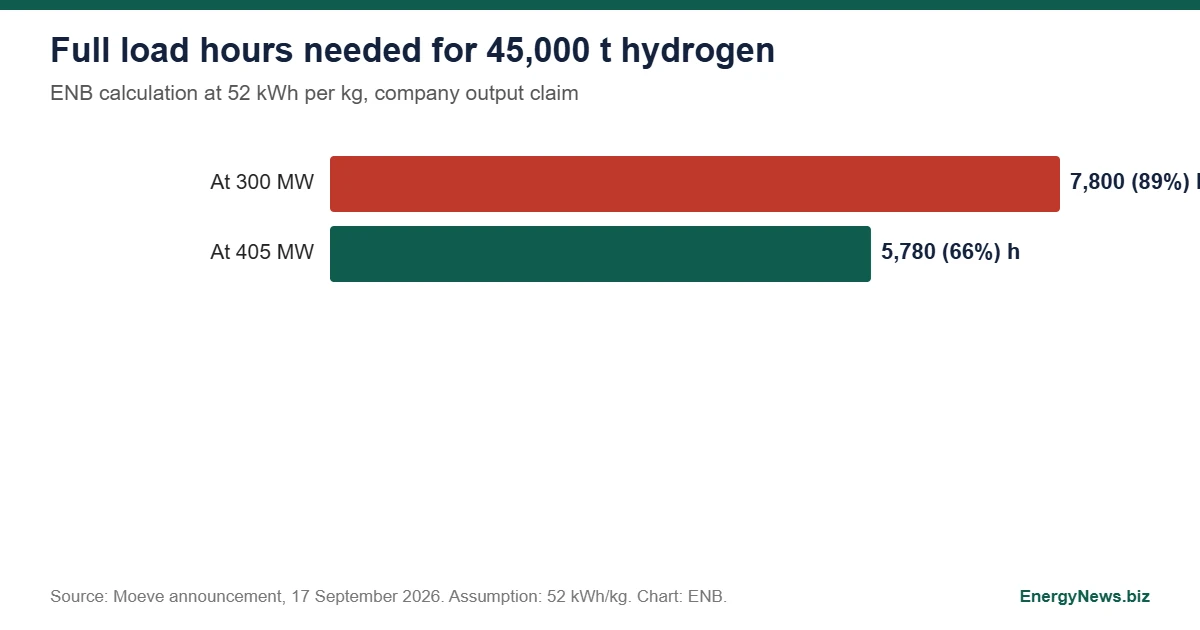
ENB assumes a system consumption of 52 kWh per kg of hydrogen, a typical figure for alkaline and PEM electrolysis and an assumption not taken from the company. At that rate 45,000 tonnes needs 2.34 TWh of electricity a year.
| Capacity | Full load hours needed | Capacity factor |
|---|---|---|
| 300 MW | about 7,800 | about 89% |
| 405 MW | about 5,780 | about 66% |
The output only fits comfortably at the full 405 MW. At 300 MW it would need near continuous operation, which is hard to square with plants fed by solar and wind, where annual use is often well below 70% of nameplate. The 45,000 tonne figure should therefore be read as the output of the whole 405 MW build, not of the first 300 MW alone, unless the system runs on firmed power or uses less than 52 kWh per kg.
Does 250,000 tonnes of CO2 fit?
Dividing 250,000 tonnes of CO2 by 45,000 tonnes of hydrogen gives 5.6 tonnes of CO2 avoided per tonne of hydrogen. The result depends on the fuel displaced: hydrogen from steam methane reforming is commonly put at roughly 9 to 11 tonnes of CO2 per tonne of hydrogen, so 5.6 implies either partial displacement or a lower baseline. The company has not published the baseline in the material ENB reviewed.
Cost per megawatt
More than €1 billion over 405 MW is about €2.5 million per MW, an ENB division. That figure covers a valley, not only the electrolyser, and the announcement does not break out the share for storage, pipelines or the digital twin the company says it will use.
Context and what to watch
Hydrogen policy and production routes are tracked on the IEA hydrogen page. For a comparable European project that still lacks a final investment decision, see ENB’s report on the 280 MW electrolyser deal for Danish e-SAF. Moeve has started building; the open points are the power supply that will set the capacity factor, the buyers for the hydrogen, and the start up date, which the announcement does not give.
Add EnergyNews.biz as a preferred source on Google


