


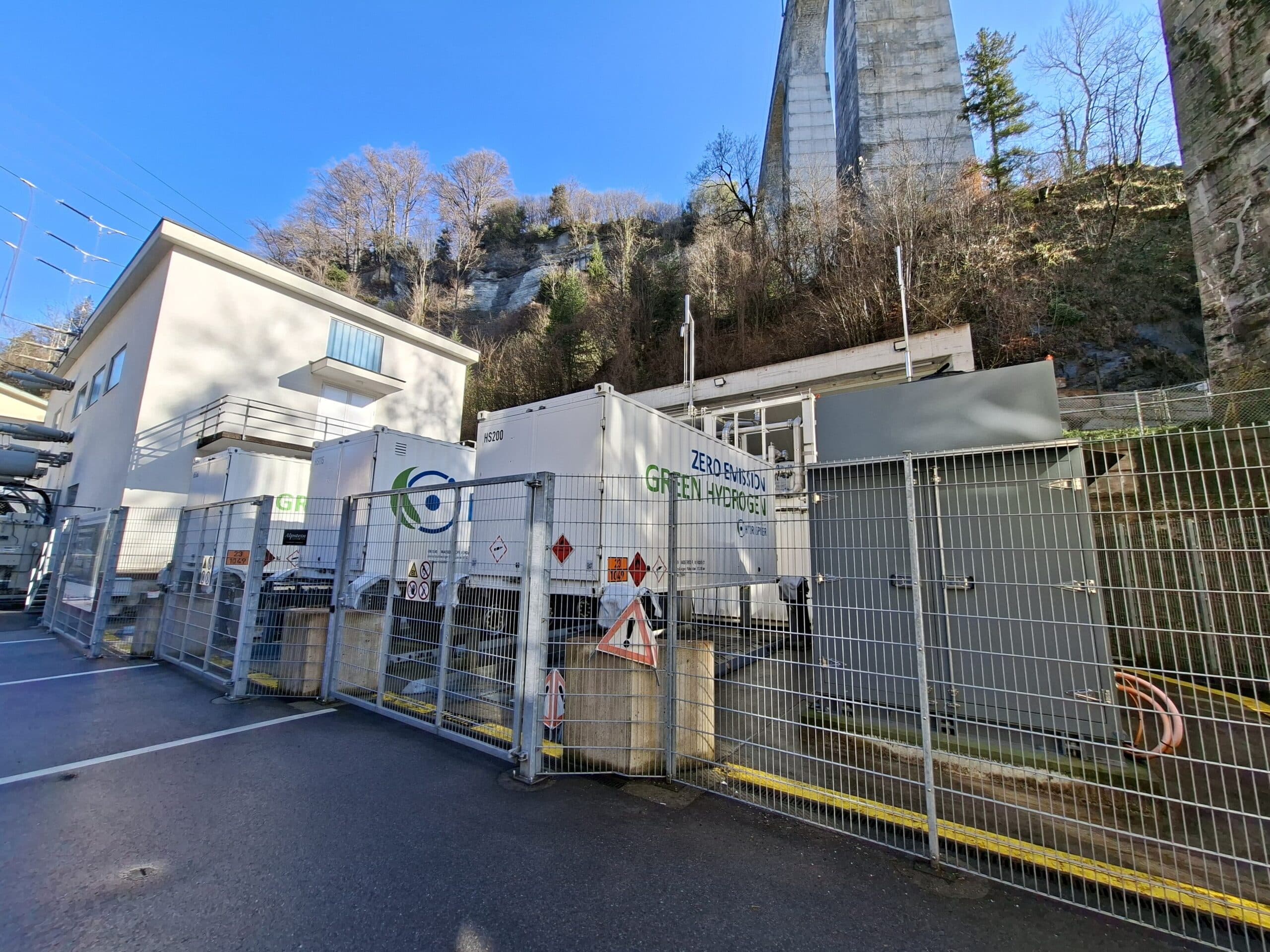


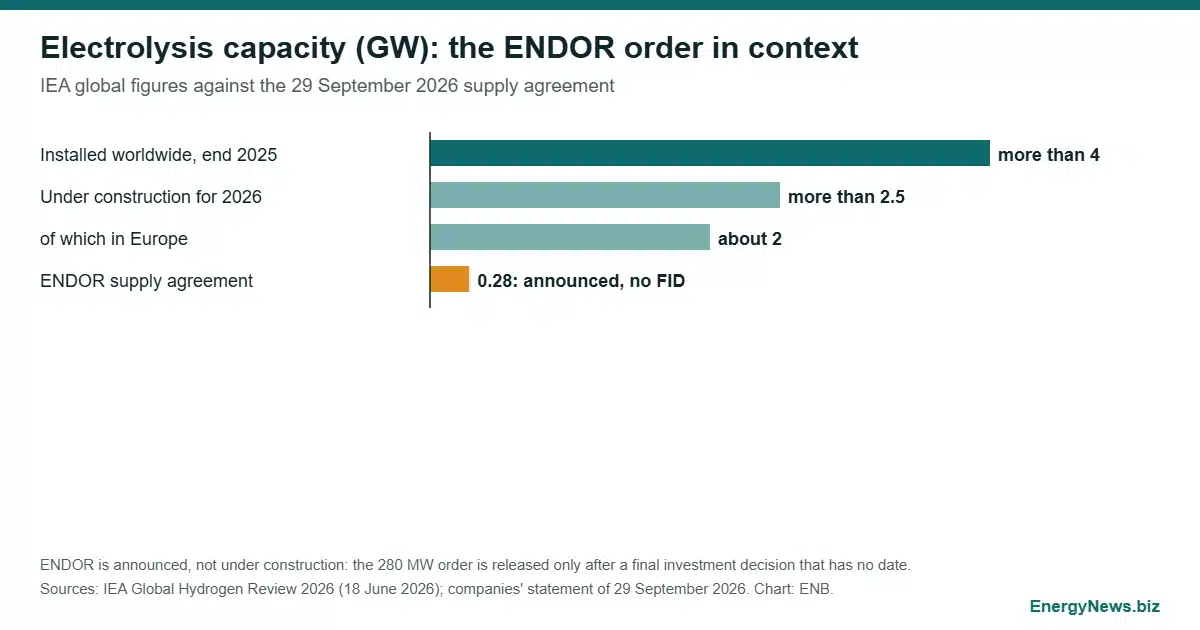
A 280 MW electrolyser supply agreement signed on 29 September 2026 for a Danish e-SAF plant is not a final investment decision, and the developer says so itself. Arcadia eFuels states that its ENDOR project at Vordingborg is still on the path to FID, and that electrolyser deliveries begin only after a notice to proceed, for which no date is given. The IEA puts installed electrolysis capacity worldwide at just over 4 GW at the end of 2025. A deal equal to roughly 7% of that base has been announced; a construction start for it has not.
What the 29 September agreement covers
Plug Power and Arcadia describe a strategic cooperation: 280 MW of electrolysers for the first ENDOR phase, plus preferred supplier status for four further Arcadia projects totalling more than 1 GW in Europe and the Americas. The companies state that ENDOR would produce about 110 tonnes of renewable hydrogen per day, combined with captured CO2 to make sustainable aviation fuel. The announcement, as published, gives no contract value, no delivery schedule, no financing details and no subsidy information.
Note the wording: a supplier is chosen, volume is reserved, and the physical order is released only at notice to proceed. That is a framework with a trigger, and the trigger is the investment decision.
ENDOR timeline from permit to pending FID
Dates below are taken from the developer’s own news record and the project announcements it lists. They are company statements, not regulator publications.
| Date | Milestone | Stage |
|---|---|---|
| 21 May 2024 | Front-end engineering design completed | Engineering |
| 26 May 2025 | Environmental permit obtained | Permitting |
| 25 Mar 2026 | EU Innovation Fund grant agreement signed (No 101251576) | Grant |
| 23 Sep 2026 | Offtake: 40,000 t/yr e-SAF, tied to FID and commercial operation | Conditional offtake |
| 29 Sep 2026 | 280 MW electrolyser supply agreement | Conditional supply |
| Not set | Final investment decision | Pending |
| Early 2030s | Production start, per the offtake announcement | Target |
Every dated step so far is a precondition for an FID, not a consequence of one.
Hydrogen output check against stoichiometry
The company figures for hydrogen, CO2 and fuel can be tested against chemistry. The project is stated at up to 100 million litres a year, equal to 80,000 t of e-SAF, using about 260,000 t of CO2 a year and 360 MW of electricity.
- Fuel as CH2 units from CO2 + 3 H2: 3.14 t CO2 and 0.43 t H2 per tonne of fuel.
- For 80,000 t: about 251,000 t CO2 and 34,300 t H2.
- Stated CO2 of 260,000 t is 3% above the minimum, which is plausible for losses.
- 110 t/d over 365 days is 40,150 t H2 a year, 17% above the stoichiometric minimum, leaving room for losses and partial load.
The numbers are internally consistent. Now the electrical side: 280 MW over 24 hours is 6,720 MWh a day. Divided by 110,000 kg, that is 61 kWh per kg at continuous nameplate load, or 64% efficiency against the higher heating value of 39.4 kWh/kg. At an assumed 52 kWh/kg system consumption, 110 t/d implies about 85% load on the electrolysers. The plant therefore needs power for roughly 7,500 hours a year. Whether that is secured is not stated in the announcement.
Electrolyser capacity versus IEA global data
The IEA Global Hydrogen Review 2026, published 18 June 2026, reports that installed electrolysis capacity doubled in 2025 to above 4 GW, with China accounting for nearly three quarters of new installations. More than 2.5 GW is under construction for operation in 2026, about 2 GW of it in Europe. By that measure the ENDOR order, if released, would equal 14% of everything now being built in Europe, and it would arrive years after that cohort.
The same review shows how thin firm demand is: new offtake agreements were around 1.7 Mt in 2025, and only around 20% of newly signed volumes had firm commitments. The 40,000 t a year reserved by Uniper, half of ENDOR’s planned 80,000 t, is conditional on FID, so it belongs with the volumes that lack a firm commitment, not with the 20% that have one.
Pipeline risk if decisions slip
The IEA reports that projects committed or with strong potential to operate by 2030 fell from 10 Mt to just above 6 Mt, while the announced pipeline stands at 27 Mt. It warns that more than 100 GW of announced electrolysis capacity could lose any chance of operating by 2030 without investment decisions before the end of 2027, and that about 22 Mt of potential production faces the same risk without decisions by early 2027. It also notes consolidation among electrolyser makers, driven by slow market development.
Decisions do get taken: ENB covered a final investment decision on South Africa’s first e-SAF project. For ENDOR, the next verifiable events are a dated FID and the notice to proceed that releases the 280 MW. Until the developer publishes either, the project belongs in the announced category of the IEA pipeline, and the IEA deadlines of early and end 2027 are the practical test.
Add EnergyNews.biz as a preferred source on Google


