




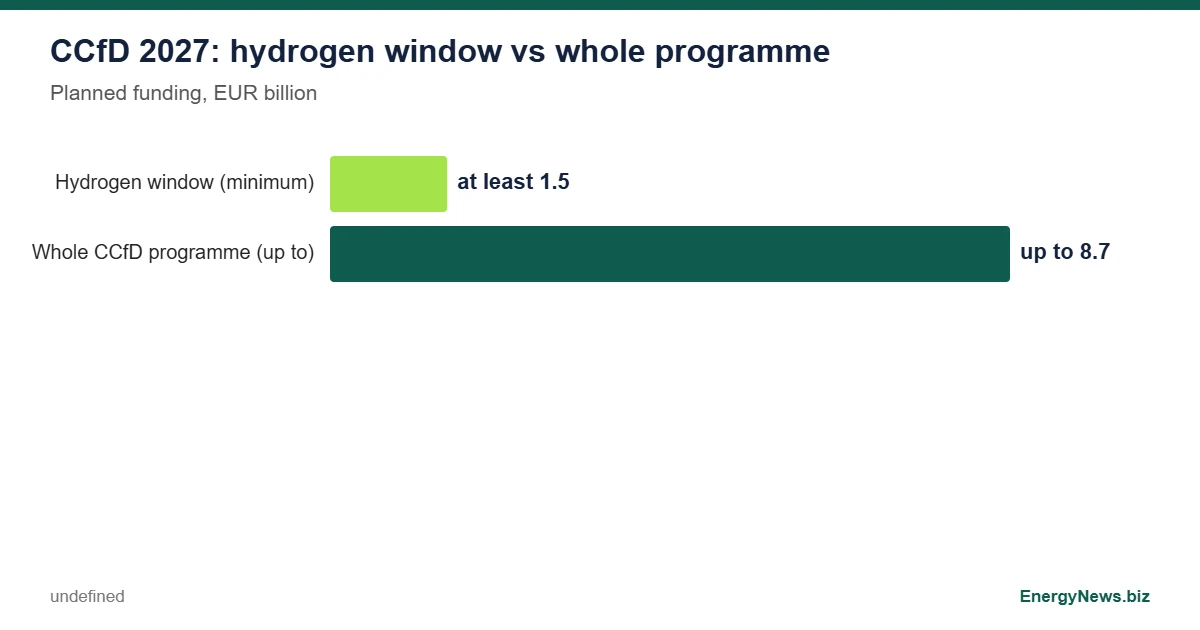
The Germany hydrogen package published by the federal economy ministry (BMWE) on 19 October 2026 puts one hard number on industrial demand: at least €1.5 billion for hydrogen in the 2027 round of the carbon contracts for difference (CCfD) programme. The whole programme carries up to €8.7 billion in planned funding, so the hydrogen window is 17% of it, and that sum has to bridge the gap between what hydrogen costs to produce and what industrial buyers will pay.
The position that follows from the text is plain. The Germany hydrogen package is a demand side bet, and the money is conditional. The ministry’s CCfD notice sets the hydrogen budget at a minimum of €1.5 billion only if interest in the preliminary procedure is high enough, keeps the 2027 round under a budget reservation, and still needs EU state aid approval. A number with three conditions attached is a ceiling on ambition, not a contract.
What the Germany hydrogen package contains
The Germany hydrogen package groups ten measures into four areas. On competitiveness it plans a pragmatic adjustment of EU rules for renewable hydrogen, reliable electricity grid fees and lower cost imports from diversified supplier countries; the release gives no figures for any of the three. On infrastructure it names a demand oriented, cost efficient build out of the hydrogen core network, import corridors and storage, plus the conversion of distribution networks under the EU gas and hydrogen market package, again without figures or dates.
The demand block carries the numbers. Besides the CCfD window, the ministry will fund the conversion of 4 GW of power plant capacity to hydrogen, as previously announced in the StromVKG, but the legal basis is still being drafted. A first lead market for low emission steel is also planned: offshore wind turbines built under the WindSeeG would have to use steel made with renewable or low carbon hydrogen. The fourth area, governance, refocuses the National Hydrogen Council on the government’s advisory needs, implementing a reform decided in June 2026, and starts a hydrogen technology roadmap inside the Hightech-Agenda Deutschland.
The CCfD arithmetic behind the Germany hydrogen package
The preliminary procedure for the 2027 round started on 19 October 2026, and the bidding procedure is planned to begin in May 2027. Taking part in the preliminary procedure is a precondition for bidding later. The ministry plans separate technology budgets for hydrogen, CCU and CCS, and process heat, and says the final amounts follow from participation. The hydrogen window is therefore sized by declared industrial demand, not by an engineering estimate of how many electrolysers Germany needs.
The programme is aimed mainly at energy intensive installations under the EU emissions trading system: chemicals, steel, metals, cement, lime, glass, paper and ceramics. Projects must invest in innovative, low CO2 production processes. The stated aim is to close the gap between production cost and what industrial buyers are willing to pay, and to support first movers while the market ramps up. The arithmetic is simple: €1.5 billion is 17% of €8.7 billion, and the other two technology windows are sized separately.
Steel is the only lead market with a mechanism
Within the Germany hydrogen package, the release names steel as the first lead market. The requirement sits in the offshore wind law (WindSeeG), so demand would arrive through wind tenders and not through a separate subsidy. The release gives no tonnage, no start date and no definition of low carbon steel, so this demand cannot be sized from the published text. The low carbon steel credit in the EU car CO2 compromise shows how quickly such definitions move once they reach legislation.
What the release leaves open
The 4 GW conversion programme has no tender dates, no support formula and no legal text in the release. The ministry’s paper Zehn Impulse für den Markthochlauf (PDF) carries the measures in more detail than the press release and should be read alongside it, together with the ministry press release of 19 October 2026 and the separate CCfD notice.
Three dated checks decide whether the Germany hydrogen package becomes money: the close of the preliminary procedure, which the ministry has not dated; the start of the bidding procedure planned for May 2027; and the EU Commission’s state aid decision on the round.
Add EnergyNews.biz as a preferred source on Google


