




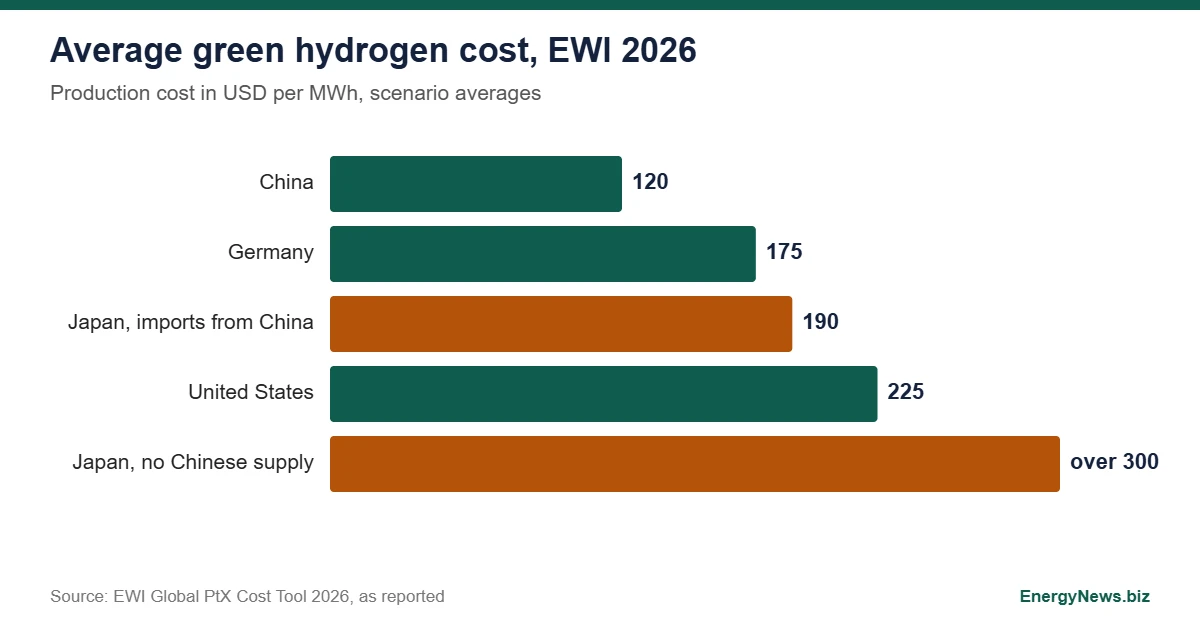
Green hydrogen cost in China averages $120 per MWh, against $175 in Germany and $225 in the United States, according to the 2026 update of the EWI Global PtX Cost Tool from the Institute of Energy Economics at the University of Cologne. The gap of $105 per MWh between China and the United States is almost as large as the full cost of Chinese production, and it frames the supply side of any green hydrogen economy.
Green hydrogen cost by country in the EWI study
In the modelled scenario China meets all of its demand through domestic production, and so does the United States. Germany combines domestic output with imports from North Africa and other EU countries, which lifts its average green hydrogen cost to $175 per MWh. Japan has limited and expensive domestic potential. Imports from China would give Japan an average of $190 per MWh, while supply without Chinese volumes would exceed $300 per MWh. The study estimates that seaborne transport alone adds about $80 per MWh for Japan.
The study figures are given per MWh. On a lower heating value basis of about 33.3 kWh per kilogram, which is our own conversion and not a figure from the study, $120 per MWh is roughly $4 per kilogram, $175 is about $5.8 and $225 is about $7.5. Those are production cost averages in a model, not market prices, and they should not be compared with offers from individual projects.
Why China leads on green hydrogen cost
EWI attributes the Chinese advantage to favourable wind and solar resources, lower capital expenditure for renewables and electrolysers, and lower labour and financing costs. The update also revises renewable and electrolyser capex assumptions and uses country specific weighted average cost of capital. That last point matters, because financing cost is one of the largest drivers of green hydrogen cost, and the study treats it as a national variable rather than a global constant.
The Japanese case shows how strongly the ranking depends on trade. Without Chinese supply the average green hydrogen cost for Japan is more than two and a half times the Chinese figure, and even with imports it stays $70 per MWh above China. For an importer, the cheapest source and the most secure source may not be the same, and the study flags import dependence as a supply security risk for Germany.
What the tool covers and what it leaves open
The EWI tool covers hydrogen and derived products including ammonia, methane, methanol and Fischer Tropsch fuels. It models pipeline and ship transport, and lets users compare two cost scenarios through 2050 and two supply profiles. It is available free on the EWI website, so buyers and policymakers can test their own assumptions.
Two cautions apply. First, the results are scenario outputs that depend on assumed demand, resource quality and transport routes. Second, we read the figures from reporting on the study, because the primary report was not accessible to us at the time of writing, so the underlying tables should be checked before the numbers are used in a business case. What the results already make clear is that green hydrogen cost differences between regions are large enough to shape trade flows, and that importers such as Germany and Japan face a choice between domestic cost, import cost and supply security. For related analysis see our coverage of a hydrogen supply chain model for Bahia, and for the study itself visit the Institute of Energy Economics at the University of Cologne.
Add EnergyNews.biz as a preferred source on Google


