




Sustainable cooling has moved from a side topic to a formal track at the UN climate conference in Antalya. COP31, which runs until 20 November, hosts the third ministerial dialogue on heat resilience and sustainable cooling, and a dedicated pavilion run by the UNEP Cool Coalition with GlobalABC, UN-Habitat and the Turkish development bank İLBANK.
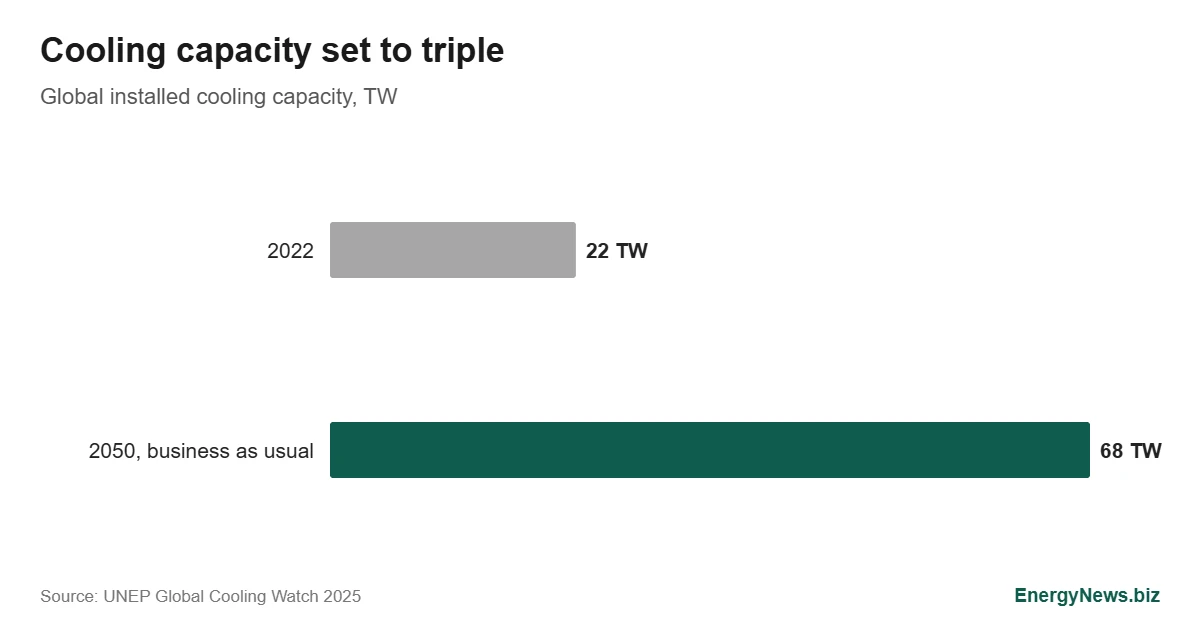
The reason is simple arithmetic. UNEP’s Global Cooling Watch 2025 found that global installed cooling capacity could rise from 22 TW in 2022 to 68 TW by 2050 under business as usual. Heatwaves are now the deadliest climate hazard, and air conditioning demand is growing fastest in South Asia and Africa, where grids are already stretched.
An ENB calculation of the sustainable cooling gap
An ENB calculation shows the size of the challenge: growth from 22 TW to 68 TW is a factor of 3.1, or about 46 TW of new capacity in 28 years. That is an average of more than 1.6 TW of new cooling capacity every year. Much of it will run during heatwaves, when power systems are already at their limits.
The Global Cooling Pledge, launched at COP28 in Dubai, commits signatories to cut cooling-related emissions by 68% by 2050 compared with 2022, while expanding access to cooling. By COP30 in Belém, 72 countries had signed. More than 200 cities have joined the parallel Beat the Heat campaign, including Rio de Janeiro, Chennai and Paris.
COP31 is being run as an “implementation COP” by Turkish president of the conference Murat Kurum, with Australia leading parts of the negotiations. Cooling fits that frame because the technologies already exist. The gap is finance and delivery, especially in hot countries where incomes are rising fastest. The ministerial dialogue in Antalya is expected to report on progress against the pledge targets.
What sustainable cooling means in practice
UNEP’s Sustainable Cooling Pathway combines four tools: passive design such as shading, insulation and reflective roofs; low-energy options such as fans; hybrid systems that pair fans with efficient air conditioners; and a faster phase-out of high-warming HFC refrigerants under the Kigali Amendment. Combined with a clean power sector, UNEP estimates residual cooling emissions could fall 97% below business as usual.
The pledge now has a governance structure. The Intergovernmental Committee on Cooling, formalised in Belém, monitors delivery of the pledge’s 14 targets, and the EPIC platform supports national implementation. The first Global Cooling Pledge Assembly met in Singapore in September and invited countries to co-design a Global Heat Resilience Roadmap ahead of Antalya.
UNEP warns that unmanaged growth of air conditioning in Africa and South Asia could strain grids and trigger outages during heatwaves, when demand for cooling and the risk to health peak at the same time. Building codes, minimum efficiency standards for appliances and urban heat plans are the cheapest tools, because they shape demand before it reaches the grid. Sustainable cooling therefore sits as much with housing and city ministries as with energy ministries.
Why grids should care
For power systems, cooling is the main driver of summer peaks. Every efficiency gain in air conditioners reduces the generation, storage and grid capacity needed for the hottest hours. Measured as useful energy, cooling is also one of the clearest cases where electricity already dominates, a point made in our analysis of useful energy demand.
For investors, sustainable cooling creates demand for efficient equipment, district cooling networks and low-GWP refrigerants. For grid operators, it is a question of how much peak capacity they must build. The answer depends on whether the 68% target becomes national policy, with standards and budgets, or stays as a declaration signed at a summit.
The Global Cooling Watch report and the pledge text are available from UNEP.
Add EnergyNews.biz as a preferred source on Google


