




Urenco HALEU will fuel the first SEALER reactor of Swedish developer Blykalla. Under a supply agreement announced on 16 November, Urenco will enrich high-assay low-enriched uranium at its Capenhurst plant in the United Kingdom for Blykalla’s first project in the United States. Blykalla will supply the natural uranium feed.
The companies describe it as the first HALEU enrichment agreement in the world for a commercial lead-cooled reactor. SEALER, short for Swedish Advanced Lead Reactor, is a small modular design rated at 55 MWe. Blykalla aims to sell power and heat to industry and data centers in the United States and Europe.
Why Urenco HALEU matters for advanced reactors
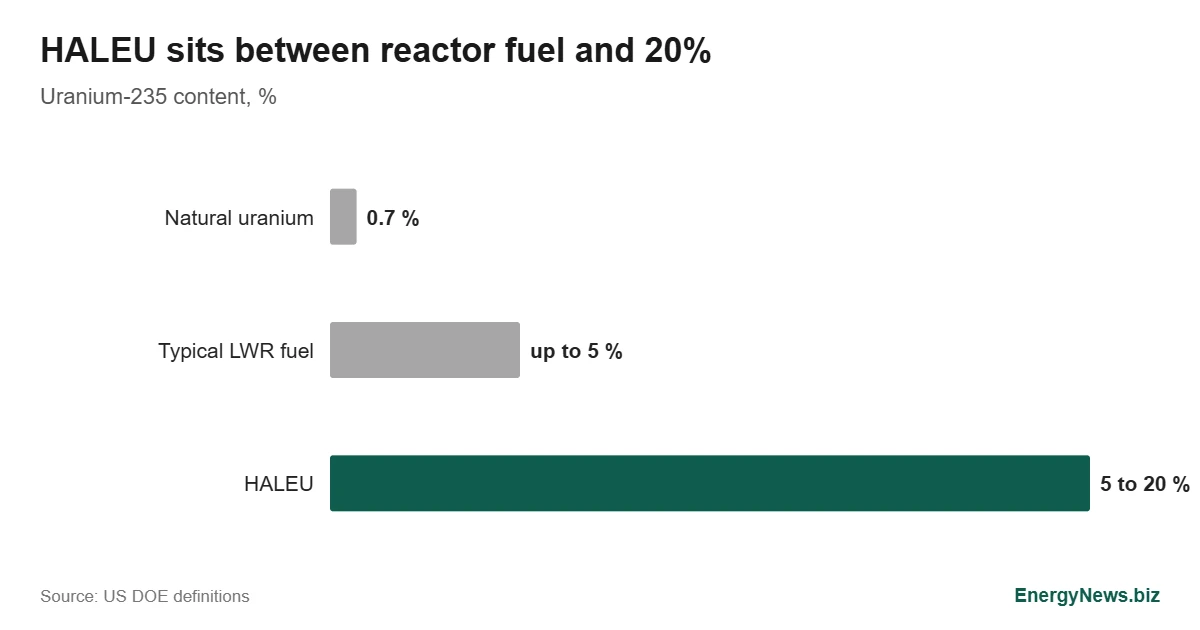
HALEU contains between 5% and 20% uranium-235, compared with 0.7% in natural uranium and up to 5% in the fuel used by today’s large light water reactors. Many advanced reactor designs need HALEU to run longer between refuelling or to fit a compact core. Until recently, the only commercial supplier was Russia’s Rosatom, a dependency that Western governments are trying to end.
Urenco received about $246 million in UK government support in 2024 to build HALEU capacity at Capenhurst. Since then, it has signed a series of Western HALEU contracts: with Radiant for its Kaleidos microreactor in September 2025, with Westinghouse for eVinci, and with Antares for its microreactors in May 2026. Blykalla adds a lead-cooled design to that list.
Lead cooling and SEALER
Lead-cooled reactors run at atmospheric pressure and high temperature, and lead does not react violently with air or water as sodium does. The trade-offs are corrosion of structural materials and the weight of the coolant. Blykalla has spent more than a decade on material tests in Sweden and is developing a non-nuclear electrical prototype before its first nuclear unit.
The deal comes as fuel supply becomes a deciding factor for which SMR designs are built first. Companies such as newcleo are pursuing recycled MOX fuel for lead-cooled reactors to avoid relying on new enrichment, while others such as GE Vernova Hitachi with the BWRX-300 use conventional low-enriched fuel and face fewer fuel constraints.
What to watch next
An ENB calculation shows how small SEALER is compared with conventional plants. At 55 MWe, about 22 SEALER units would match the output of one 1,200 MW VVER unit such as the reactor now starting up at Rooppur in Bangladesh. Small units need much less fuel per reactor, but a fleet of them needs a steady fuel supply chain, which is why early contracts with enrichers matter.
The United States is building its own HALEU supply as well. Centrus Energy operates a demonstration cascade in Piketon, Ohio, under a Department of Energy contract, and the department runs a HALEU availability programme to allocate material to advanced reactor developers. Urenco HALEU from the UK adds a second Western source that customers can contract commercially.
For Blykalla, securing fuel early reduces one of the biggest risks investors see in advanced reactor startups. Many SMR developers have struggled to show a credible fuel path before licensing, and a named enricher with an operating plant gives the company an answer to that question. The remaining risks are licensing, financing and building the first unit on time, the same hurdles faced by every first-of-a-kind reactor, whatever its coolant.
The agreement does not disclose volumes, price or delivery dates, and Blykalla has not yet named a US site. Neither company has said when the first enrichment work at Capenhurst for Blykalla will start. The next milestones are site selection, a US licensing application and the timing of first HALEU deliveries from Capenhurst. For Urenco HALEU, the key question is how quickly the UK plant can scale to serve a growing list of customers. Company updates are published by Urenco.
Add EnergyNews.biz as a preferred source on Google


