




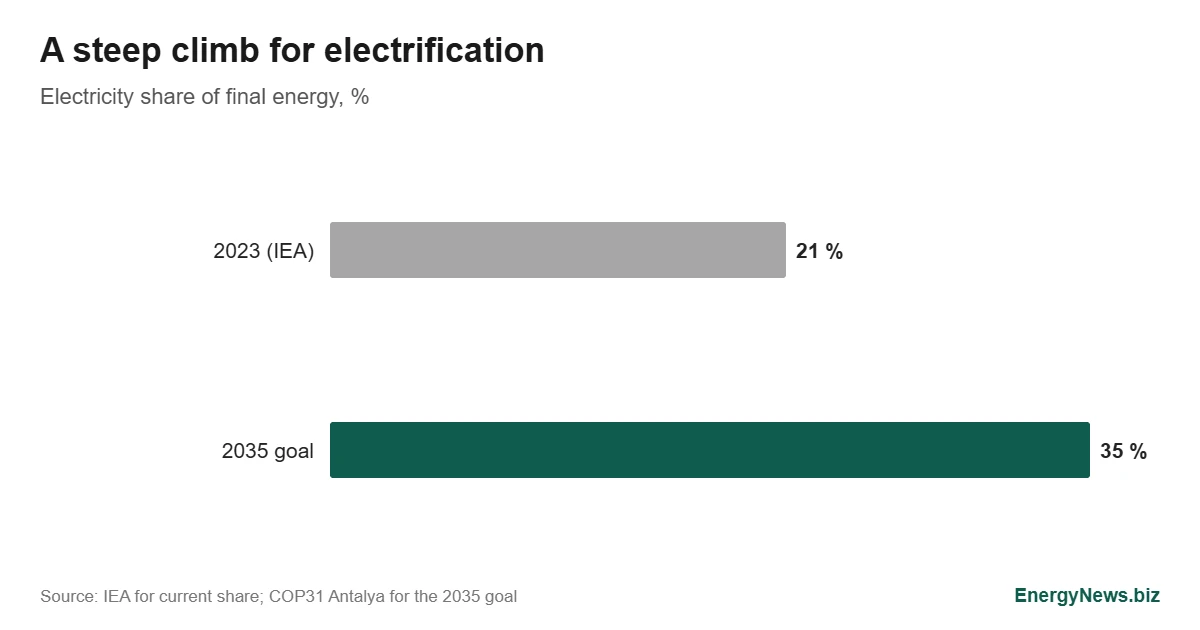
Electrification has a number attached to it at the COP31 climate conference in Antalya, which runs to 20 November. One of the headline initiatives is a goal to raise electricity’s share of global final energy consumption to 35% by 2035, a target promoted by the Turkish presidency. The goal is clean on paper. The arithmetic behind it is demanding.
Electricity today is about 21% of final energy consumption worldwide, according to the International Energy Agency. Moving to 35% by 2035 means adding roughly 14 percentage points in about twelve years, or about 1.2 points every year. The share has historically risen by closer to 0.4 points a year. The target therefore asks for about three times the usual pace, sustained for more than a decade.
Why electrification is the lever
The logic is sound even if the number is hard. Measured as useful energy rather than raw fuel, electricity already does more work per unit than combustion, because electric motors, heat pumps and electrolysis waste far less than engines and boilers, a point set out in the analysis of useful energy demand. Raising the electricity share is the most direct way to cut both fossil demand and total primary energy at the same time.
Heat and transport are where the share has to move. Cooling is already mostly electric and growing fast, as the report on sustainable cooling at COP31 set out. Road transport is shifting, as China’s move to electric heavy trucks shows. Industrial heat and heavy transport are the harder parts, and they are where the 35% target will be won or lost.
What a point a year of electrification requires
Each percentage point of final energy is a large quantity. Global final energy consumption is on the order of 440 exajoules a year. One percentage point is therefore about 4.4 exajoules, or roughly 1,200 terawatt-hours of electricity if it displaces fuel one for one, before efficiency gains. Adding more than a point a year means building generation, grids and storage at a pace well above recent records, every year to 2035.
That is why grids, not generation alone, decide the outcome. The connection queues and cost fights visible in markets such as PJM are the practical limit on how fast electrification can run. A target set in a conference hall meets a transmission queue in the real world.
The number to track
The regional picture explains why the global average moves slowly. In parts of Europe and East Asia electricity is already close to 30% of final energy, while in much of Africa and South Asia it is well under 15% because transport and cooking still run on fuel and biomass. Lifting the global figure to 35% means both raising the leaders further and electrifying the countries starting lowest, at the same time. That is a development question as much as a climate one, and it is where finance at COP31 meets the electrification target.
Electrification is also a resilience story, not only a climate one. A system fed by diverse domestic generation is less exposed to imported fuel prices than one built on gas and oil, which is why energy-security ministries, not just climate ones, now back the electrification push. The target set in Antalya will be judged on grids built, not words agreed.
The clearest yardstick is the electricity share of final energy, reported each year by the IEA. If it rises by a point or more a year through the late 2020s, the 35% goal is live. If it stays near half a point, the goal is rhetorical. Whether the Antalya cover decision even references the target is itself contested, with some governments pushing to keep it out. The full negotiating texts are published by the UNFCCC.
Add EnergyNews.biz as a preferred source on Google


