


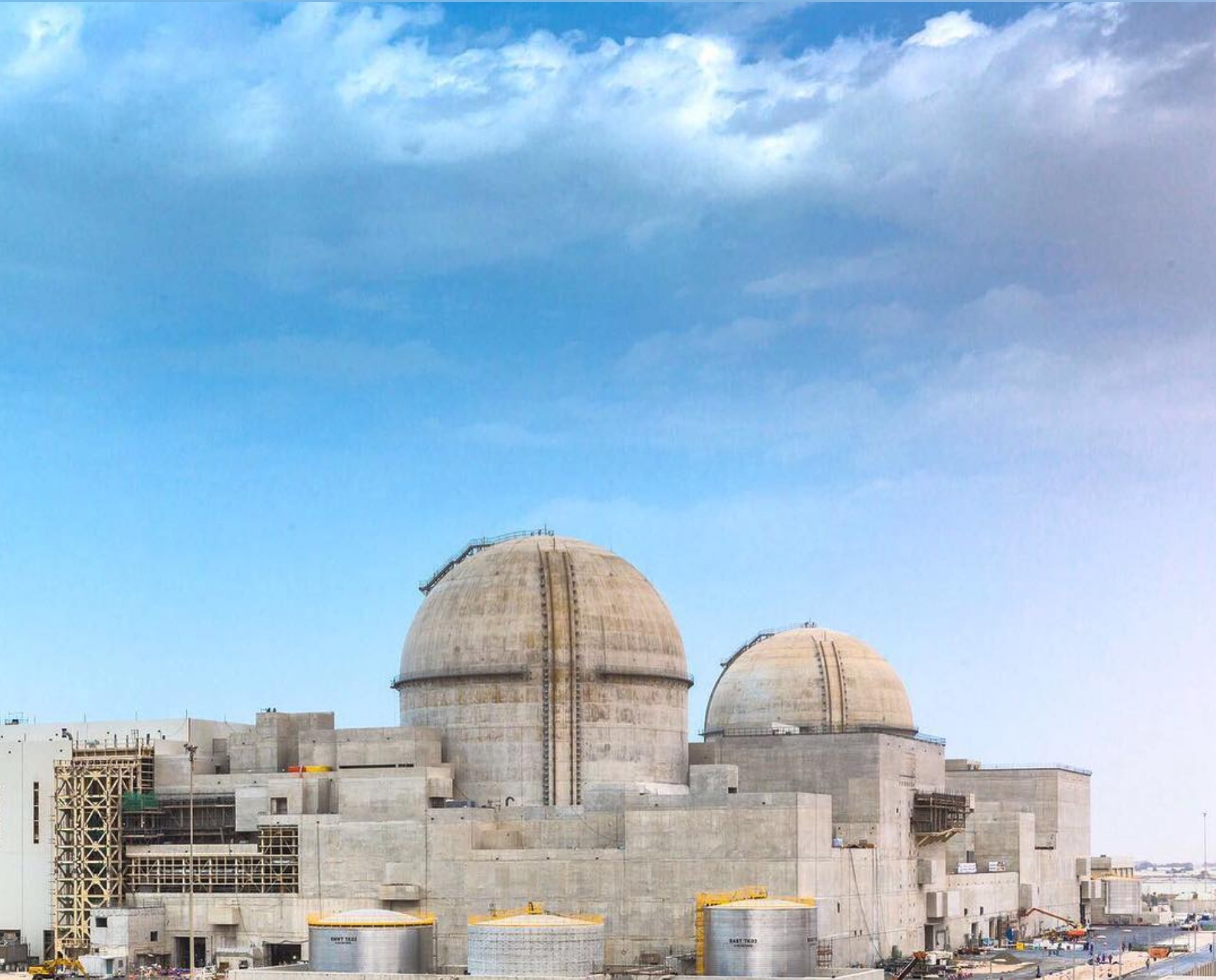


The small modular reactor wave now has serious money behind it. In the United States, a joint initiative announced by President Trump and Japanese Prime Minister Takaichi targets $40 billion and about 3 GWe of capacity using GE Vernova Hitachi’s BWRX-300 design, with Tennessee’s Clinch River site in the lead. The Department of Energy has selected the Tennessee Valley Authority and Holtec among first-mover teams, and TVA has a separate agreement with ENTRA1 Energy to develop up to 6 GW. In Britain, Rolls-Royce SMR has a firm contract with Great British Energy Nuclear for three units at Wylfa, backed by billions in state funding.
The common feature of every one of these programs is that nothing is built. Not a single Western commercial small modular reactor is generating power. The wave is real, the capital is real, and the field record is still zero.
What the small modular reactor numbers show
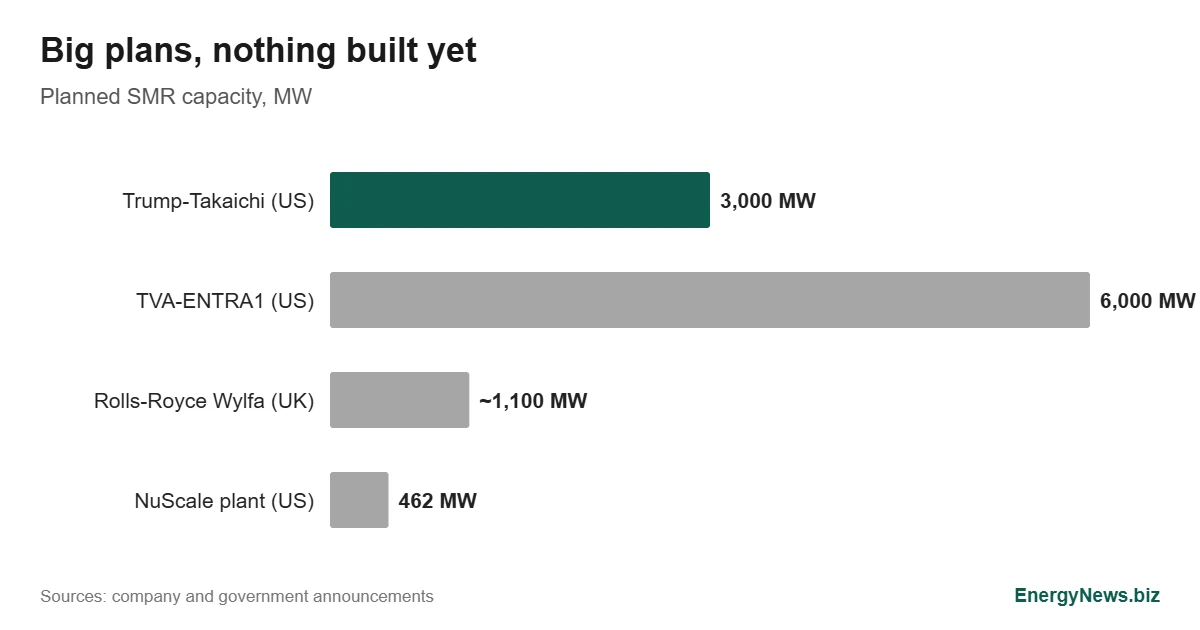
The announced capacities are large. The Trump-Takaichi plan is about 3,000 MW, the TVA-ENTRA1 ambition up to 6,000 MW, Rolls-Royce’s first Wylfa fleet around 1,100 MW across three units, and NuScale’s approved design a 462 MW plant built from 77 MW modules. NuScale holds the only US design approval, granted in March 2026. GE Vernova Hitachi’s BWRX-300 is the design TVA has taken furthest, with a construction permit application at the Nuclear Regulatory Commission.
Why cost per kilowatt is the missing number
Capacity is the easy figure to announce. Cost per kilowatt is the one that decides whether SMRs matter, and none of these programs has a proven first-of-a-kind cost in the field. Large conventional reactors have repeatedly run over budget and behind schedule, as Canada’s Darlington SMR delay showed even for a modular design. The whole promise of SMRs is that factory build and repetition bring cost down, but repetition only helps after the first units are built and measured.
The driver behind the money is data-center demand, the same force pulling on grid connection queues and reviving retired plants across the US. Tech buyers want firm, carbon-free power and are willing to underwrite it. That solves the demand question. It does not yet answer the cost question.
The milestone that counts
Schedule is where the promise will be tested first. Large nuclear projects have slipped by years and billions before, and the SMR case rests on factory build and repetition compressing that timeline. The first units will not be fast or cheap, because first-of-a-kind always carries the learning cost. What matters is whether the second and third units are measurably faster and cheaper than the first, which is the only way the modular argument is proven in practice rather than in a brochure.
Fuel and grid are the other two constraints. Many advanced designs need high-assay low-enriched uranium that the West is only now building capacity to supply, and even a finished reactor needs a transmission connection in markets where queues already run for years. A reactor that is ready but cannot connect, or cannot be fuelled, is not firm power. The money announced this year addresses the demand side; the supply chain and the grid decide the delivery.
The near-term test is narrow. No small modular reactor will be cheap or fast on its first build; the question is whether the second and third units of each small modular reactor design come in measurably faster and cheaper, which is the only proof the modular argument offers.
The number to watch is not another gigawatt of announcements but the first Western SMR to reach commercial operation and disclose its real cost per kilowatt. Until one does, the sector is a set of plans backed by public money, not a proven source of cheap firm power. The fuel supply chain is moving in parallel, as the Urenco HALEU agreements show. Program filings are published by the US Nuclear Regulatory Commission.
Add EnergyNews.biz as a preferred source on Google


