


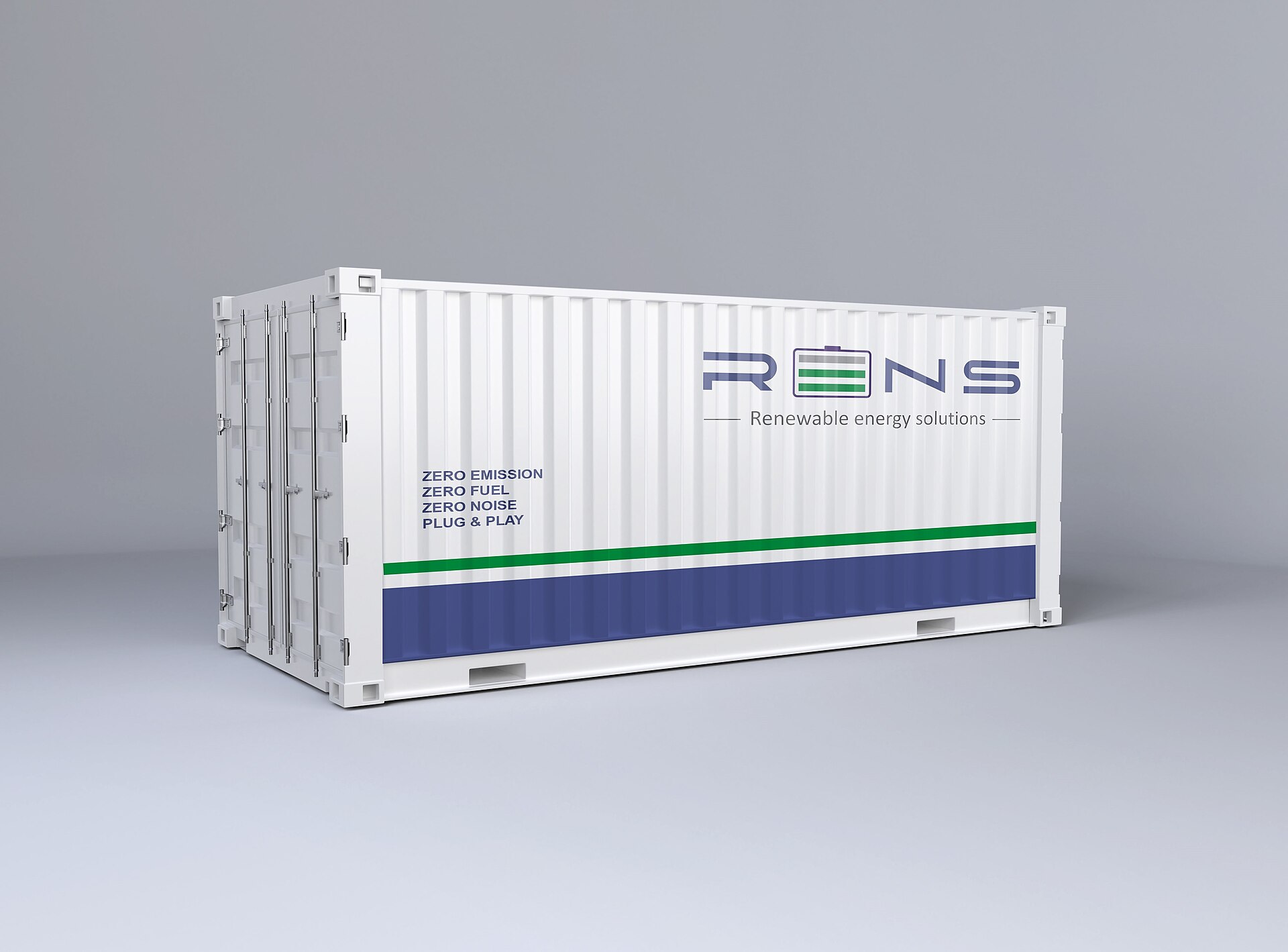


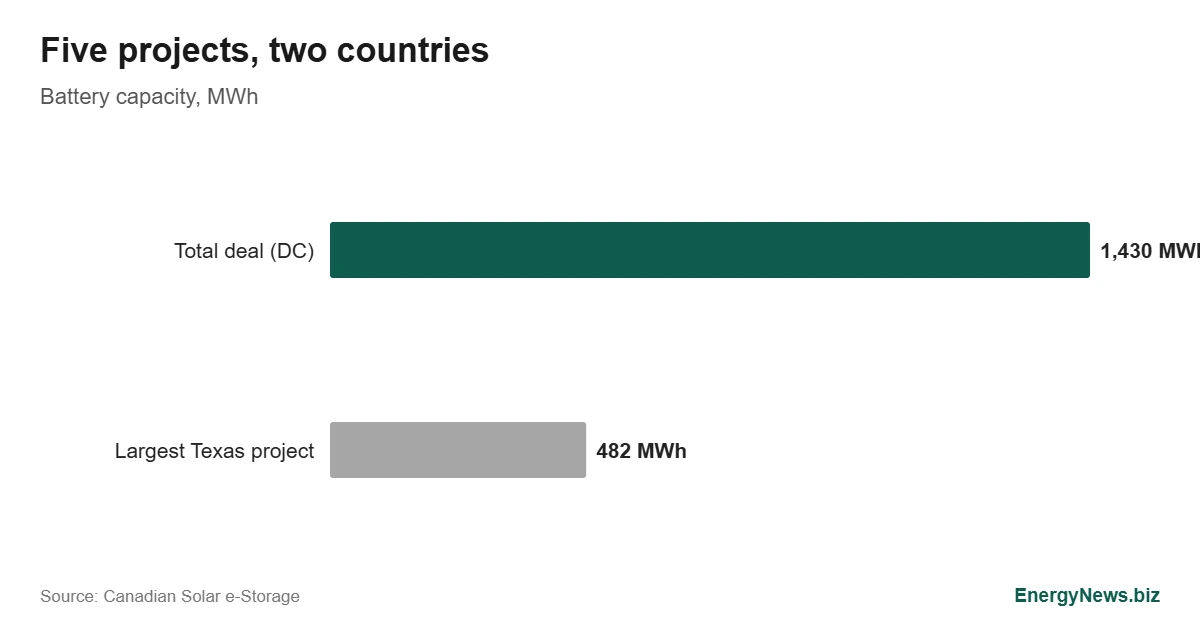
e-Storage, the battery storage arm of Canadian Solar, has agreed to supply battery systems with 590 MW of power and 1.43 GWh DC of capacity to X-Elio for five projects. Four of the projects are in Texas and one is in New South Wales, Australia. The agreement includes long-term service, and the projects are scheduled to reach commercial operation within two years.
One of the Texas projects is rated at 200 MW and 482 MWh. It will use e-Storage’s EQ-S energy management system, which controls charging and discharging against market prices and grid signals. The batteries are SolBank 3.0 units, each holding about 5 MWh.
What the e-Storage deal includes
The portfolio averages about 2.4 hours of storage duration, based on 1.43 GWh across 590 MW. That is typical for projects built to shift solar output from midday into the evening peak and to earn revenue from price spreads in both markets. At about 5 MWh per unit, the deal implies roughly 290 SolBank containers.
e-Storage will also provide service under a 22-year agreement. Long service contracts have become standard in utility-scale storage, as owners and lenders want guarantees on capacity, availability and degradation over the life of a project. The manufacturer takes on part of the performance risk in exchange for a steady service revenue stream.
Why Texas and Australia
Texas and the National Electricity Market in eastern Australia are two of the most active battery markets in the world. Both have high shares of solar and wind, volatile wholesale prices and market rules that pay storage for fast response. Batteries there can earn from energy arbitrage as well as from ancillary services, which supports project finance without long-term government contracts.
The deal adds to a strong year for storage. US installed battery capacity has passed 200 GWh, and large projects are increasingly linked to data centre demand, as with the 600 MWh battery firming a Meta site in Utah. Australia has also expanded support for home and grid batteries, adding to demand.
Supply chain and policy
Battery sourcing has become a policy issue in the United States, where tax credit rules and tariffs now favour cells and components from outside China. e-Storage manufactures systems in several countries and has been adding US production capacity. For buyers, the origin of cells affects eligibility for credits as well as the risk of delays at the border.
X-Elio is a developer and operator of solar and storage projects in Europe, the Americas and Australia. Adding batteries to its pipeline follows a wider trend among solar developers, who now pair most new plants with storage or add it to existing sites to capture higher evening prices.
For e-Storage, the order adds to a backlog that has grown with the storage market. The company reports contracted backlog in the billions of dollars, and multi-project agreements such as this one give it visibility on production years ahead. For X-Elio, a single supplier across two markets simplifies operations, spare parts and the service relationship over the life of the projects.
Duration is the main design choice in deals like this. Two-hour systems dominated early markets because they captured the most valuable price spikes at the lowest cost. As more batteries enter Texas and the NEM, those spikes shrink, and developers are moving toward longer durations to reach further into the evening. The mix in the e-Storage order, averaging about 2.4 hours, reflects that gradual shift, and leaves room to extend duration later as markets change.
The next steps are construction start on the projects and the first deliveries of SolBank units. Company information is available from Canadian Solar.
Add EnergyNews.biz as a preferred source on Google


