





US energy storage has passed a milestone: more than 200 GWh of battery storage capacity is now installed across the country. A new US Energy Storage Market Outlook from the Solar Energy Industries Association and Benchmark Mineral Intelligence, released on 17 November during the RE+ event in Las Vegas, reported 14.3 GWh of new capacity in the third quarter of 2026, bringing the first nine months to 48.3 GWh.
The 200 GWh figure is a cumulative total, the sum of everything installed over years of build-out. Passing it matters because storage has gone from a niche grid accessory to infrastructure measured in the same units as generation, and because most of that total is recent.
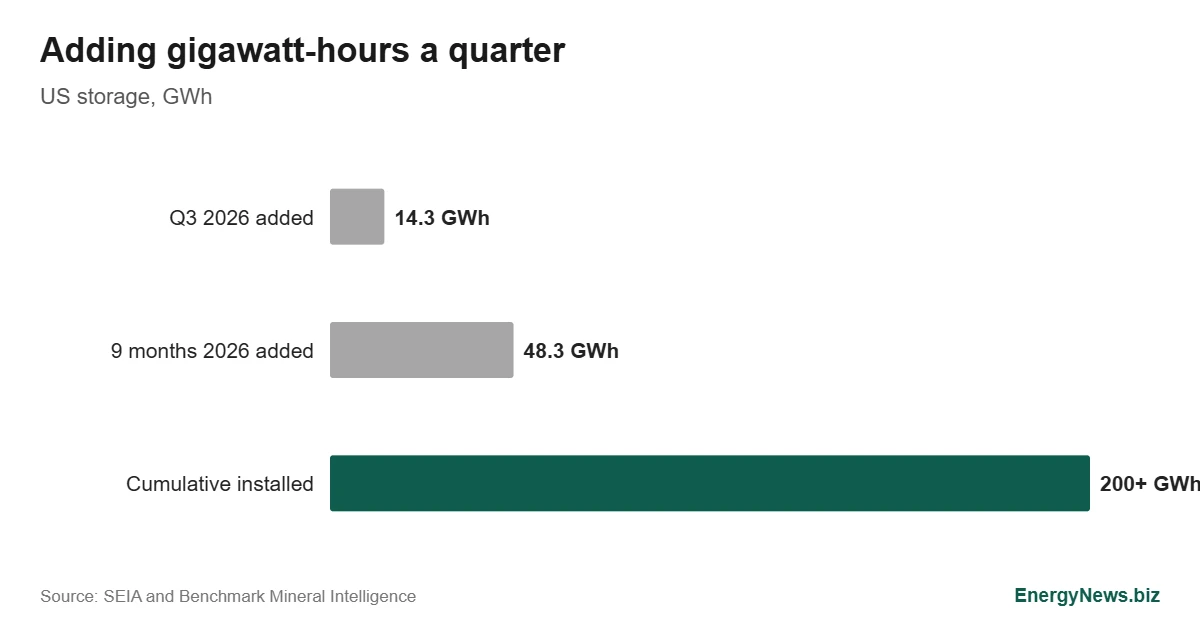
An ENB calculation behind the US energy storage milestone
The acceleration is the story. An ENB calculation makes it concrete: with 48.3 GWh added in just nine months of 2026, close to a quarter of the entire 200 GWh installed base has gone in this year alone. A technology that took years to reach its first hundred gigawatt-hours is now adding tens of gigawatt-hours annually, and the fourth quarter is usually the strongest.
The growth comes despite policy headwinds. New sourcing rules and tax-credit changes have reshaped which suppliers projects can use, pushing demand toward domestic, non-Chinese cells such as the large battery orders now being signed. Utility-scale projects make up the bulk of installs, with data centers and behind-the-meter systems adding a growing share, as sites like the Energizar project near Boston show.
The 200 GWh figure is cumulative, the sum of everything installed over years of build-out, and passing it matters because storage has gone from a niche grid accessory to infrastructure measured in the same units as generation. Most of that total is recent, which is the real signal: the technology that took years to reach its first hundred gigawatt-hours is now adding tens of gigawatt-hours every year.
Utility-scale projects make up the bulk of installs, with data centers and behind-the-meter systems adding a growing share. The growth has come despite policy headwinds, as new sourcing rules and tax-credit changes reshaped which suppliers projects can use, pushing demand toward domestic cells. That the installed base still cleared 200 GWh through that disruption shows how strong the underlying demand for storage has become.
The fourth quarter is the figure that now matters for US energy storage. Developers push projects to commercial operation before year end to lock in tax treatment and contract dates, so the final quarter is usually the strongest, and it will decide whether the market hits its roughly 70 GWh full-year forecast.
A strong close would confirm that US energy storage is still accelerating despite the policy disruption of 2026, and keep the country on track for the much larger annual market forecasters expect by 2030. A weak one would push capacity into 2027 rather than cancel it, and be the first sign the sourcing rules are biting.
Behind the 200 GWh milestone sits a simple shift in how grids are planned. Storage is now treated as firm, dispatchable capacity rather than an experiment, which changes how utilities value solar and wind and how they plan for the evening peak. The next milestones, a quarter-terawatt-hour and beyond, will arrive faster than the first, because the annual run-rate keeps climbing.
For developers and utilities, the milestone is also a procurement signal: at this scale, supply chains, financing and interconnection queues, not demand, are the limits on how fast US energy storage can still grow.
The number to watch next is the fourth-quarter total, which will set whether the US hits the roughly 70 GWh full-year forecast. The quarterly reports are published by SEIA.
Add EnergyNews.biz as a preferred source on Google


