


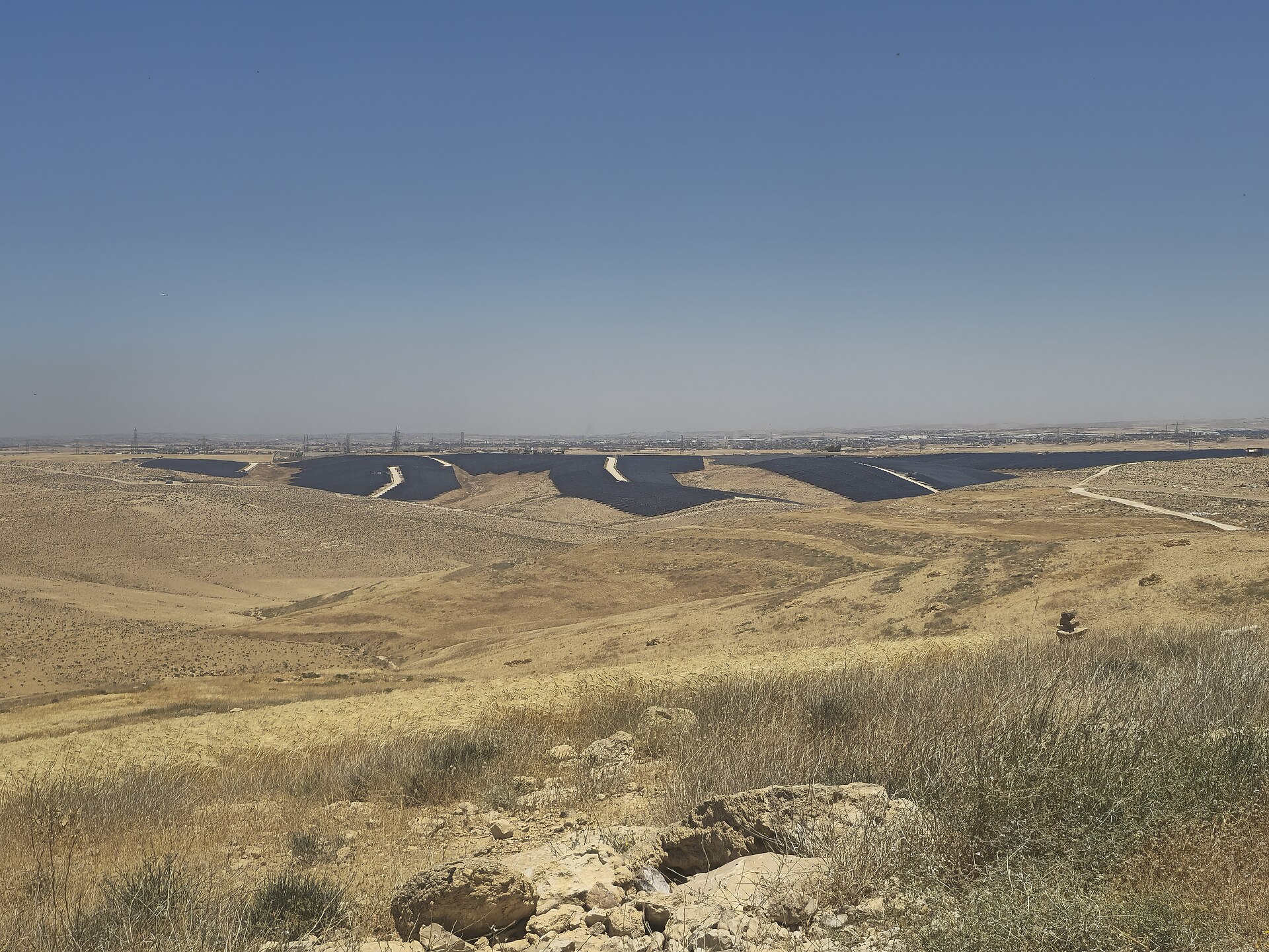


Jordan solar storage plans are heading to market. The Ministry of Energy and Mineral Resources unveiled a 200 MW solar project and a 100 MW, 400 MWh battery energy storage system at the first Jordan-EU Investment Conference last week. It plans to invite private investors to develop both in the new year.
Both projects will follow a build, own and operate model. The state-owned National Electric Power Company (NEPCO) will buy the electricity from the solar plant and act as the beneficiary of the storage project.
Jordan solar storage timeline and budgets
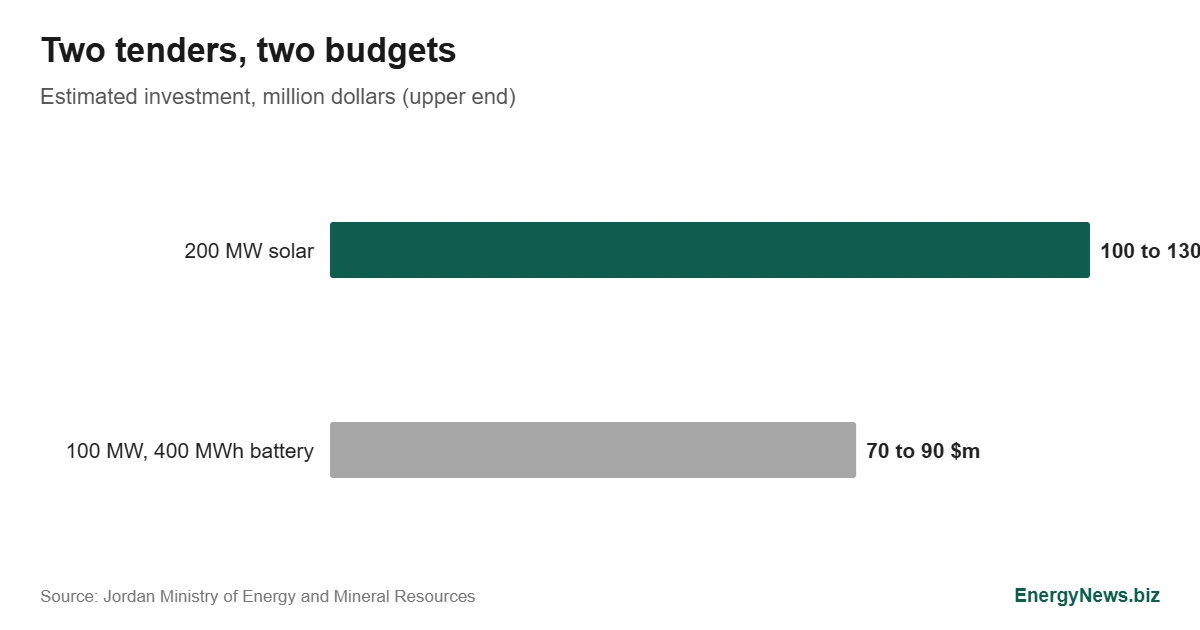
The solar project is expected to need an investment of $100 million to $130 million, with initial requests for investor prequalification due in February 2027. The battery is expected to cost $70 million to $90 million, with prequalification in March 2027.
An ENB calculation turns those ranges into unit costs. For solar, $100 million to $130 million for 200 MW equals about $0.50 to $0.65 per watt, in line with recent utility-scale costs in sunny markets once grid connection and development are included. For storage, $70 million to $90 million for 400 MWh equals about $175 to $225 per kWh for a four-hour system, a realistic range given today’s lower battery prices.
Why a four-hour battery
A 100 MW battery with 400 MWh can deliver full power for four hours. That duration suits a grid where solar dominates the middle of the day and demand peaks in the evening, as in much of the Middle East. Storing midday solar and releasing it after sunset reduces the need for evening generation from imported fuel and helps NEPCO manage a grid with a growing share of variable power.
Jordan’s cumulative solar capacity stood at 2,195 MW at the end of 2025, unchanged from a year earlier according to IRENA. The new 200 MW plant would therefore add about 9% to the installed base, a restart after a pause in large-scale additions.
The projects are part of a wider investment package that also includes a 450 MW pumped storage hydropower project and shared infrastructure for green hydrogen and ammonia. Jordan’s regulator has also approved the first 200 systems under a revised framework for consumer-owned renewables.
Jordan solar storage in the regional context
Jordan imports most of its energy, which makes domestic solar and storage a matter of energy security as well as cost. The country was an early mover on utility-scale solar in the region, then slowed as grid constraints and curtailment became an issue. Pairing new solar with a large battery is a way to restart growth without overloading the grid at midday.
For international developers, the Jordan solar storage tenders are small compared with the gigawatt-scale projects in Saudi Arabia and the United Arab Emirates, but they offer a sovereign offtaker and a market with a long record of private power contracts. That track record can lower the risk premium bidders build into their prices.
What bidders should watch
The key details will be in the prequalification documents: the length and currency of the power purchase agreement, how the storage capacity payment is structured and what guarantees NEPCO offers. Regional benchmarks are tight. Recent tenders in the Gulf have set some of the world’s lowest solar prices, and large hybrid projects such as those in Bangladesh’s solar programme show how multilateral backing can lower financing costs. Storage procurement models are also evolving quickly, as deals like e-Storage’s agreement with X-Elio illustrate.
For Jordan solar storage, the question is whether the tenders attract enough international bidders to deliver prices at the low end of the ministry’s ranges. Updates will be published by the Ministry of Energy and Mineral Resources.
Add EnergyNews.biz as a preferred source on Google


