


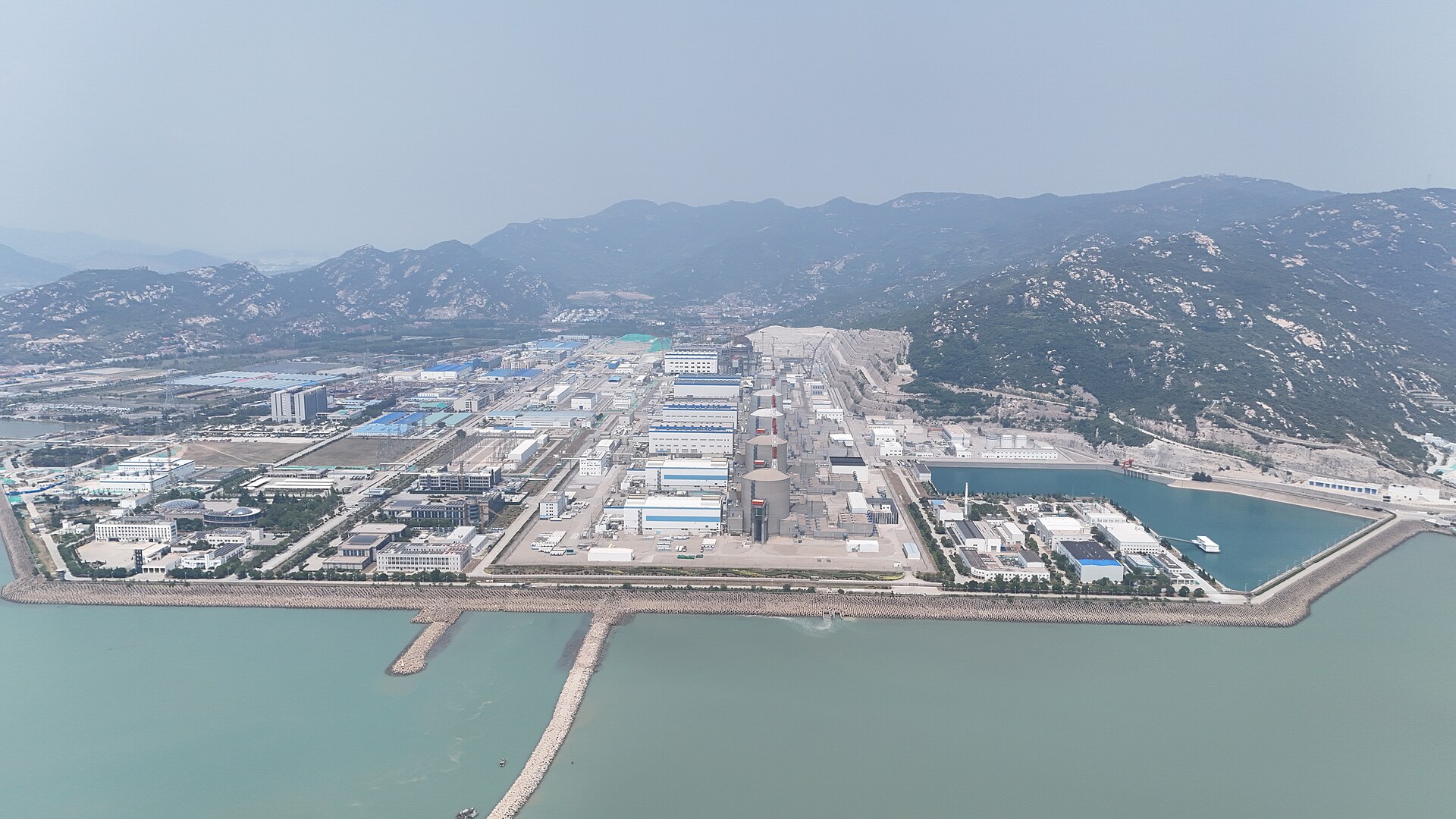


The Tianwan nuclear plant in Jiangsu is one step from becoming the largest nuclear power station in the world. Unit 8, a Russian-designed VVER-1200, has completed hot functional tests and its fuel has been delivered, World Nuclear News reported on 26 November. When it enters service, the site will have eight reactors and about 9.1 GW of capacity, ahead of Kashiwazaki-Kariwa in Japan at about 8.2 GW.
CNNC expects the completed Tianwan nuclear site to generate more than 70 TWh a year and avoid 57.4 million tonnes of CO2. Those two numbers allow a check on how hard the plant is expected to run, and on what the last two units add on their own.
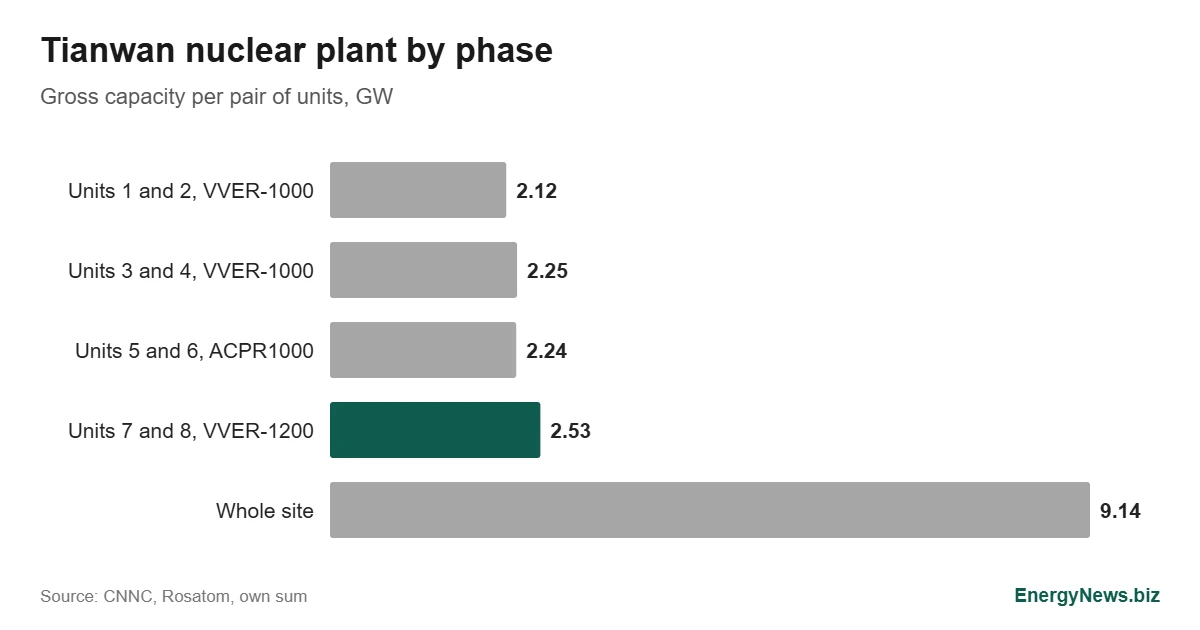
Tianwan nuclear plant unit by unit
Tianwan has been built in four phases over two decades. Units 1 to 4 use VVER-1000 reactors and entered service between 2007 and 2018. Units 5 and 6 use the Chinese ACPR1000 design and started commercial operation in 2020 and 2021. Units 7 and 8 are VVER-1200s, ordered under agreements signed by Russia and China in June 2018, according to World Nuclear News.
| Units | Reactor | Approx. capacity | Status |
|---|---|---|---|
| 1 and 2 | VVER-1000 | 2 x 1.06 GW | Operating since 2007 |
| 3 and 4 | VVER-1000 | 2 x 1.13 GW | Operating since 2018 |
| 5 and 6 | ACPR1000 | 2 x 1.12 GW | Operating since 2020 and 2021 |
| 7 | VVER-1200 | about 1.27 GW | Fuel loaded August 2026, commercial operation planned 2026 |
| 8 | VVER-1200 | about 1.27 GW | Hot tests done, fuel delivered, commercial operation planned 2027 |
| Site | about 9.1 GW |
The capacity figures are approximate gross ratings and add up to about 9.14 GW. Net output to the grid is lower. The site is owned by CNNC with 50%, State Power Investment Corporation with 30% and Jiangsu Guoxin with 20%.
How fast Tianwan nuclear units 7 and 8 were built
Construction of unit 7 began in May 2021. Fuel loading of its 163 assemblies started on 12 August 2026, with commercial operation planned this year. Unit 8 started construction on 25 February 2022 and completed cold functional tests on 3 August 2026. Hot tests followed, and commercial operation is planned for 2027.
That puts both VVER-1200s at about five to five and a half years from first concrete to commercial operation. By the standards of recent European and American builds, this is fast. It also follows the pattern of the Chinese programme: repeated designs, a stable supply chain and a site that has hosted construction crews almost without pause since the 2000s.
Rosatom’s fuel division TVEL supplied the first core for unit 7 in January 2026, the first VVER-1200 fuel delivered to China. The Yibin fuel plant in Sichuan already makes VVER-1000 assemblies under TVEL licence and is completing localisation of VVER-1200 fuel production, according to TVEL.
What 70 TWh a year implies
Divide 70 TWh by 9.14 GW and the site would run about 7,660 full-load hours a year. That is a capacity factor of about 87%, close to the level Chinese nuclear fleets have reported in recent years and well above the 80% common in markets where reactors follow load or face long outages.
The CO2 figure implies an emission factor of about 0.82 tonnes per MWh (57.4 Mt divided by 70 TWh). That matches the output of a coal plant, not the average Chinese grid, so CNNC is counting the avoided emissions as coal displaced. The comparison is fair for Jiangsu, where coal still sets much of the generation mix, but it overstates the benefit against a grid that adds solar and wind every year.
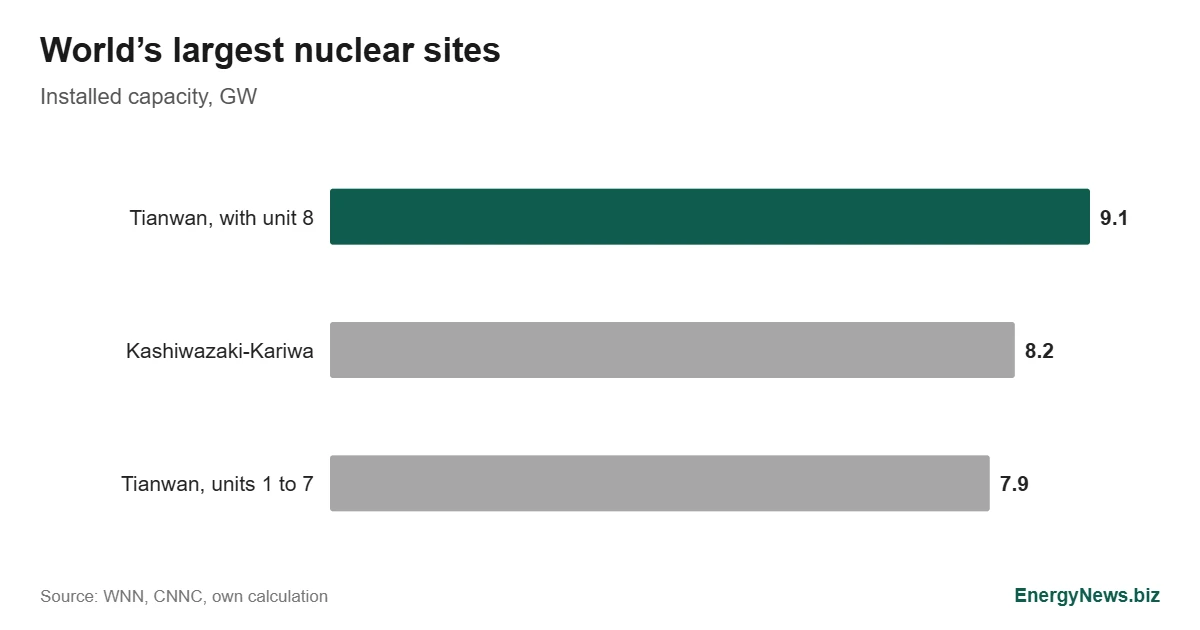
What units 7 and 8 add on their own
The two VVER-1200 units add about 2.53 GW. At a 90% capacity factor, they would produce about 20 TWh a year. At CNNC’s implied factor of 0.82 t per MWh, that is roughly 16 million tonnes of CO2 avoided a year. At a more conservative 0.55 t per MWh, closer to a grid average, the figure falls to about 11 million tonnes.
For comparison, 20 TWh a year is more than the annual electricity use of many mid-sized European countries. It is delivered from one site that already has the transmission lines, cooling water intake and workforce in place. That is the hidden advantage of large multi-unit sites: each new reactor costs less to connect than the last.
Why the Tianwan nuclear record matters outside China
The Tianwan nuclear plant shows three things that matter to buyers of new reactors elsewhere.
- Series building works. Four pairs of reactors on one site, two of them with the same design family, gave CNNC experienced crews and a known supply chain. Countries planning a single first-of-a-kind unit will not get these benefits.
- Russia remains a supplier to China. Western sanctions have not stopped Rosatom from delivering reactors and fuel to Chinese customers. For European utilities that still use Russian fuel for VVER-440 and VVER-1000 units, the Chinese localisation of fuel production is a reminder that alternatives take years.
- Site size drives economics. At 9.1 GW, Tianwan needs its own grid planning. Large sites concentrate risk: a common-cause outage, a grid fault or a cooling water problem could take several gigawatts offline at once.
Nuclear supply chains in Europe face a different scale problem, as shown in this report on Framatome’s reactor internals workshop for the EPR2 programme. Russian construction continues too, as in the delivery of steam generators to Leningrad II unit 3.
Tianwan nuclear output in a coal-heavy province
Jiangsu is one of China’s largest industrial provinces and one of its biggest electricity consumers. Coal plants still supply much of its power, while offshore wind and rooftop solar grow along the coast. A baseload source of more than 70 TWh a year from a single Tianwan nuclear site gives the provincial grid a large block of low-carbon supply that does not depend on weather.
That has a cost on the grid side too. Eight large reactors on one coastline mean several high-voltage lines must stay available, and the grid must hold reserves large enough to cover the loss of one 1.27 GW unit at any moment. As more units come online, the reserve requirement grows with the size of the largest unit, not with the size of the site, so the VVER-1200 units set the new benchmark for Jiangsu.
For investors in Chinese power, the Tianwan nuclear numbers also show how nuclear earnings work there. Units sell at regulated or negotiated tariffs with high utilisation, which explains why CNNC can plan around 87% capacity factors. In markets where nuclear follows demand or competes with cheap midday solar, the same reactors would run fewer hours and earn less per MW.
What to check next
- The date of first criticality and grid connection for unit 8, which will show whether the 2027 target holds.
- Commercial operation of unit 7, which would confirm VVER-1200 performance in China.
- Real output: whether the site reaches the 70 TWh a year that CNNC expects, which needs a capacity factor near 87%.
- Whether Kashiwazaki-Kariwa restarts more units, which would change the comparison of operating, not installed, capacity.
The number to watch
The number to watch is 7,660, the full-load hours a year the Tianwan nuclear site needs to deliver CNNC’s 70 TWh. Annual generation data for 2027 and 2028 will show whether eight reactors of three designs on one coastline can run as hard as promised. If they do, Tianwan becomes the reference for multi-unit nuclear sites everywhere.
Add EnergyNews.biz as a preferred source on Google


