




TC Energy has closed a second Indigenous investment in Coastal GasLink, the 670 km pipeline that supplies the LNG Canada export plant in Kitimat, British Columbia. Twelve First Nations along the route, through CGL First Nations Limited Partnership, acquired an economic interest in the entity that holds TC Energy’s limited partner interest in the pipeline, the company said on 26 November in a release.
The deal is backed by a loan guarantee under the Canada Indigenous Loan Guarantee Program, run by the Canada Indigenous Loan Guarantee Corporation. TC Energy did not disclose the size of the stake or its value. The first Indigenous investment, through FN CGL Pipeline Limited Partnership, was announced on 13 October.
Who is in the Coastal GasLink deal
The opportunity was offered to all 20 Indigenous communities that hold agreements with Coastal GasLink, and each decided independently. The 12 participants are Cheslatta Carrier Nation, Kitselas First Nation, Lheidli T’enneh First Nation, Nadleh Whut’en First Nation, Nee Tahi Buhn Indian Band, Saik’uz First Nation, Skin Tyee Nation, Stellat’en First Nation, Ts’il Kaz Koh First Nation, Wet’suwet’en First Nation, Witset First Nation and Yekooche First Nation.
“This investment represents a historic milestone for our Nations and a new chapter in our relationship with Coastal GasLink,” said Corrina Leween, director and executive committee member of CGL FNLP. TC Energy chief executive François Poirier said the deal shows “what is possible when Indigenous communities, industry and governments come together”.
Coastal GasLink in LNG terms
Coastal GasLink can move 2.1 billion cubic feet of gas a day. Over a year, that is about 767 billion cubic feet, or roughly 21.7 billion cubic metres. Using a typical conversion of about 1.36 bcm of gas per million tonnes of LNG, the pipeline carries the equivalent of about 16 million tonnes of LNG a year. Part of that gas is used as fuel at the plant, which is why it matches LNG Canada’s first phase of 14 million tonnes a year.
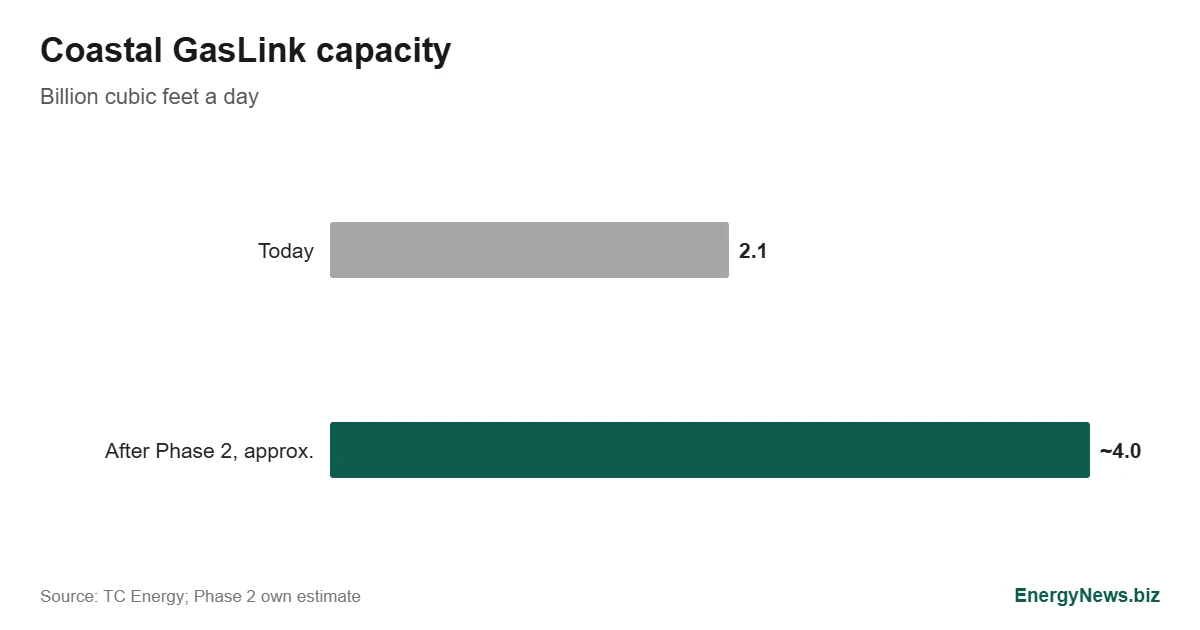
That is why Phase 2 matters. Shell, which leads LNG Canada, announced on 29 September a plan to double the terminal to 28 million tonnes a year. TC Energy says Coastal GasLink Phase 2 will nearly double system capacity, to roughly 4 Bcf/d on these figures, so pipeline and plant expansion would move together.
Why Indigenous ownership is spreading
Federal and provincial loan guarantees have made it possible for First Nations to buy into large energy assets without raising cash up front. Repayment comes from the dividends of the asset. For a regulated pipeline with long-term contracts, such as Coastal GasLink, cash flows are predictable, which suits that model. Canadian gas policy is moving in the same direction, as shown by Alberta’s bill to support new pipeline capacity.
The route was the scene of protests in 2019 and 2020, mainly by Wet’suwet’en hereditary chiefs who opposed the pipeline. The Wet’suwet’en First Nation, an elected band council, is among the 12 investors in this deal. Ownership by elected councils does not settle every governance question, but it gives communities a share of the income.
What Coastal GasLink means for Asian LNG buyers
LNG Canada ships to Asia across the Pacific in about two weeks, avoiding the Panama Canal and the Strait of Hormuz. With Middle East supply disrupted in 2026, that route has gained value for buyers in Japan, Korea and China. A stable pipeline with local ownership reduces one of the risks buyers price in for Canadian projects: opposition along the route. For Coastal GasLink owners, Indigenous partners also strengthen the case for permits on Phase 2.
What to watch
- The size of the combined Indigenous stake after both transactions, if TC Energy discloses it.
- A final investment decision on LNG Canada Phase 2 and Coastal GasLink Phase 2.
- Whether the remaining eight communities with Coastal GasLink agreements join a later round.
Add EnergyNews.biz as a preferred source on Google


