


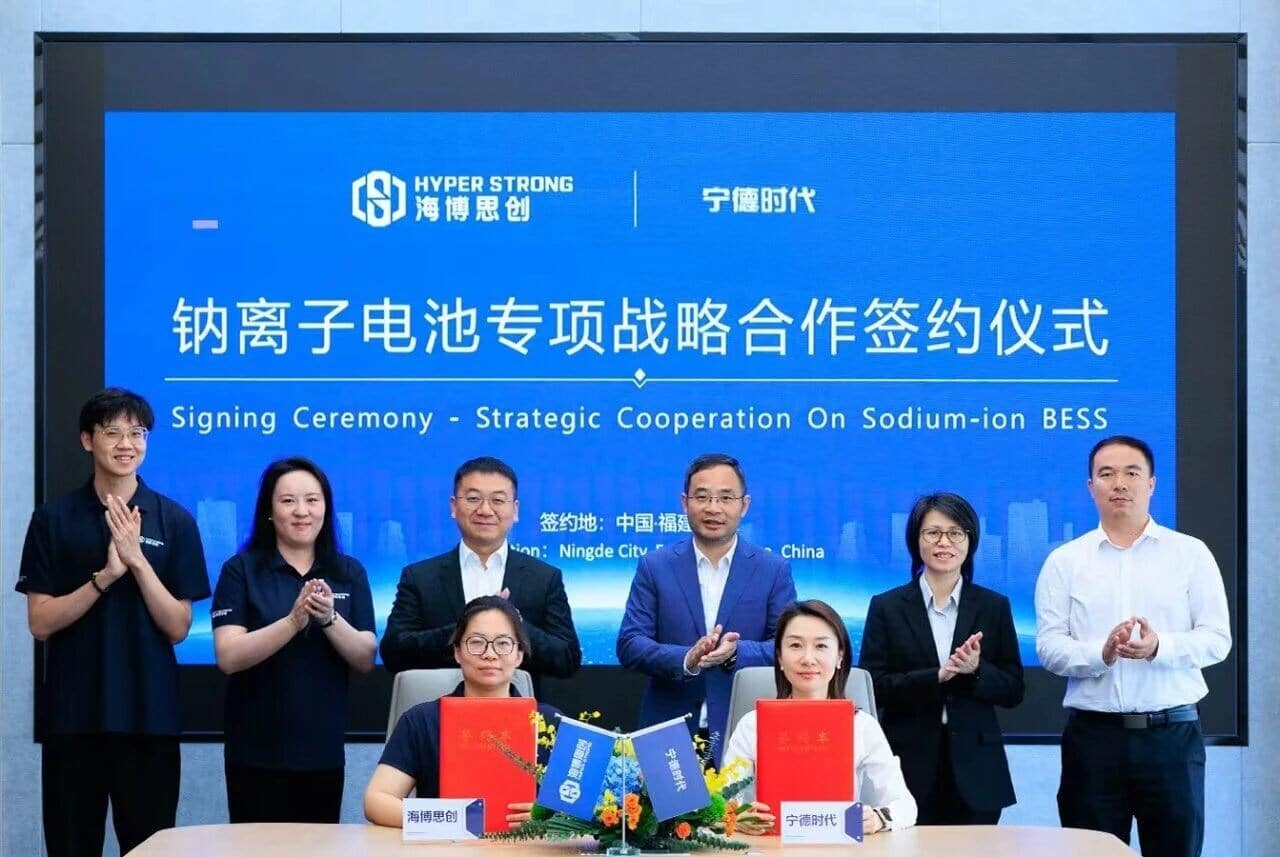


A 60 GWh supply agreement for sodium-ion batteries signals a shift in the global energy storage market, where reliance on lithium-based chemistries is increasingly being challenged by emerging alternatives. The three-year partnership between CATL and HyperStrong marks the largest sodium-ion battery deal announced to date, highlighting growing confidence in the technology’s readiness for large-scale deployment.
The agreement positions sodium-ion batteries as a viable option for grid-scale storage, particularly in applications where cost, safety, and resource availability are critical constraints. Unlike lithium-ion systems, which depend on materials such as lithium, cobalt, and nickel, sodium-ion batteries utilize more abundant and geographically diversified resources, potentially reducing supply chain risks and price volatility.
For CATL, the deal represents a transition from pilot-scale development to industrial-scale production. The company has focused on addressing key technical challenges that have historically limited sodium-ion adoption, particularly energy density and manufacturing consistency. Through material engineering approaches such as morphology control and surface modification, CATL has improved energy density metrics, narrowing the performance gap with lithium-ion systems while maintaining cost advantages.
Manufacturing scalability remains a central issue for any emerging battery chemistry. Sodium-ion production introduces distinct process challenges, including moisture sensitivity and material stability during electrode formation. CATL’s reported advances in pore size regulation and surface treatment are aimed at stabilizing production conditions and ensuring uniformity across large volumes, a prerequisite for utility-scale deployment.
The partnership with HyperStrong extends beyond supply, encompassing joint development in system integration and project deployment. This reflects a broader trend in the energy storage sector, where battery manufacturers and system integrators are increasingly collaborating to optimize performance at the plant level rather than focusing solely on cell-level innovation.
From a performance standpoint, sodium-ion batteries offer distinct advantages in specific use cases. Their ability to operate across a wider temperature range, combined with lower thermal risk and reduced expansion stress, makes them suitable for environments where lithium-ion systems may require additional thermal management. These characteristics can translate into lower system complexity and reduced auxiliary energy consumption, improving overall project economics in long-duration storage applications.
However, trade-offs remain. Even with recent improvements, sodium-ion batteries typically exhibit lower energy density than lithium-ion alternatives, which can limit their competitiveness in applications where space and weight are critical factors, such as electric vehicles. As a result, early adoption is expected to concentrate in stationary storage, where footprint constraints are less restrictive and cost per kilowatt-hour is a primary consideration.
A key factor supporting commercialization is compatibility with existing manufacturing infrastructure. CATL has designed its sodium-ion systems to share form factors with lithium-ion batteries, enabling integration into current production lines and reducing the need for extensive retooling. This approach lowers capital expenditure requirements and accelerates time to market, addressing one of the main barriers to scaling new battery chemistries.
The scale of the 60 GWh agreement suggests that sodium-ion technology is moving beyond demonstration projects into mainstream procurement strategies. For grid operators and developers, diversification of battery chemistries offers a hedge against material supply constraints and price fluctuations, particularly as global demand for energy storage continues to rise in parallel with renewable energy deployment.
At the system level, the integration of sodium-ion batteries could alter project design considerations. Lower heat generation and improved safety characteristics may reduce the need for complex cooling systems, while stable cycling performance at higher temperatures can expand deployment options in regions with challenging climates. These factors contribute to total cost of ownership rather than just upfront capital cost, which is becoming an increasingly important metric in storage project evaluation.
Add EnergyNews.biz as a preferred source on Google


