




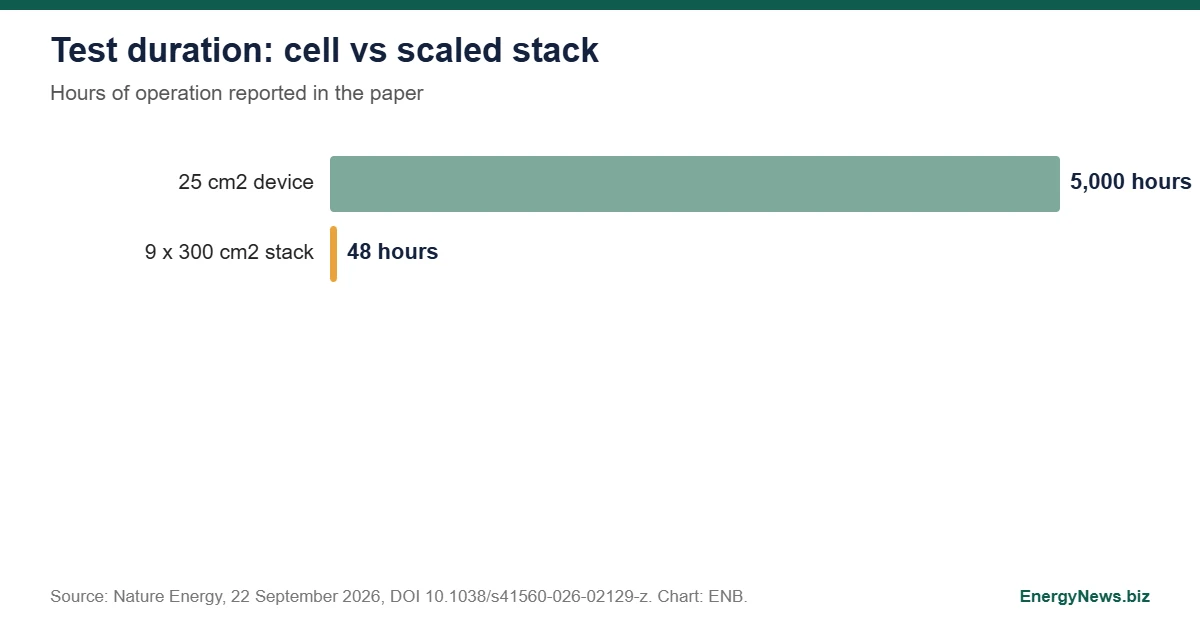
A battery style direct air capture cell has captured CO2 at 132 kJ per mole in a scaled stack, equal to 0.83 MWh per tonne of CO2, according to a paper published on 22 September 2026 in Nature Energy. The authors, including researchers at the University of Delaware Center for Clean Hydrogen, report a stack of nine 300 cm2 cells run for 48 hours at a flux of 0.19 mol CO2 per square metre per hour. The long durability result comes from a smaller 25 cm2 device tested for 5,000 hours.
How the cell works
The design uses a symmetric nickel hydroxide battery with a hydroxide exchange membrane, so both electrodes are the same material. ENB has read the published abstract and results summary, not the full methods, so the capture and release chemistry is not described here. The authors report that the stack meets a 300 Pa pressure drop target, which matters because moving air through a contactor is a major energy cost for any direct air capture system.
Reported results
| Metric | Result | Test |
|---|---|---|
| Energy per mole of CO2 | 132 kJ | Scaled stack, 48 hours |
| Energy per tonne of CO2 | 0.83 MWh | ENB conversion of 132 kJ per mole |
| CO2 flux | 0.19 mol per m2 per hour | Scaled stack, equal to 75 kg per m2 per year |
| Stack format | 9 cells of 300 cm2 | 2,700 cm2 total |
| Durability | 5,000 hours | 25 cm2 device |
| Cost pathway | below US$100 per tonne | Authors’ projection from learning rates |
What 1 million tonnes a year would need
ENB scaled the reported flux and energy to a plant that captures 1 million tonnes of CO2 a year, using the paper’s figures and no other assumption.
| Item | Value |
|---|---|
| Active area at 75 kg per m2 per year | about 13.3 km2 |
| Stacks of 0.27 m2 each | about 49 million |
| Electricity at 0.83 MWh per tonne | about 830 GWh per year |
| Equivalent continuous power | about 95 MW |
The arithmetic shows why the result is a lab milestone and not a plant design. Forty nine million stacks is a manufacturing problem on the scale of a battery industry, and the 95 MW of continuous power would need to be low carbon for the capture to count. The energy figure also covers the stack alone; compressing and conditioning the CO2 for storage would add to it.
Where the evidence stops
The scaled stack ran for 48 hours, against 5,000 hours for the small cell. Durability at the stack scale is therefore not yet shown, and fouling, membrane aging and humidity effects can appear only over longer runs. The sub US$100 per tonne figure rests on learning rates, which describe how costs fall with deployment, and no plant has been built to test them. A capture cost target matters because stored CO2 needs somewhere to go: ENB’s analysis of Poland’s CCS storage plan shows how far injection capacity can sit behind a resource estimate.
What to watch
The next tests to look for are a stack run of thousands of hours, results in real outdoor air with dust and humidity swings, and an independent measure of the full system energy. Those would move this from a promising cell to a candidate for a pilot.
Add EnergyNews.biz as a preferred source on Google


