


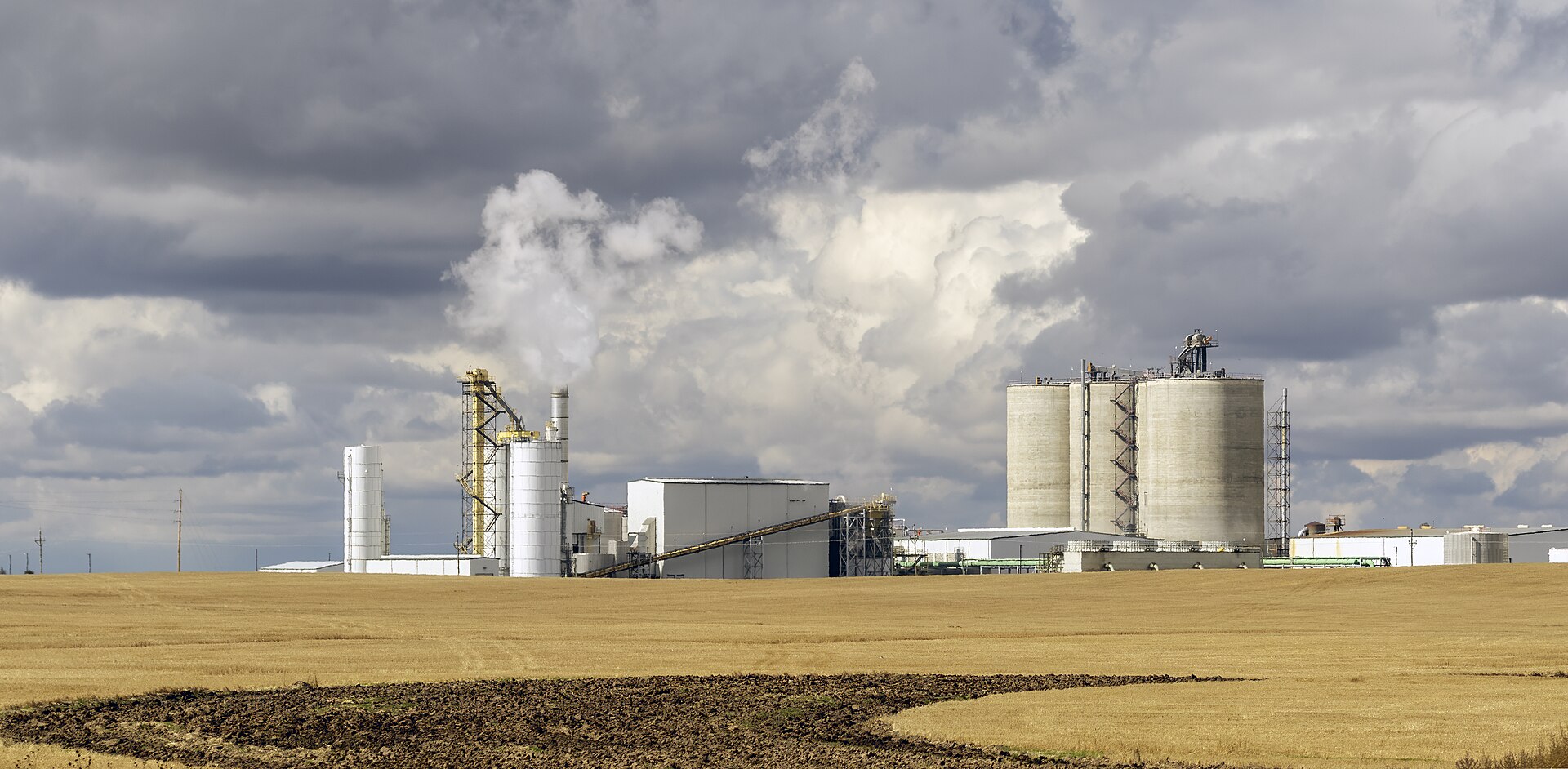


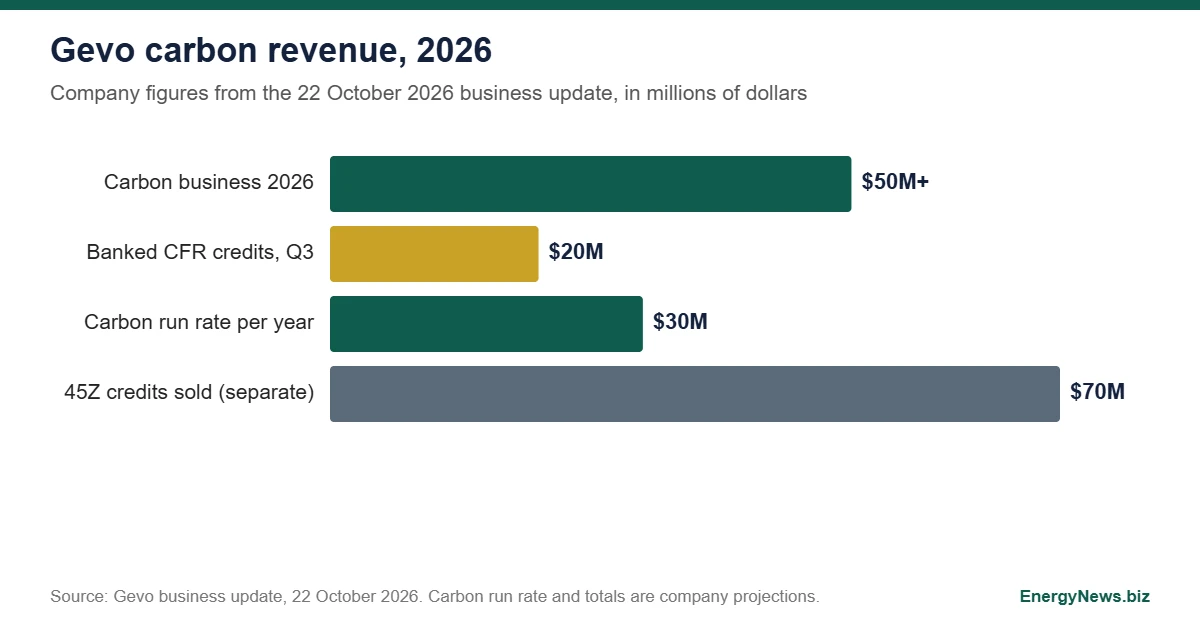
Gevo carbon revenue is projected to exceed $50 million in 2026, and $20 million of that is a one time sale of banked Canadian credits. The company said so in a business update on 22 October 2026. The remaining $30 million is described as an annual figure at current production rates and market conditions, which makes it a projection, not a result.
The headline is solid as a disclosure and thin as a trend. The two disclosed components, $20 million and $30 million, add to $50 million. Only one of them repeats, and only if production and prices hold. The $70 million of 2026 Section 45Z credits that Gevo has sold sits outside the figure. The chief executive, Paul Bloom, said carbon has real value in the marketplace independent of those tax credits. Both statements can be true at once, but they differ in kind: a tax credit is set by statute, a carbon attribute is set by a buyer.
What the Gevo carbon revenue figure is made of
The one time part comes from Canada’s Clean Fuel Regulation. Gevo sold essentially all credits banked from low carbon ethanol produced in 2025 and the first half of 2026, with the revenue expected in the third quarter of 2026. A bank of credits can be sold once. The $30 million a year excludes that bank and assumes the current production rate continues.
Several things are not disclosed: the split by quarter, the volumes and prices behind each stream, and how much of the $30 million run rate lands inside calendar 2026. The update names ClimeFi and CEEZER as intermediaries on spot and multi year deals, and Nasdaq and Whirlpool as carbon dioxide removal credit customers. Amgen and PayPal appear on Gevo’s registry through purchases made via intermediaries.
Gevo carbon revenue next to the 45Z sale
Set side by side, the picture changes. The 45Z sale of $70 million covers substantially all expected 2026 credits from renewable natural gas and low carbon ethanol. Together with $50 million of carbon revenue, the two streams come to $120 million, and carbon is 42% of it (50 divided by 120). Remove the banked Canadian credits and the recurring total is $100 million, of which carbon is 30% (30 divided by 100). The first number describes 2026. The second is the better guide to a year without a banked credit sale.
The delivery test for carbon removal credits
The update cites CDR.fyi for a sobering market figure: only about 3% of roughly 50 million contracted tonnes of carbon dioxide removal has been delivered. A contracted credit is not a delivered one, and a number of buyers on a registry is not revenue recognised.
Gevo’s growth case rests on North Dakota. A debottlenecking project adds 10% to 15% to ethanol capacity and carbon capture, with completion expected in the fourth quarter of 2026. A larger expansion would take ethanol output to 150 million gallons a year and store over 400,000 tons of CO2 annually. Gevo expects a final investment decision in the fourth quarter of 2026 and completion in 2028, and says the expansion could roughly double revenue from fuels, coproducts and carbon. It makes that conditional on market conditions and on the availability of pathways to monetise carbon attributes. Geological storage is the constraint that decides such plans, as the Poland CCS resource and injection figures show for a European case.
Two dated checks follow. Third quarter results should show whether the $20 million of Canadian credit revenue was recognised as stated. The fourth quarter investment decision on North Dakota is the next test of whether Gevo carbon revenue becomes a repeating line, or stays a one year number. Source: Gevo business update, 22 October 2026.
Add EnergyNews.biz as a preferred source on Google


