




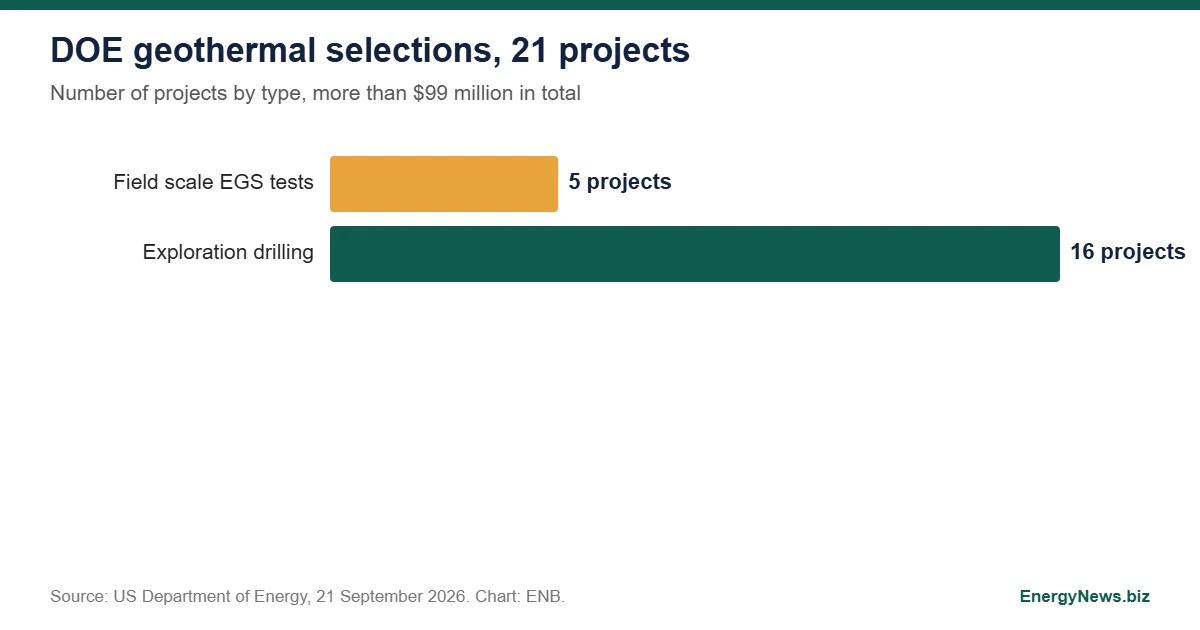
The US Department of Energy announced on 21 September 2026 that it has selected 21 projects to receive more than $99 million for geothermal work: five field scale tests of enhanced geothermal systems (EGS) and 16 exploration drilling projects. That is an average of about $4.7 million per project, an ENB calculation. Selection is not a commitment, and DOE says negotiations may be cancelled.
What was selected
The two groups do different jobs. The five EGS field tests put engineered reservoirs under real conditions, where flow rates, thermal decline and induced seismicity can be measured. The 16 exploration projects drill to find and characterize resources, which is the cheaper step that decides where a later plant can be sited. Data from the projects will go to the public Geothermal Data Repository, so the results can be reused by developers who did not receive funds.
The numbers
| Item | Value | Basis |
|---|---|---|
| Total selected funding | more than $99 million | DOE announcement, 21 September 2026 |
| Projects | 21 | DOE |
| Field scale EGS tests | 5 | DOE |
| Exploration drilling projects | 16 | DOE |
| Average per project | about $4.7 million | ENB: $99 million divided by 21 |
The announcement summary does not split the money between the two groups, so ENB does not estimate a cost per EGS test. Averages hide a wide range: a field scale test with wells and monitoring costs far more than a single exploration hole, and the true per project figures will only be known once negotiations conclude.
Why data matters more than dollars here
Geothermal developers carry most of their risk in the subsurface, before a plant exists. Public drilling data lowers that risk for the next developer because it shows temperature, permeability and flow at depth. ENB’s analysis of the Cape Station geothermal plant shows why: 33 MW net implies wells that must sustain flows near 100 kg/s, and a finding like that depends entirely on what the wells actually deliver.
What to watch
Three things will tell how much this changes the market. The first is how many of the 21 selections convert into signed awards. The second is how quickly data reaches the repository after drilling, since a repository with long delays helps no one. The third is whether the EGS field tests report flow and decline figures that other projects can test against. Until awards are signed, the $99 million is an intention rather than spending.
Add EnergyNews.biz as a preferred source on Google


