




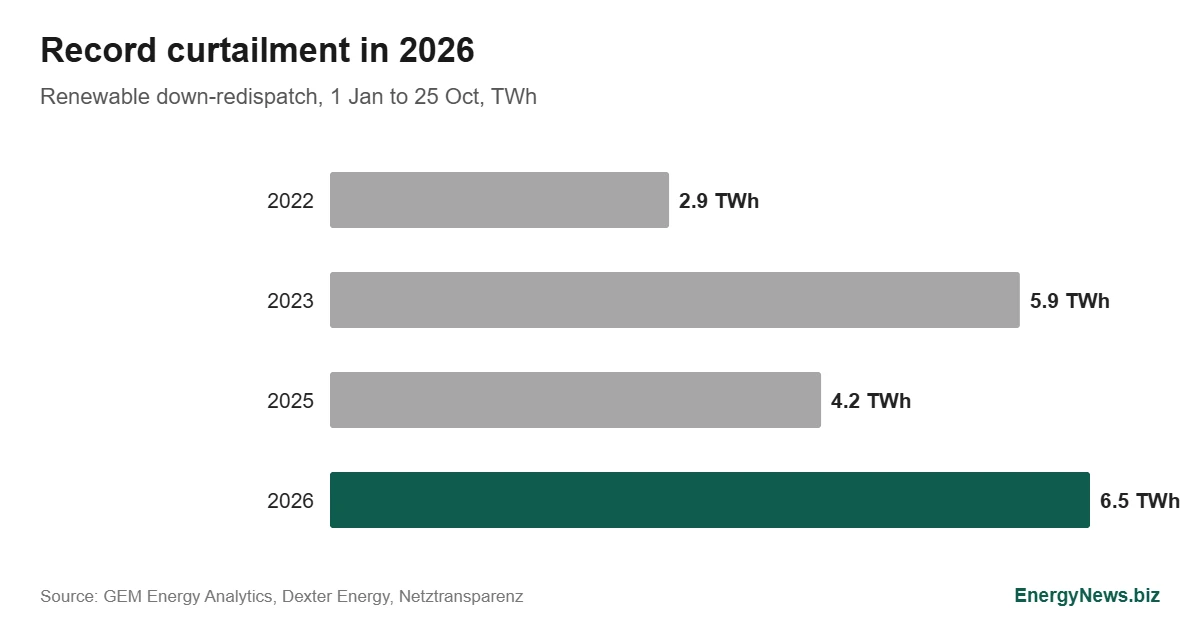
Germany redispatch volumes have reached a new record. From 1 January to 25 October 2026, grid operators curtailed 6.5 TWh of renewable generation reported on Netztransparenz, the joint data platform of the four German transmission system operators. That is ahead of the previous high of 5.9 TWh in 2023, well above 4.2 TWh in 2025 and more than twice the 2.9 TWh of 2022. The figures come from a joint analysis by GEM Energy Analytics and Roy van den Kieboom of Dexter Energy.
The number of measures tells the same story: 5,616 so far this year, 16% more than in 2025 and more than three times the 2022 count. The useful finding for anyone with a solar park, a battery or a trading book is not the record itself. It is what happens to prices when curtailed power is not replaced, and that is where Germany redispatch turns into a trading signal.
How Germany redispatch works
Germany and Luxembourg form one bidding zone. The day-ahead market clears as if power could flow freely across the whole country, but much new generation sits in the north while demand is concentrated in the south and west. When the market result would overload lines, grid operators cut output behind the bottleneck and raise output on the other side. Since Redispatch 2.0, solar, wind and storage installations from 100 kW are part of this process.
The curtailed park is paid, but the energy it already sold day-ahead still has to be delivered by someone. Since December 2025, grid operators pay plant operators directly, using a fixed price mix: 72.5% of the intraday price in the last hour before delivery and 27.5% of the imbalance price. The formula assumes most of the missing energy is bought back intraday. In large, late Germany redispatch events, more of it ends up in imbalance than the formula expects.
The real total is larger
Netztransparenz does not capture all curtailment. Measured against Bundesnetzagentur totals for 2025, it covers about 59% of renewable curtailment, close to all of offshore but only around a fifth of solar. Scaling 6.5 TWh by that coverage gives an estimate of roughly 11 TWh of total renewable curtailment in the first ten months of 2026. Annualised, Germany redispatch of renewables is on course for something in the region of 13 TWh this year.
The gap, not the volume, moves prices
On average, redispatch has only a small effect on imbalance prices. The picture changes when down-redispatch is larger than up-redispatch. In quarter-hours with little redispatch, the imbalance price differs from the day-ahead price by more than €100 per MWh about 7% of the time. When curtailment exceeds the replacement by more than 3 GW, that share rises to 28%, about four times more often. The average imbalance premium in those hours is about €65 per MWh, and the effect stays at about €55 after removing normal patterns by month and hour.
21 September in numbers
The largest day of 2026 shows the risk. At 08:00 on 21 September, curtailment jumped to 16 GW as solar was added to wind already cut overnight, while up-redispatch stayed near 6.9 GW. That left a 9.1 GW gap. At 08:15 the imbalance price hit €1,554 per MWh, against €195 day-ahead and €470 in the last hour of intraday trading.
A simple calculation shows what that means. Covering 9.1 GW for one quarter-hour is about 2,275 MWh. At the imbalance price, the premium over day-ahead was about €1,359 per MWh, or roughly €3.1 million for those fifteen minutes if all of it had landed in imbalance. The compensation formula at those prices works out at about €768 per MWh, half the imbalance price. A park that had to buy back late, at imbalance, would have recovered only about half its replacement cost.
Why Germany redispatch will keep growing
Solar reached 117 GW at the end of 2025 and needs about 20 GW a year to hit 215 GW by 2030. The big north to south HVDC links only start operating from 2027 and 2028, and the government rejected a split of the bidding zone in October 2025. Until the grid catches up, Germany redispatch remains the main congestion tool, and flexible demand in the north, such as electrolysers supplying steel plants, will be valued for soaking up power that would otherwise be curtailed.
The number to watch
The number to watch is the unreplaced gap in gigawatts on high-solar mornings. When it passes 3 GW, the odds of a large imbalance spike quadruple. Battery owners and traders who can read Germany redispatch data and see that gap early will be paid for it; solar parks that cannot will carry the cost.
Add EnergyNews.biz as a preferred source on Google


