




Of the nearly 9 trillion won that Hyundai Motor Group has committed to Saemangeum, 1 trillion won, about 11 percent, goes to a 200 MW water electrolysis plant, and 5.8 trillion won, about 65 percent, goes to an AI data center. That split is the context missing from the symposium that Jeonju city held on 12 October 2026 to work out what the investment means for its hydrogen industry.
A symposium with no number for Jeonju
About 100 people from industry, universities and research institutes met at the Jeonbuk Tech Biz Center for the 2026 Jeonju Hydrogen Industry Symposium. The keynote came from Kim Jin-hu, head of the robot and hydrogen promotion team at the Saemangeum Development and Investment Agency, who spoke on Hyundai’s 9 trillion won investment and the future of Jeonbuk. Lee Ji-hoon of the Jeonbuk Research Institute presented a response for Jeonju under the national balanced growth strategy, and Kim Myung-hwan of the Korea Automotive Technology Institute covered hydrogen mobility. A panel that included a Hyundai Motor business planning manager discussed how to build the city’s hydrogen sector.
The participants agreed that Saemangeum’s green hydrogen production base should be tied to Jeonju’s research and industrial infrastructure and to hydrogen mobility, and the city said it will pursue industry support, company links and wider household use of hydrogen. The report of the event gives no budget for the city, no tonnage and no dates. What it does establish is that a municipal strategy is being built on an investment whose composition the discussion did not break down.
5.8 trillion won for compute, 1 trillion won for 200 MW
Hyundai announced the Saemangeum hub on 26 February 2026 under an agreement with the government and Jeonbuk State, as part of its 125.2 trillion won domestic investment plan. The components are an AI data center of 5.8 trillion won, designed to scale to as many as 50,000 GPUs, a 200 MW electrolysis plant of 1 trillion won, solar power of 1.3 trillion won, a robotics manufacturing cluster of 400 billion won and an AI hydrogen smart city of 400 billion won. They add up to 8.9 trillion won, which is the nearly 9 trillion in the headline.
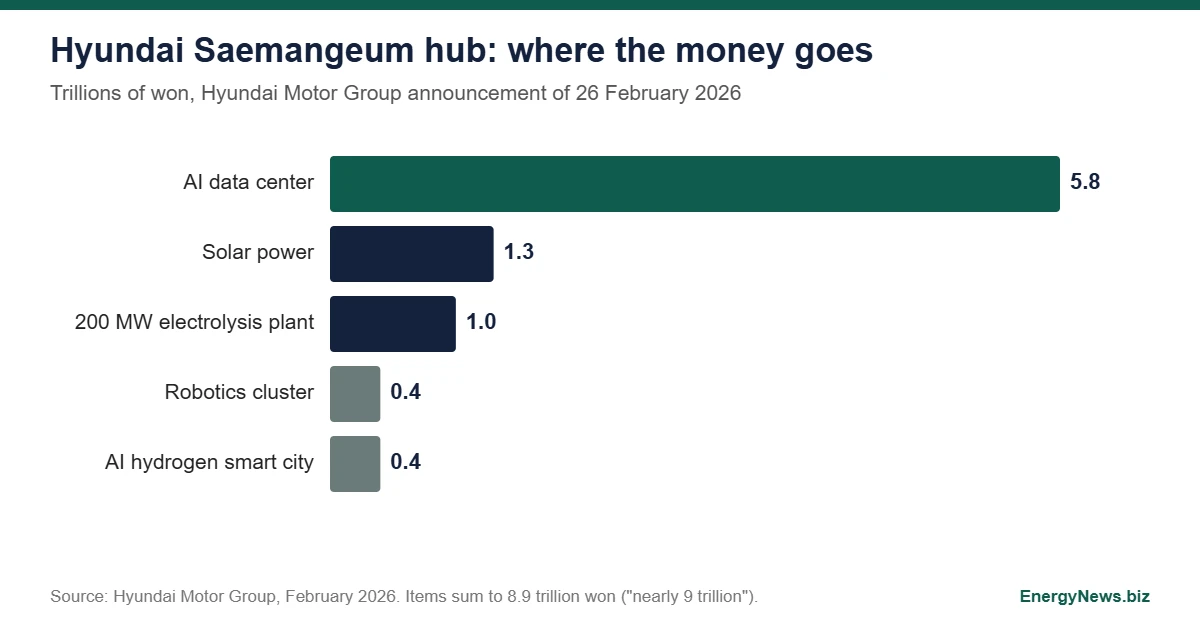
Hyundai estimates the hub will generate 16 trillion won in economic impact and about 71,000 jobs across direct, indirect and induced employment. Those are the group’s own estimates, and the induced share is the part that cannot be checked from the announcement. The hydrogen content that can be traced to a figure is the electrolysis plant at 1 trillion won, plus a share of the solar budget and of the smart city, so the hydrogen sector Jeonju is planning for is a minority of the money.
Solar by 2029 or gigawatts by 2035
The solar budget serves two loads. Hyundai says the AI data center and the solar facilities will break ground in 2027 and reach completion by 2029, and the group has said it will gradually secure a gigawatt scale solar portfolio by 2035 as the main energy source for the data center and the electrolysis plant. The two dates are not the same, and the announcement material read for this article gives no commissioning date for the electrolysis plant. If the data center reaches full load in 2029 while the solar portfolio is still being built toward 2035, the electrolyser competes with the data center for renewable supply during those years.
The group’s hydrogen manufacturing is also located elsewhere. Hyundai says it has already started construction of its Ulsan Fuel Cell Plant, which makes PEM electrolyzers and fuel cell components, with completion targeted for 2027. The announcement material does not say where the electrolysers for the 200 MW plant will be made, and the local content for Jeonju is a question the symposium report does not answer.
Five poles, three special regions, and the missing money
The policy frame is the government’s five poles and three special regions strategy, which reorganizes the country into five mega regions, Greater Seoul, the Southeast, Daegu and Gyeongbuk, the Central region and Honam, and three special self governing provinces, Gangwon, Jeonbuk and Jeju. The trade ministry held its first forum under the strategy in Gwangju on 10 June 2026 and scheduled a Jeonbuk forum for 26 June. Policy documents describe the special provinces as getting expanded autonomy and fiscal support, and a Korean research body notes that Jeonbuk and Gangwon were launched as two tier systems with basic local governments.
The test for Jeonju is concrete and dated. The 2027 groundbreaking of the data center and solar facilities, the 2027 completion target of the Ulsan plant and the unannounced commissioning date of the electrolysis plant are the three points at which a city level hydrogen plan will meet the hub’s real schedule. A comparable project elsewhere shows how dates drift: BMW’s Leipzig hydrogen link moved from mid 2027 to the first half of 2028. Sources: report of the Jeonju hydrogen symposium of 12 October 2026; Hyundai Motor Group announcement of the Saemangeum investment, February 2026; Ministry of Trade, Industry and Energy forum of 10 June 2026; Korea National Research Council for Economics, Humanities and Social Sciences on the five poles three special regions strategy.
Add EnergyNews.biz as a preferred source on Google


