





A lithium-sulfur cell described in Nature Energy on 10 September 2026 runs at 2.54 V instead of the conventional 2.05 V and draws three electrons from each sulfur atom instead of two. It also keeps 78% of its capacity after 100 cycles, according to the university summary of the work. The headline energy figure, above 1,700 Wh/kg at electrode level, cannot be reconciled with sulfur mass alone, and the team’s own stack-level estimate is 477 Wh/kg. That estimate comes from a single-layer pouch cell with lithium metal and excess electrolyte. The distance between those numbers is what matters for anyone planning around lithium-sulfur.
What the Nature Energy paper reports
The paper, “Lithium-disulfur dichloride batteries” (Nature Energy, volume 11, issue 9, pages 1297 to 1306, DOI 10.1038/s41560-026-02120-8), was received on 29 May 2025 and accepted on 9 July 2026. It comes from a team at the University of Maryland with partners including Vanderbilt University and Brookhaven National Laboratory. The article is behind a subscription, so the figures here come from its abstract page and the university summary. The abstract page gives these results, all at 25 °C and a 0.2C rate: operating voltage raised from 2.05 V to 2.54 V, sulfur-specific capacity up 58%, electrode-level specific energy above 1,700 Wh/kg, and more than 100 cycles.
The mechanism is a three-electron sulfur redox reaction that reversibly converts Li2S to S2Cl2, which takes sulfur to the +1 oxidation state. It relies on a free-chloride-rich ionic liquid electrolyte that acts as an ionic mediator. The authors present it as a fix for three known weaknesses of lithium-sulfur: low voltage, slow redox kinetics and polysulfide shuttling.
Vanderbilt’s summary, published on 22 September 2026, adds three numbers that the abstract page does not carry: 78% capacity retention after 100 cycles, an estimated stack-level specific energy of 477 Wh/kg described as 37% above conventional lithium-sulfur, and a list of limits. The cell uses a lithium-metal electrode, a modest amount of sulfur and excess electrolyte relative to commercial requirements, and was built as a single-layer pouch cell. The summary calls it an early-stage demonstration.
Is the 3-electron chemistry plausible from first principles?
Yes, and the arithmetic is simple. Taking sulfur from Li2S (oxidation state minus 2) to S2Cl2 (plus 1) moves three electrons per sulfur atom. With a Faraday constant of 26,801 mAh per mole of electrons and a sulfur atomic mass of 32.06 g/mol, the theoretical capacity is 3 x 26,801 / 32.06 = 2,508 mAh per gram of sulfur. The familiar two-electron route gives 1,675 mAh/g, so the theoretical gain is 50%. The reported 58% is therefore measured against the authors’ own experimental baseline, not against theory, because 1.58 x 1,675 would be 2,647 mAh/g, above the ceiling.
Voltage and capacity combine. The voltage gain is 2.54 / 2.05 = 1.24, or 24%, which matches the paper. Multiplying 1.58 by 1.24 gives about 1.96, so on a sulfur-mass basis the cathode reaction delivers close to twice the energy of the conventional one.
Why 1,700 Wh/kg needs a basis check
If 1,700 Wh/kg were calculated on sulfur mass alone at 2.54 V, it would imply 1,700 / 2.54 = 669 mAh per gram of sulfur. That is 27% of the 2,508 mAh/g theoretical value and far below the 1,000 to 1,500 mAh/g reversible capacity range that a 2025 benchmarking study (Nature Communications, DOI 10.1038/s41467-025-60528-4) found for practical lithium-sulfur cells. At the theoretical capacity, the same voltage would give 2,508 x 2.54 = 6,370 Wh per kilogram of sulfur.
So the 1,700 figure must include more mass than sulfur, probably the carbon host and other electrode components, and the university describes it as sulfur alone. The abstract page says electrode level. The open pages do not settle which is right, and the sulfur loading and electrolyte-to-sulfur ratio, which would decide it, are not visible without the full text. Treat 1,700 Wh/kg as a cathode-level metric, not a cell figure. The same gap between a lab number and a usable cell is the theme of ENB’s piece on how lithium-metal batteries are being validated on the wrong clock.
From cathode to stack: where the gain shrinks
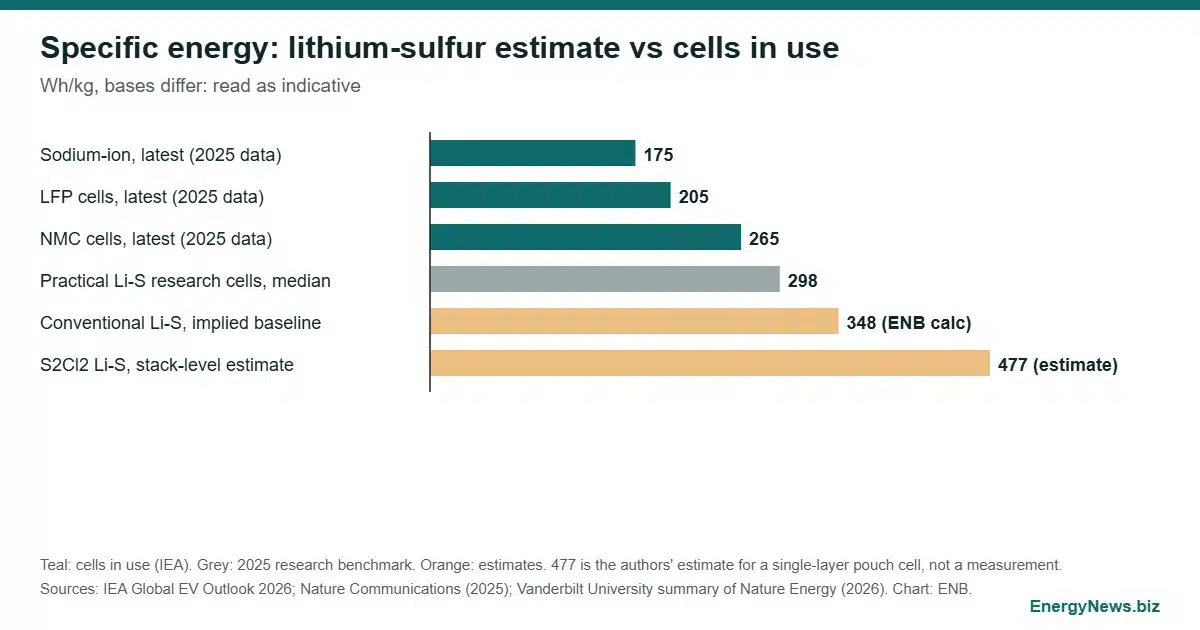
The stack-level estimate shows the dilution. The arithmetic above gives a roughly 96% energy gain at the cathode reaction, while the team’s stack-level estimate is 37%. Dividing 477 Wh/kg by 1.37 implies a conventional lithium-sulfur baseline of about 348 Wh/kg on the same basis. Lithium metal, electrolyte, current collectors and packaging carry mass whatever the cathode does.
| Figure | Value | Basis and year |
|---|---|---|
| Operating voltage | 2.54 V (was 2.05 V) | Paper, 25 °C, 0.2C, 2026 |
| Sulfur-specific capacity | +58% | Paper, against authors’ baseline |
| Specific energy, electrode level | above 1,700 Wh/kg | Paper abstract page, 2026 |
| Specific energy, stack level, estimated | 477 Wh/kg (+37%) | University summary, 2026 |
| Capacity retention | 78% after 100 cycles | University summary, 2026 |
| Practical lithium-sulfur research cells, median | 298 Wh/kg | 866 plots from 184 articles, loading above 4 mg/cm2, E/S below 5 µl/mg, 2025 |
| NMC cells, latest generation | up to 265 Wh/kg | IEA Global EV Outlook 2026, 2025 data |
| LFP cells, latest generation | up to 205 Wh/kg | IEA Global EV Outlook 2026, 2025 data |
Read against the table, 477 Wh/kg is 1.8 times the IEA’s NMC figure and 1.6 times the benchmark median for lean-electrolyte lithium-sulfur research cells. Neither ratio is clean. The bases may differ, the demonstration cell carries excess electrolyte, and the stack-level number is the team’s estimate, not a measurement.
Lithium-sulfur cycle life arithmetic
Retention of 78% after 100 cycles is a loss of 0.22 percentage points per cycle on average. Applied as a constant geometric rate, 0.78 to the power of 1/100 gives 99.75% retained per cycle, and the cell would cross 80% retention at about cycle 90 and fall to roughly 8% by cycle 1,000 (0.78 to the power of 10). That extrapolation is illustrative only, because fade is rarely constant, and it should not be read as a prediction. It does show how short 100 cycles is against any multi-year service life. The accessible sources give no figure for calendar life, low-temperature operation or rate capability beyond 0.2C.
How far from market is the S2Cl2 cell?
Far. The chemistry reaches a new operating point, and that is a real result, since voltage is the lever lithium-sulfur has lacked. But three conditions in the demonstration stand between it and a product: a lithium-metal anode, excess electrolyte and a single-layer format. The ionic liquid electrolyte also has to be costed, and chloride species that bind lithium and halogen-mediated reactions that consume electrolyte are the problems the paper itself names as the reason high-valence sulfur chemistry has been hard.
The commercial reference is not static. The IEA reports that the latest NMC cells reach up to 265 Wh/kg and LFP up to 205 Wh/kg, with sodium-ion up to 175 Wh/kg, and those are the cells a new chemistry has to beat. For the nearer-term rival, see ENB’s analysis of sodium-ion batteries moving toward the mainstream. For the S2Cl2 cell to matter, it has to show its stack-level advantage with lean electrolyte, high sulfur loading and a lithium-metal anode that survives well beyond 100 cycles.
The next evidence to look for is the supplementary data and any follow-up on multilayer pouch cells: sulfur loading in mg/cm2, electrolyte-to-sulfur ratio in microlitres per milligram, lithium excess, and capacity retention past 500 cycles. Until those appear, the 477 Wh/kg estimate stays a projection.
Add EnergyNews.biz as a preferred source on Google


