


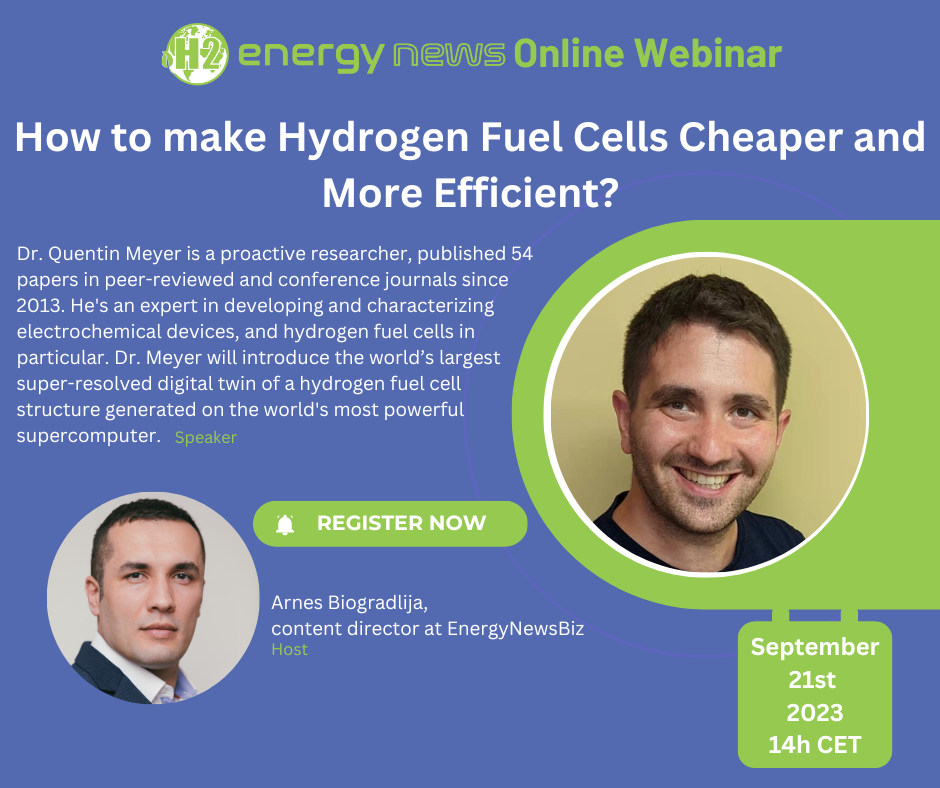


Title of Webinar: How to Make Hydrogen Fuel Cells Cheaper and More Efficient?
Topic of Webinar: A research perspective on how to make hydrogen fuel cells cheaper and more efficient.
YouTube Link
Description of Webinar: Low-cost, high-performance, and durable hydrogen fuel cells are crucial for the success of the global hydrogen economy and Australia’s hydrogen roadmap. However, their large-scale commercialization is hindered by their high costs and less than satisfactory efficiency. Hydrogen fuel cells currently rely on costly platinum to generate electricity, with a lot of active research on alternative materials using iron, manganese, and cobalt. While iron-nitrogen-carbon catalysts are very promising replacements for platinum, its hydrogen fuel cells’ durability (<300 hours) is much lower than platinum (10 to 20,000 hours), suggesting complex device-level challenges. Dr. Meyer’s work will provide an overview of these challenges, focusing on how to capture them in real devices, with key findings recently published in Energy & Environmental Science in July 2023. Finally, Dr. Meyer will introduce the world’s largest super-resolved digital twin of a hydrogen fuel cell structure generated on the world’s most powerful supercomputer. This model allows the visualization of large-scale (> 16 mm2) water transport using Lattice-Boltzmann simulations. These ground-breaking findings were published in Nature Communications in February 2023. This model will be crucial to further optimize the gas diffusion electrode and flow field structure to improve hydrogen fuel cells’ performances.
Add EnergyNews.biz as a preferred source on Google


