


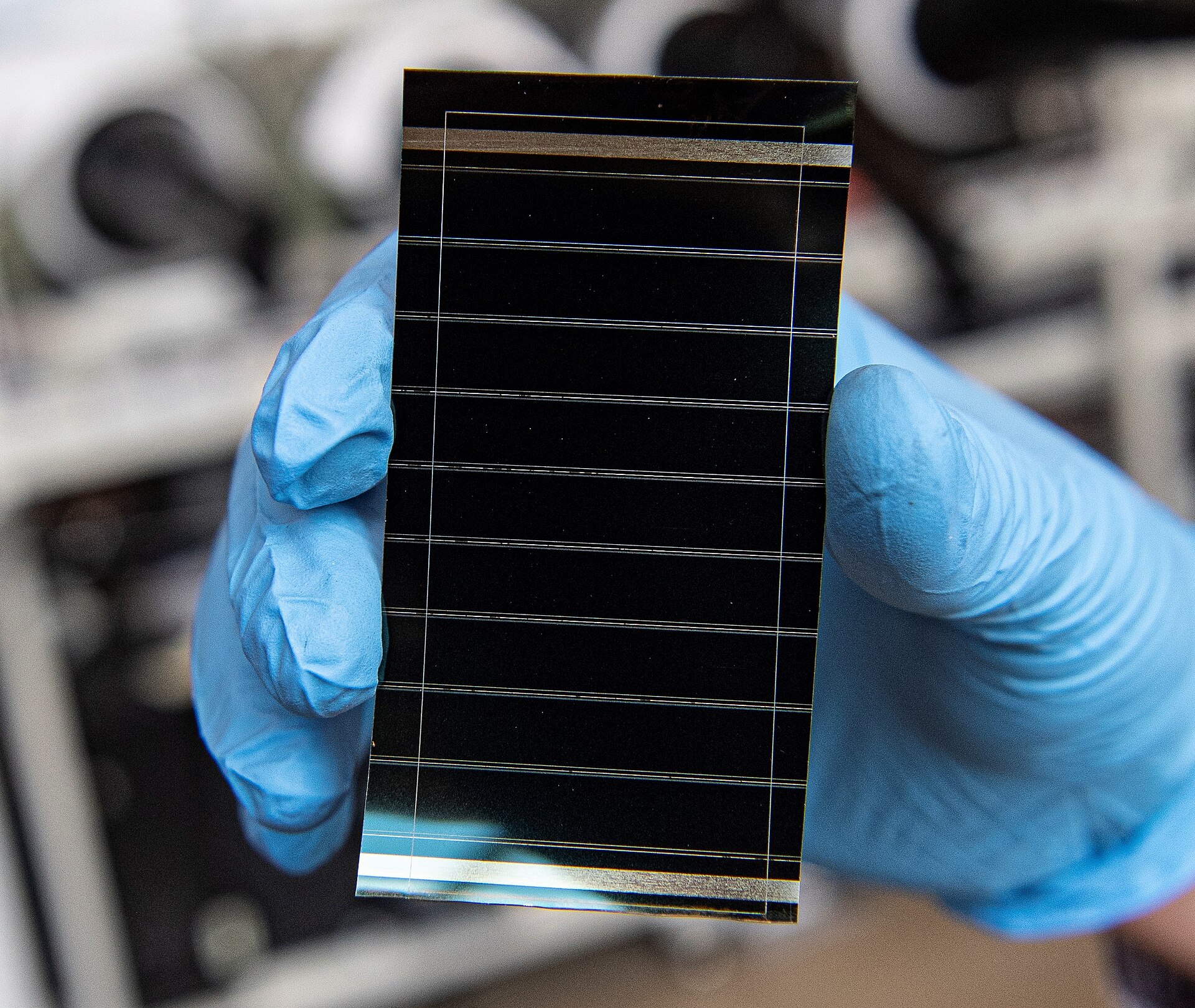


JinkoSolar has announced a certified conversion efficiency of 35.24% for a perovskite tandem cell built on its n-type TOPCon technology. The result was confirmed by the Shanghai Institute of Microsystem and Information Technology of the Chinese Academy of Sciences, the same body that certified the company’s 34.82% result in June. JinkoSolar says it is the 34th time it has set a record for cell efficiency or module power.
Perovskite tandem records like this arrive often, and it is easy to treat each one as a headline and move on. Lining them up gives a more useful picture: how fast the technology is improving, and how far it still is from the panels that developers actually buy.
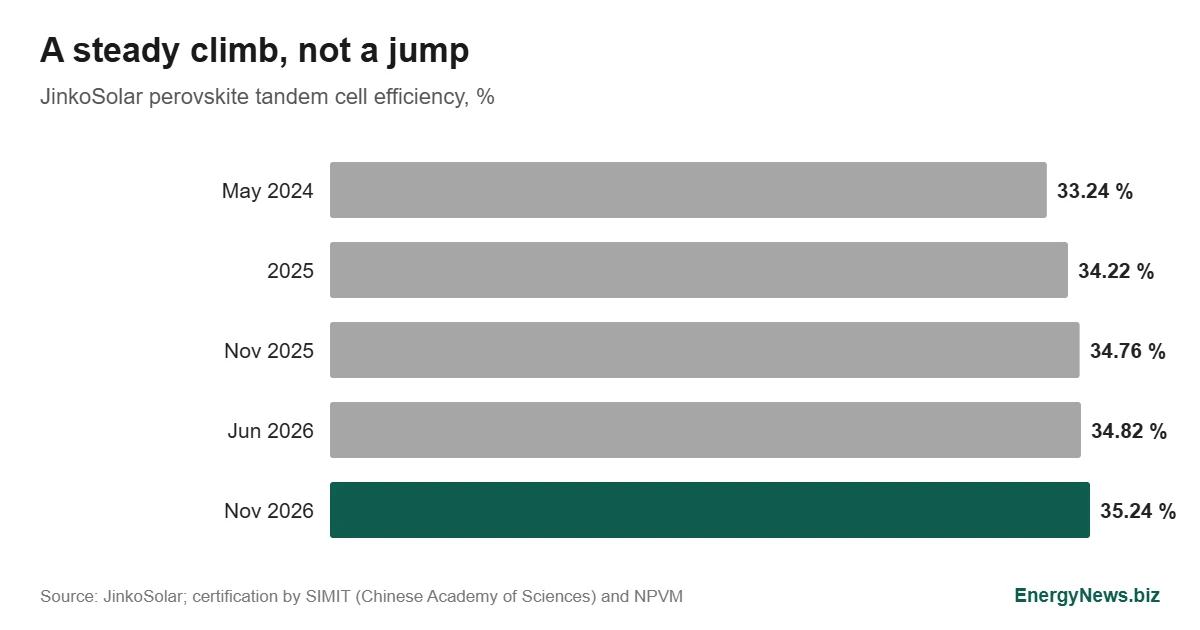
The perovskite tandem timeline
In May 2024 JinkoSolar reported 33.24% for a tandem cell with a TOPCon bottom layer. It then moved to 34.22%, and in November 2025 to 34.76%, certified by China’s National PV Metrology and Testing Centre. In June 2026 it reached 34.82%, and now 35.24%.
From 33.24% to 35.24% is a gain of exactly 2 percentage points in about 30 months, or about 0.8 points a year. The latest step added 0.42 points in five months, which is close to one point a year if annualised. That is steady progress, not a sudden breakthrough. Compared with the 0.06 point gain between November 2025 and June 2026, the latest step is seven times larger, which suggests the new passivation work has opened a fresh round of improvement. The company credits selective passivation on textured silicon, better control of how the perovskite layer crystallises, and new interface materials that reduce losses where the two layers meet.
JinkoSolar is not alone. LONGi reported 34.85% for a perovskite tandem cell in April 2025, and IndexBox reports that LONGi now holds a higher result of 35.5%. The perovskite tandem race between the two largest Chinese manufacturers is now measured in tenths of a percentage point.
What 35% means against silicon
The best single-junction TOPCon cell JinkoSolar has reported reached 27.79%. Comparing the two lab results, the tandem cell converts about 27% more of the sunlight that falls on the same area into electricity. Single-junction silicon has a practical ceiling of about 29.4% for this cell type, so the industry has little room left without adding a second layer. That is why every major manufacturer runs a tandem programme.
For a buyer, more power per square metre matters most where land, roof space or installation labour is expensive. A module that delivers a quarter more electricity from the same footprint cuts the number of panels, racks and cables needed for a given capacity. In markets with high labour costs, those balance of system savings can be worth more than the module price itself.
Why perovskite tandem panels are not here yet
Lab cells are small, and the records apply to cells, not to full modules. Scaling the same structure to a module of about two square metres, producing it at gigawatt volumes and keeping it stable for 25 or 30 years outdoors are three separate problems. Durability is the hardest. Perovskite materials can degrade with heat, moisture and light, and the industry has not yet shown long field records for large tandem modules.
That is why developers should treat these records as a guide to the direction of the market, not to their next purchase order. Module prices are also being reshaped by trade policy, such as the US policy shifts that followed the BAAJA vote in the Senate.
What to watch
The next milestone that matters is not another cell record. It is the first certified full-size perovskite tandem module with published degradation data from independent testing, offered with a bankable warranty. The number to watch is module efficiency on a commercial format above 26%, which would put tandem clearly ahead of today’s best TOPCon panels. Certified results are listed by research institutes, and the underlying cell data is collected in NREL’s efficiency chart.
Add EnergyNews.biz as a preferred source on Google


