





Researchers at the Dalian Institute of Chemical Physics, Chinese Academy of Sciences, report a seawater hydrogen system that uses waste heat from alkaline electrolysis to drive low temperature desalination. In a paper published on 15 September 2026 in Nature Energy, the team says a 250 kW unit made 48 normal cubic metres of hydrogen an hour and 31.6 kg of fresh water an hour, with system electrical efficiency 14.4% above a freshwater alkaline electrolyser. ENB checked the water numbers against basic stoichiometry and found a question the abstract leaves open.
What was built and tested
The design couples alkaline electrolysis with desalination that runs on the heat the electrolyser would otherwise reject, so the seawater feed is purified without a separate energy supply. The authors ran a 20 kW pilot and a 250 kW unit. The paper’s techno-economic analysis concludes the integrated system is more profitable than a tandem arrangement of a standalone desalination plant followed by an electrolyser.
| Scale | Hydrogen | Fresh water | Other result |
|---|---|---|---|
| 20 kW pilot | 3.8 Nm3 per hour | 1.2 kg per hour | Stable for 100 days |
| 250 kW unit | 48 Nm3 per hour | 31.6 kg per hour | System electrical efficiency up 14.4% |
The water balance question
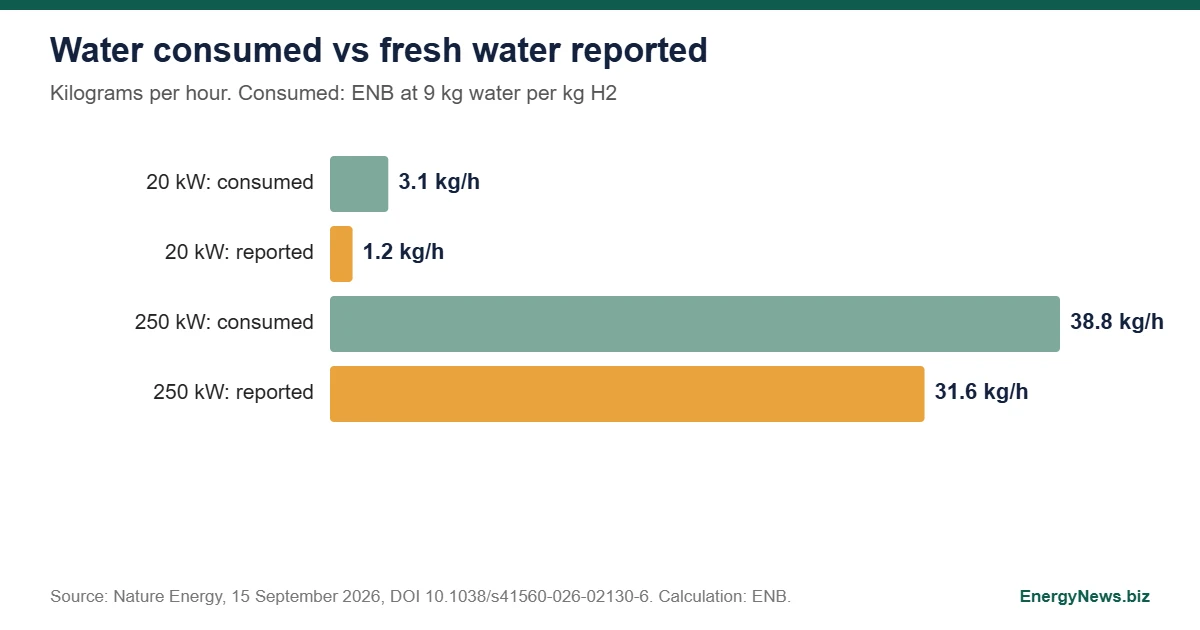
Splitting water takes 9 kg of water for each kilogram of hydrogen (18 divided by 2). At a hydrogen density of 0.0899 kg per Nm3, ENB converts the reported hydrogen output to mass and works out the water the electrolysis itself consumes.
| Scale | Hydrogen, kg per hour | Water consumed, kg per hour | Fresh water reported, kg per hour | Reported as share of consumed |
|---|---|---|---|---|
| 20 kW pilot | 0.34 | 3.1 | 1.2 | about 39% |
| 250 kW unit | 4.3 | 38.8 | 31.6 | about 81% |
On those numbers the reported fresh water covers 39% of the electrolysis demand at pilot scale and 81% at 250 kW. The abstract does not say whether the fresh water figure is gross production, net surplus after the electrolyser, or measured over a different interval. Until the full paper is read against these figures, ENB cannot say whether the system is water self sufficient. The rising share with scale is a promising direction, not a finding.
Why waste heat is the point
Alkaline electrolysers convert part of their input to heat, and in a conventional plant that heat is lost. Desalination that runs at low temperature can use it, which removes one of the energy costs that seawater routes usually add. The reported 14.4% gain in system electrical efficiency, measured against a freshwater alkaline electrolyser, is the paper’s headline for this effect.
Limits
The tests are small. A 250 kW unit makes about 4.3 kg of hydrogen an hour, roughly 100 kg a day if run continuously, while projects planned in the hundreds of megawatts are three orders of magnitude larger. The 100 day stability test is at the 20 kW scale, and the abstract gives no long run for the 250 kW unit. Salt management, membrane fouling and brine disposal at scale are not addressed in the summary ENB reviewed.
What to watch
The next steps are a longer run at the 250 kW scale, a full water and energy balance published with the data, and a demonstration at several megawatts in a coastal setting. The profitability result will only carry weight once the same comparison is repeated with independent cost inputs.
Add EnergyNews.biz as a preferred source on Google


