




South Korea SMR ambitions got a stage this week. The country hosted the International Atomic Energy Agency’s ministerial conference on nuclear power in Incheon from 27 to 29 October, and small modular reactors were named a core policy goal. Yet no small modular reactor operates in South Korea today, even though the country won the world’s first standard design approval for one in 2012.
The approved design, SMART, is a 100 MW unit. A newer design, the 170 MW i-SMR developed by KHNP, applied for standard design approval on 27 February 2026, according to Korean reports.
South Korea SMR timeline: a long road from approval to power
The first i-SMR is planned for Gijang County in Busan, with commercial operation targeted for 2035 and detailed design starting in 2027. That is almost a quarter century after the SMART approval. The gap says as much about the difficulty of financing and siting a first of a kind reactor as it does about technology.
South Korea’s industry has meanwhile become a supplier to others. Doosan Enerbility is reported to provide components for the TerraPower Natrium, NuScale and X-energy designs, and its Changwon site targets about 20 reactors a year by 2031. The country builds reactor parts for the world while its own first unit waits for the 2030s.
Data centers raise the stakes for South Korea SMR plans
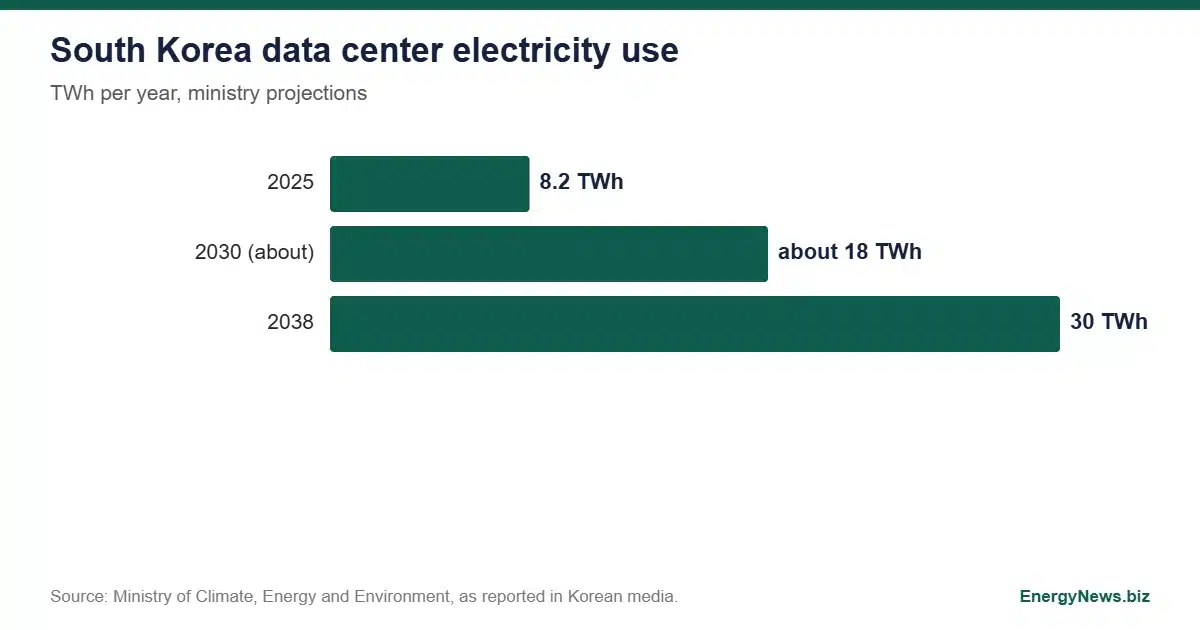
The ministry for climate, energy and environment projects electricity use by data centers rising from 8.2 TWh in 2025 to about 18 TWh in 2030 and 30 TWh in 2038. Greater Seoul is where the pressure is concentrated. A CBRE Korea analysis of KEPCO data found about 33.6 GW of data center projects in the Seoul area had sought grid reviews by March 2026, while about 1 GW, ten projects, had been approved.
The gap between 33.6 GW requested and about 1 GW approved suggests that many requests are speculative and that the grid, not demand, is the limiting factor. For advocates of a South Korea SMR fleet it is also an argument: reactors that sit next to demand can ease transmission needs, although the 2035 date means they cannot meet this decade’s shortfall.
The global backdrop
The South Korea SMR story sits inside a larger global one. The IAEA, as quoted in Korean coverage, projects world nuclear capacity growing from 377 GW at the end of 2025 to between 641 and 1,045 GW by 2050. That wide range shows how much depends on policy, financing and delivery. Korea’s own plans, including a target mentioned by the minister of 15 GW of nuclear additions by 2035, have not been traced to a source document, so that figure should be treated cautiously.
The grid side of the question, including who pays for large equipment orders, appears in our report on the GE Vernova acquisition of Trench, a reminder that reactors and wires are bought from the same stretched supply chains. Global nuclear statistics and conference materials are available from the agency at iaea.org.
What to watch
The key milestones are the regulator’s decision on the i-SMR design, the start of detailed design in 2027 and any binding export order for Korean SMR technology. Most figures above come from a single Korean news report and should be checked against regulator and agency releases as they appear. Until a reactor is under construction at home, South Korea SMR leadership remains a promise about 2035 and beyond.
Add EnergyNews.biz as a preferred source on Google


