


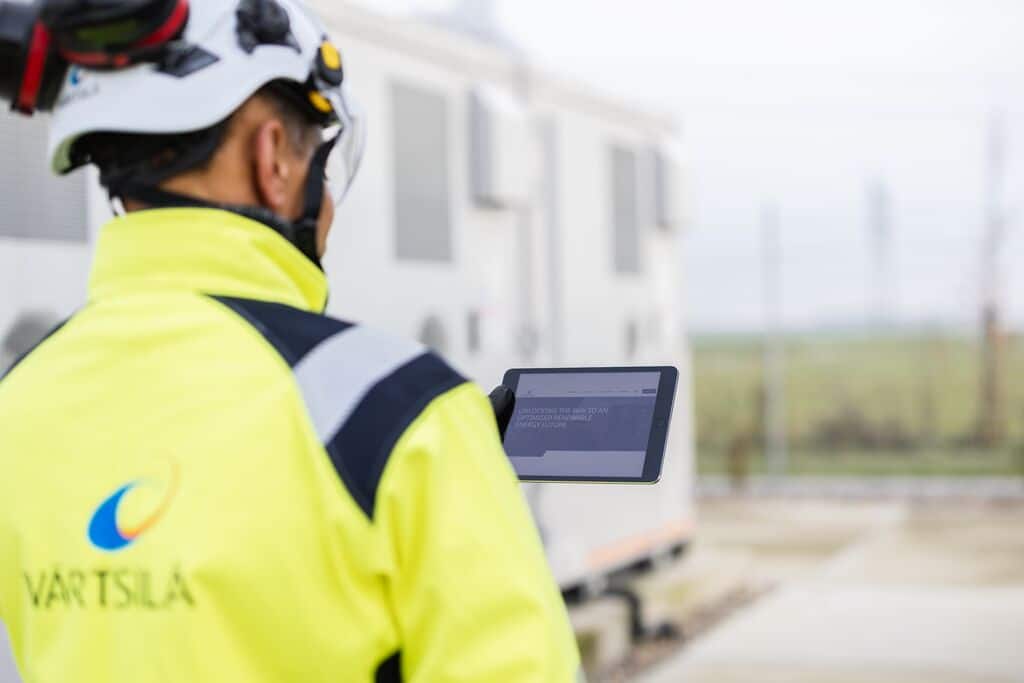


Wärtsilä is separating its global Energy Storage business into a new joint venture with German engineering company RCT Solutions GmbH as competition, supply chain pressures, and margin challenges reshape the battery energy storage sector.
The move will remove energy storage from Wärtsilä’s standalone reporting structure and shift the business into an associated company model once the transaction closes, marking a strategic change in how the company approaches one of the fastest growing segments of the energy transition.
The planned joint venture will be equally owned by Wärtsilä and RCT Solutions, with each holding a 50% stake initially. The companies said additional investors could join at a later stage, potentially reducing the ownership share of the founding partners.
Wärtsilä’s Energy Storage business has been the smallest of the company’s reporting segments, employing approximately 480 people globally. In 2025, the division generated €694 million in net sales but reported profitability of only 3.3%, reflecting the increasingly difficult economics of large scale battery storage projects.
The restructuring comes as the battery energy storage market expands rapidly but faces intense pressure from declining equipment prices, project delays, supply chain competition, and the need for stronger vertical integration. While demand for grid scale storage is rising as renewable generation increases, developers and technology providers are operating in a market where cost competitiveness has become a central factor.
The new joint venture will combine Wärtsilä’s existing battery energy storage systems, software capabilities, project expertise, and installed customer base with RCT Solutions’ engineering capabilities, supply chain knowledge, and manufacturing ambitions.
Wärtsilä’s storage portfolio currently includes utility scale battery energy storage systems, optimization software, control platforms, and lifecycle services designed to support grid balancing and renewable integration. However, the company’s decision indicates that scaling these activities independently has become more challenging.
RCT Solutions, founded in 2012, brings experience in solar and battery storage engineering as well as involvement in the development of battery and solar manufacturing facilities. The company has also been involved as a supplier to Wärtsilä’s Energy Storage operations.
A key element of the partnership is RCT’s ambition to develop a vertically integrated battery energy storage platform, including an existing manufacturing initiative in the United States. Vertical integration has become increasingly important in the battery sector as companies attempt to reduce exposure to supply chain disruptions and dependence on external cell and system suppliers.
Wärtsilä President and CEO Håkan Agnevall said the partnership is intended to strengthen the competitiveness of the storage business by combining complementary capabilities. RCT Solutions CEO Peter Fath said the joint venture aims to create a stronger global platform by integrating technology, engineering expertise, and manufacturing capabilities.
The transaction also reflects the financial challenges facing the business. Wärtsilä expects the joint venture to be loss making in 2026 due to weaker recent order intake and transformation costs, including write downs of capitalized research and development expenses. The company estimates the impact on its 2026 operating result will be between €40 million and €50 million, depending on the timing of the closing.
The joint venture is expected to move toward positive results by the end of 2027, although the outlook depends on market recovery, order growth, and the ability to improve operational efficiency.
Until the transaction closes, expected in the third quarter of 2026 subject to regulatory approvals and financing arrangements, Wärtsilä will classify Energy Storage as discontinued operations and assets held for sale. After completion, the company will report its share of the joint venture’s results under Other Business Activities rather than as a separate operating segment.
The restructuring also ends Wärtsilä’s previous financial targets and demand guidance for Energy Storage as an independent segment. The company said the transaction is not expected to create a material profit and loss impact at closing.
For the wider battery storage industry, the development highlights a broader consolidation trend. Energy storage providers are facing a market paradox: demand for storage infrastructure is increasing, but profitability remains under pressure due to aggressive pricing, technology competition, and evolving project requirements.
Large scale battery storage projects increasingly require more than battery hardware. Developers are seeking integrated solutions combining energy management software, grid optimization, financing structures, long term service agreements, and reliable supply chains. Companies that can control more parts of the value chain may have an advantage as the sector matures.
Add EnergyNews.biz as a preferred source on Google


