




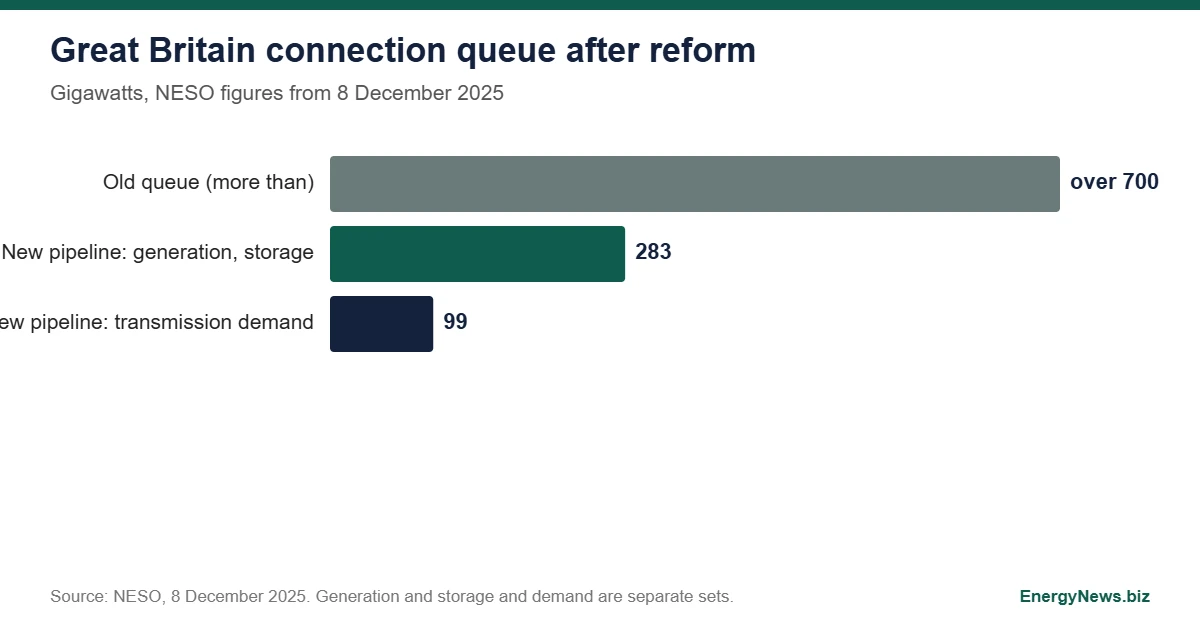
283 GW. That is the generation and storage capacity left in Great Britain’s new connections pipeline, set against an old queue that NESO measured at more than 700 GW, and alongside 99 GW of transmission connected demand. On 1 October 2026 NESO’s Director of Connections added that more than 75 percent of the offers needed to support the 2030 energy system have been issued. The connections reform replaced first come, first served with a readiness test, and the operator now warns that an offer is not a project.
700 GW in, 283 GW out
NESO announced the pipeline on 8 December 2025, after the old queue for grid access had grown tenfold in five years to more than 700 GW, around four times what Great Britain is projected to need by 2030. The reform replaced first come, first served with a test of readiness and fit with the government’s Clean Power Action Plan. Thousands of projects, from wind and solar farms to batteries and hydrogen, learned that day whether they were in the 283 GW of generation and storage or the 99 GW of transmission connected demand.
The figures are not like for like. The 283 GW of generation and storage and the 99 GW of demand are separate sets, so the pipeline is not simply 40 percent of the old queue, though 283 GW against more than 700 GW suggests that well over half of the capacity that applied did not make it. NESO describes the retained projects as deliverable and shovel ready, and claims they unlock £40 billion in clean investment annually. That is NESO’s claim, not a measured outcome.
Offers by Q3 2026, and a 75 percent figure on 1 October
The December timetable had the first batch of protected projects, those scheduled to connect in 2026 and 2027, receiving formal offers from December onward, and the remaining offers finalised by the third quarter of 2026. Projects wanting back in were told they could reapply from late 2026, and would have to show readiness and alignment with the Clean Power Action Plan.
The third quarter ended on 30 September. The next day NESO’s post reported that more than 75 percent of the offers needed to support the 2030 system had been issued and did not say when the rest would follow. That is progress, and it also means the December deadline for the final offers has passed without a stated completion date. NESO adds that issuing offers is not the same as delivering projects.
An offer is a milestone, not a connection
The 1 October post sets out the dependencies in plain terms: a connection also needs planning consent, network construction, supply chains, finance and a project that is ready. Developers are responsible for consent, finance and supply chains, network companies for the infrastructure, NESO for coordinating the process and strategic planning, Ofgem for the regulatory framework and government for policy. When one part falls behind, the post says, it affects the whole supply chain.
The British example matters for the European argument because the two systems face the same arithmetic. In her 6 October speech Commission President Ursula von der Leyen put the EU’s wait at six times last year’s 80 GW of new renewables, and Ember counted almost 700 GW in queues across the eight countries that publish data. The three counts of the EU queue measure different things, and Great Britain’s experience shows why the definition decides the answer: one operator, one reform, and, on NESO’s own figures, a queue that shrank sharply once readiness became the test.
What the EU is trying to copy, and the dates
EU member states agreed their negotiating position on the Grids Package on 26 June 2026, under the Irish presidency. It backs a common planning framework across electricity, hydrogen and gas, digital permitting portals, and treating electricity and renewable projects as being of overriding public interest unless proven otherwise. The Council will open negotiations with the European Parliament once Parliament adopts its own position, and aims for a final agreement as soon as possible in 2026. Von der Leyen asked Parliament on 6 October to agree it by the end of the year.
For Great Britain the checks are dated and specific. The reapplication window opens in late 2026, the remaining offers have no stated completion date, and the figure to watch is not offers issued but projects energised. Sources: NESO announcement of 8 December 2025; NESO post of 1 October 2026; European Commission speech of 6 October 2026; Council of the EU press release of 26 June 2026; Ember analysis of 1 April 2026.
Add EnergyNews.biz as a preferred source on Google


