


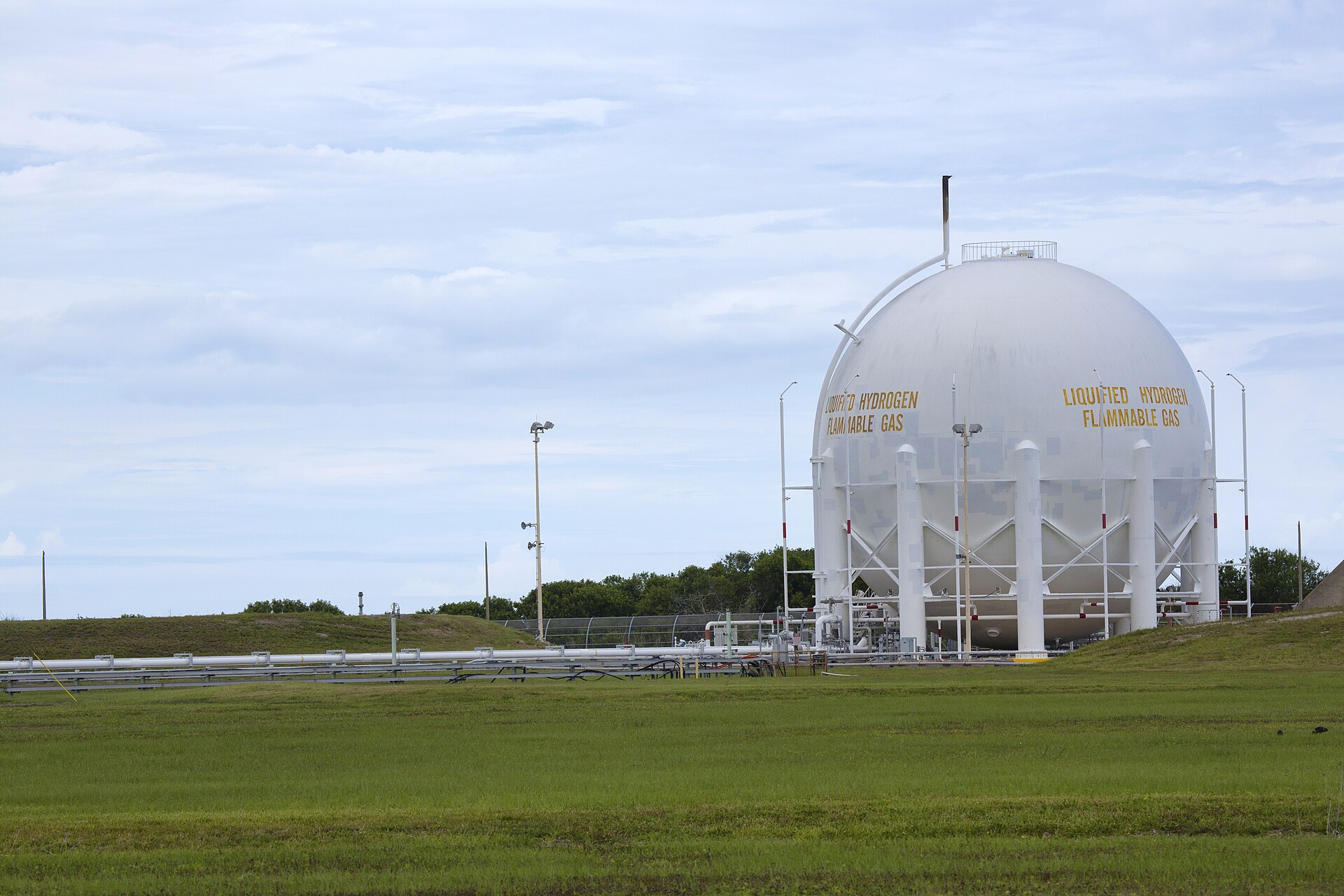


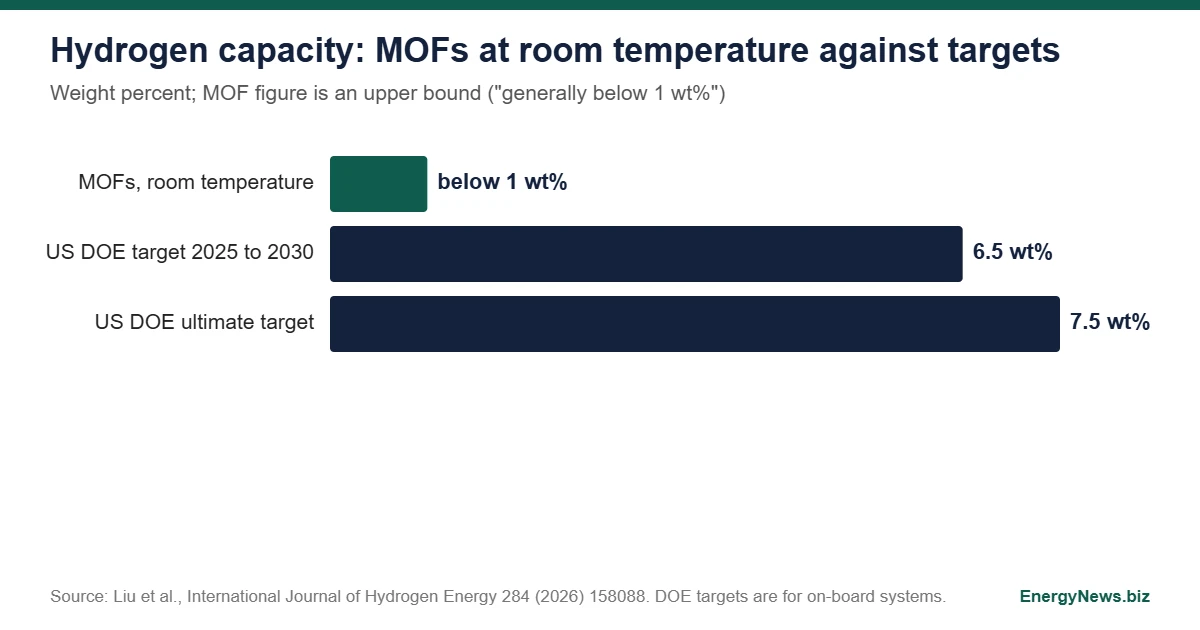
Metal organic frameworks store generally less than 1 weight percent of hydrogen at room temperature, against a US Department of Energy on-board system target of 6.5 weight percent for 2025 to 2030. A review in the International Journal of Hydrogen Energy by Peng Liu and colleagues walks through the whole chain of these materials for hydrogen storage, from synthesis to modification to performance, and it traces the room temperature shortfall to the weak interaction between hydrogen and the framework.
The target and the shortfall
The DOE targets for on-board hydrogen storage systems are 6.5 wt% gravimetric capacity and 50 g per litre volumetric capacity for 2025 to 2030, with ultimate targets of 7.5 wt% and 70 g per litre. Against a room temperature capacity below 1 wt%, the 2025 to 2030 target is at least 6.5 times higher and the ultimate target at least 7.5 times higher. At 1 wt%, a material needs about 99 kg of framework for each kilogram of hydrogen it holds, against about 14 kg of material per kilogram of hydrogen at 6.5 wt%.
The comparison is generous to the materials. The targets are for complete systems, which add the vessel, thermal management and other hardware to the storage medium, so a material that reached 6.5 wt% in a powder test would deliver less once it was packaged. The review makes that point under the heading of the powder to prototype gap, and it names densification and thermal management as the areas where practical work is lacking.
Why room temperature is the hard case
MOFs are crystalline porous materials built from metal ions or clusters joined by organic linkers, with very high surface areas and designable pores. Their first reported hydrogen storage performance, for MOF-5 in 2003, drew wide interest, and research output has grown steeply since. The difficulty is physical: at room temperature the interaction between hydrogen molecules and the framework is weak van der Waals attraction, which thermal motion overwhelms.
The review insists that performance at different temperatures cannot be read across. Low temperature measurements help researchers understand pore geometry, exposed metal sites and adsorption energy, because thermal motion masks those factors at room temperature, but a good result at low temperature does not mean a good result at room temperature. A capacity quoted at cryogenic temperatures is not a room temperature figure.
What the alternatives cost
The review frames the choice among four mainstream storage routes. High pressure gas storage at 35 to 70 MPa is mature and fast to fill but has low volumetric density and high cost. Cryogenic liquid storage below 20 K gives high density but needs substantial liquefaction energy and suffers boil off losses. Liquid organic hydrogen carriers are compatible with existing fuel infrastructure but need high dehydrogenation energy and often noble metal catalysts. Conventional metal hydrides have high theoretical capacity but need dehydrogenation temperatures above 300°C and show slow kinetics and poor cyclability. MOFs are proposed as a solid state route with milder operating conditions, which is why the room temperature figure decides their value.
Four mechanisms, four routes to close the gap
The paper compares four storage mechanisms, physisorption, chemisorption, the Kubas interaction and hydrogen spillover, and assesses synthesis methods including solvothermal, microwave assisted, ultrasound assisted, mechanochemical and electrochemical for scalability, cost and reproducibility. Performance enhancement strategies span structural engineering, post synthetic modification, composite construction and theory and data driven design. The review also flags data quality problems in machine learning for MOF hydrogen storage.
What would have to be true
For MOFs to matter for hydrogen storage, a material has to show room temperature capacity far above 1 wt% in a measurement that is reproducible, and then keep a useful part of that capacity when densified and packed into a system with the thermal management it needs. The material read for this analysis describes neither step as demonstrated at the target level. The check is concrete: a prototype report that gives system level capacity in wt% and g per litre, at room temperature, with densification and heat handling included. The review itself is the map of where such a result would have to come from. For a different storage question on the same fuel, see the 1:20 test of hydrogen leaks in a refuelling area. Source: Liu et al., Recent advances in the synthesis methods, modification strategies, and performance optimization of metal-organic frameworks for hydrogen storage, International Journal of Hydrogen Energy 284 (2026) 158088. The authors declare no competing interests and acknowledge company funded research support from PowerChina Chengdu Engineering. The sections read for this analysis were the abstract, highlights, introduction and section snippets.
Add EnergyNews.biz as a preferred source on Google


