


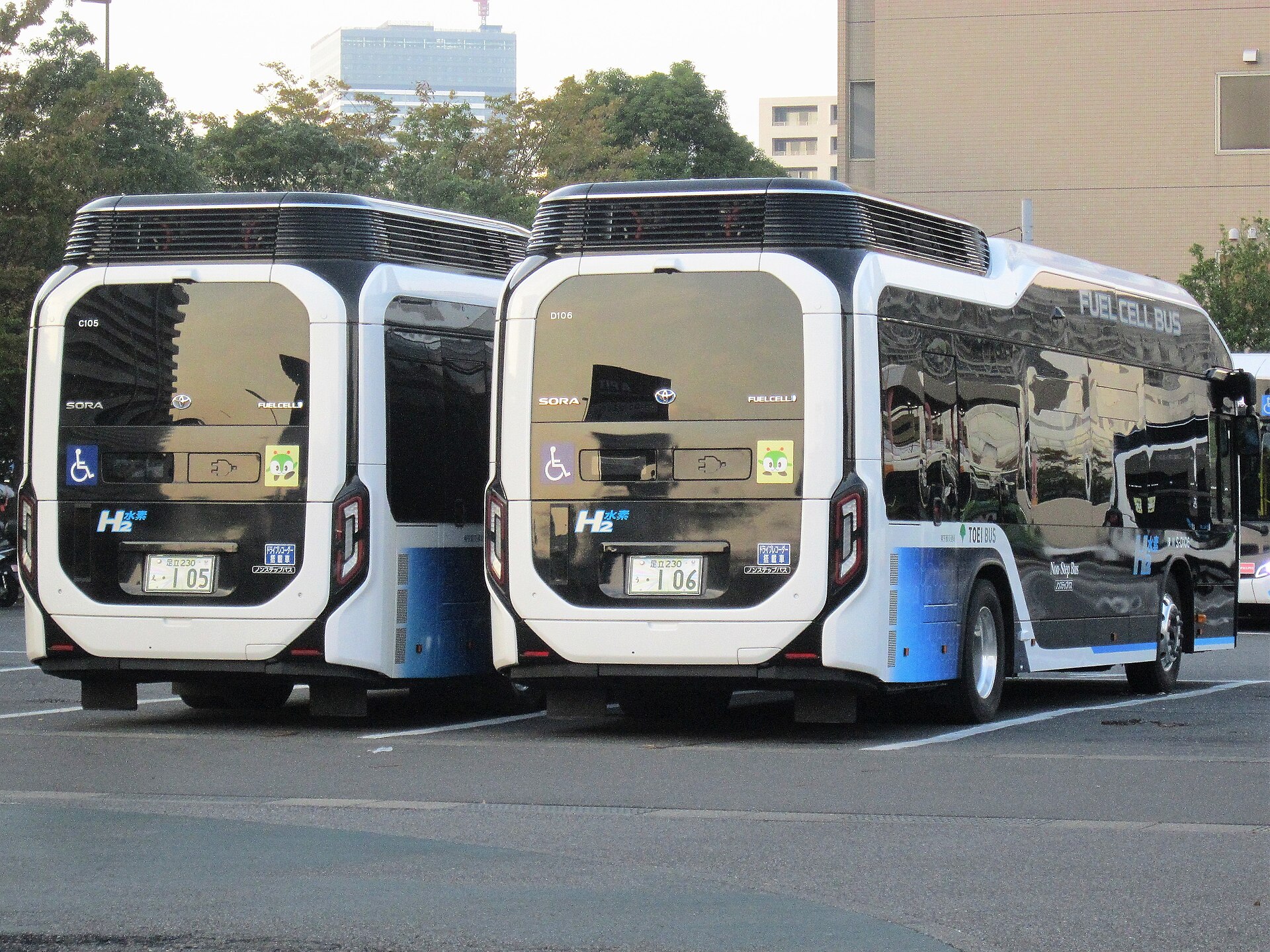


The new Toyota Sora fuel cell bus travels more than 300 km on a hydrogen tank that is about 20 percent smaller than before, and that pairing is the real claim behind the unveiling on 14 October 2026. Toyota developed the bus with Isuzu, combining Isuzu’s battery electric city bus platform with a Toyota fuel cell system, and says a more efficient fuel cell and a high capacity battery let it shrink the total hydrogen capacity while adding about 100 km of range.
What changed in the powertrain
The first generation Sora appeared in 2018 as Toyota’s fuel cell answer for urban transit. The new generation has a more compact fuel cell for commercial vehicles with greater power and durability, installed compactly on the bus roof to make maintenance easier for operators. The combination of that fuel cell with a larger battery is what Toyota credits for the range gain, and the battery is plausibly part of the explanation, since a bus that stores more energy in a battery needs less hydrogen on board for the same distance, although the announcement does not give the split.
The bus can be refuelled in about 10 minutes, which Toyota presents as a way to keep vehicle availability high through the day. It also meets a high speed refuelling standard that, where compatible stations exist, cuts the refuelling time by about half, which would put it near five minutes. The statement leaves out the station requirements, so the faster figure applies only where the infrastructure already exists.
| Item | Previous generation | New Sora |
|---|---|---|
| Range | About 200 km (implied by the 100 km gain) | More than 300 km |
| Total hydrogen tank capacity | 100 percent | About 80 percent |
| Refuelling time | Not stated | About 10 minutes, about half with a high speed standard |
| Variants | Not stated | Four: two urban, two suburban |
Range per unit of hydrogen: roughly 1.9 times
The two figures can be combined, with caveats. If the previous range was about 200 km, inferred from a gain of about 100 km to over 300, and the tank is about 20 percent smaller, range per unit of tank capacity rises by a factor of 300 divided by 200 divided by 0.8, or about 1.9. That is a minimum, since the new range is stated as more than 300 km, and it overstates the fuel cell’s own improvement, because the larger battery supplies part of the extra range. Neither the tank size in kilograms nor the battery capacity in kWh is given, so the split between hydrogen and battery cannot be calculated.
Power, safety and access
The bus can serve as an emergency power source when connected to an external power unit, which Toyota notes could matter in emergencies and natural disasters. On safety, the Emergency Driver Stop System works with a Driver Status Monitor: if the system detects that the driver has a problem, the bus slows gradually and comes to a complete stop, then applies the parking brake so it stays in place even on an incline. A front blind spot monitor detects pedestrians and bicycles in front of the vehicle and alerts the driver.
Inside, the floor is completely flat and step free, and a wheelchair securing system with a single action mechanism is available as an option. The bus will be offered in four variants, two for urban routes and two for suburban routes, with different seating configurations. These are features aimed at operators who buy on availability, accessibility and safety as much as on range.
What the announcement leaves out
The announcement gives no price, no hydrogen tank size, no fuel cell power rating, no battery capacity, no production volume and no delivery date or list of markets. Those are the figures that decide whether the range per tank gain translates into a lower cost per kilometre for an operator, and none can be checked from the material available. The dated fact is the unveiling on 14 October 2026; the next measurable steps are the first orders and the first buses in service. For on site hydrogen handling questions that apply to depots and refuelling areas, see the 1:20 test of hydrogen leaks in a refuelling area. Source: report of Toyota’s unveiling of the new Sora, 14 October 2026.
Add EnergyNews.biz as a preferred source on Google


