




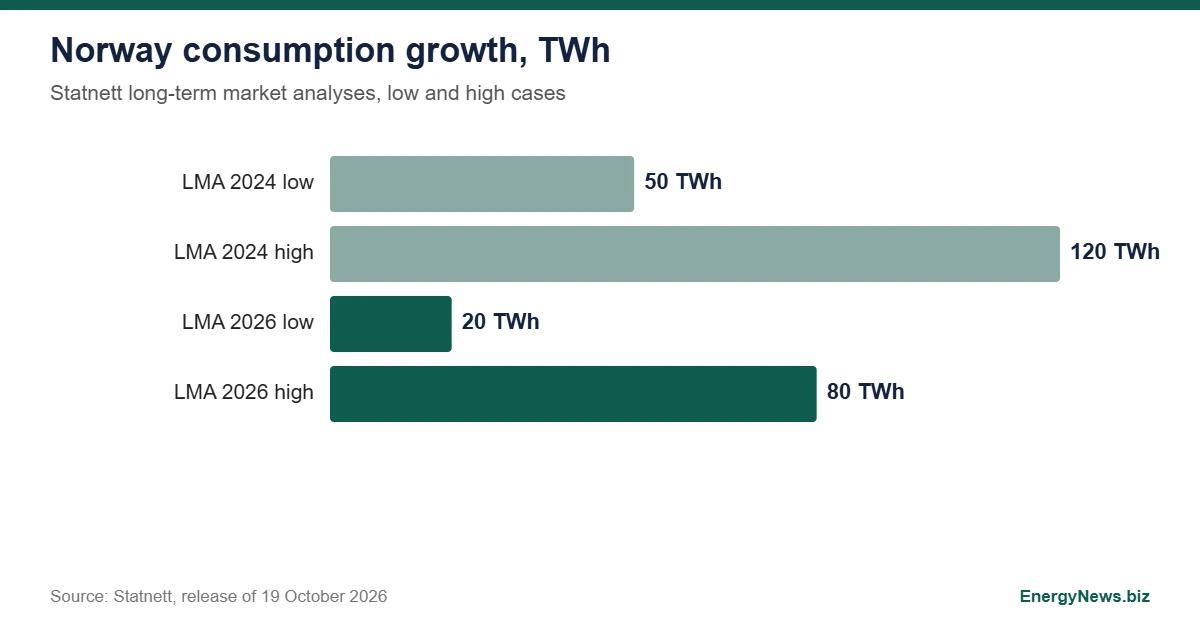
The Statnett LMA, its Long-term Market Analysis 2026 to 2060, was published on 19 October 2026 and projects an increase in Norwegian electricity consumption of 20 to 80 TWh over the analysis period, down from 50 to 120 TWh in the previous analysis covering 2024 to 2050. The grid operator says the new analysis confirms the need for its planned reinforcements linking Norway’s regions in both high and low growth cases.
Why the Statnett LMA range fell
Statnett says few concrete plans for new generation exist, so it lowered its estimates, and that generation growth looks more dependent on support schemes. Consumption growth is still driven partly by transport electrification and new data centres. The top of the new range is 40 TWh below the old top, and the bottom is 30 TWh below the old bottom. Statnett has reserved grid capacity for about 50 TWh of new consumption, which equals the lower end of the old range and sits inside the new one.
The Statnett LMA balance and what it costs
Norway moves toward a tighter energy balance and a larger import need. A lasting deficit above 20 to 30 TWh would cause serious problems in dry years, Statnett says, and would push prices up and make new consumption in Norway less attractive. Base scenario prices in southern and central Norway fall to roughly 40 to 50 euros per MWh in the coming years, and from 2030 the scenarios give Norwegian average prices of 30 to 70 euros per MWh.
The European picture
For Europe, Statnett says wind and solar cover nearly all demand growth from electrification and data centres and replace most gas and coal, moving the system quickly toward near-emission-free generation. Over the next decade fossil generation still sets prices when wind and solar output is low, and short-term and seasonal swings can be large. In the base scenario, interconnector bottleneck revenues are estimated at NOK 150 billion in net present value through 2060.
The release does not mention hydrogen or batteries. Their role sits in the full report, which was not opened for this article. Related market context on ENB: UK battery daily price spread and the winter test.
Add EnergyNews.biz as a preferred source on Google


