




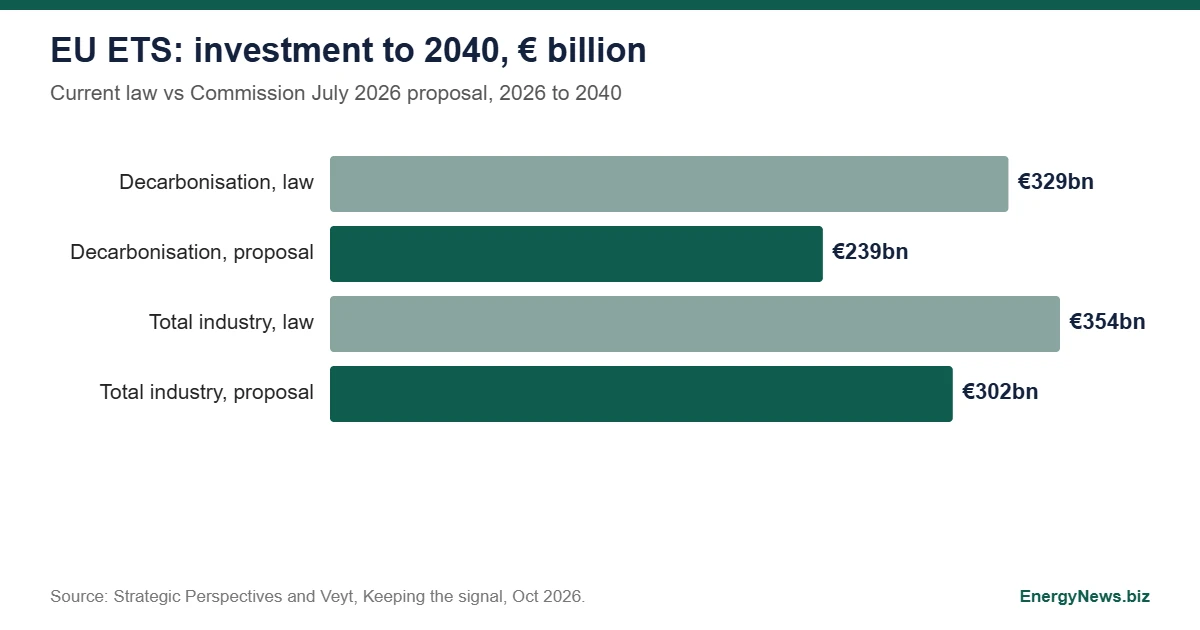
The EU ETS proposal published in July would cut industrial decarbonisation investment by €90 billion between 2026 and 2040, from €329 billion under current law to €239 billion, according to a study by Strategic Perspectives and Veyt. That is a fall of 27 percent, and it arrives alongside a reform that the Commission presents as relief for industry. The study’s finding is that relief and investment pull in opposite directions.
What the EU ETS proposal changes
The study compares three cases: current EU law, the Commission’s July 2026 proposal, and an earlier cost efficient scenario assuming an 85 percent domestic emissions cut by 2040. The proposal lowers the linear reduction factor, the annual rate at which the cap shrinks, from 4.4 percent to 3.7 percent in 2031 to 2035 and to 1.7 percent in 2036 to 2040. It also delays the point at which no new allowances enter the market from 2039 to 2048.
Other elements reported alongside the proposal extend free allocation beyond 2034 until 2038 and allow high integrity international credits from 2036, creating up to 2 percent of additional emissions space. From 2031, free allocation becomes conditional on investment plans worth 100 percent of its value, a mechanism the study summary does not break out.
The EU ETS investment gap in numbers
Total industrial investment for 2026 to 2040 falls from €354 billion to €302 billion, a gap of €52 billion. The decarbonisation line falls by €90 billion over the same period. The two pairs of figures imply that investment outside decarbonisation rises from €25 billion to €63 billion, a shift of €38 billion that the summary does not explain. The arithmetic is calculated from the reported totals.
Technology effects are uneven. Carbon capture and storage investment could fall by €44.8 billion, about half of the total decarbonisation reduction. Low carbon steel investment could fall by about three quarters, and green hydrogen outside steel would almost disappear. The study adds that gross emissions in 2040 could be more than 200 million tonnes of CO2 higher than in the cost efficient scenario.
Where the EU ETS shortfall lands by country
Corporate Leaders Group Europe, citing the study, reports that the Netherlands would be hit hardest, with its total roughly halving to less than €20 billion. Germany would lose €15 billion and Italy €12.5 billion. The study summary itself gives no country breakdown, so these figures rest on that secondary citation.
Carbon capture and hydrogen are the technologies most exposed, so the sector mix matters beyond the €44.8 billion capture figure. Hydrogen supply plans such as those in Germany’s hydrogen package and 4 GW of plants depend on a carbon price that makes the green route cheaper than the alternative.
Why the price signal decides the outcome
The problem is simple to state. A slower cap means fewer scarce allowances, a lower expected carbon price and a longer payback on capital that has to be committed in this decade. The solution on the table in the proposal is conditional free allocation, which ties relief to reinvestment. Whether that offsets a weaker cap is the open empirical question, because the study’s headline figure compares the proposal as a whole with current law.
The European Parliament’s draft report would weaken the EU ETS further, according to Corporate Leaders Group Europe, but no figure has been published for that case. The full analysis, Keeping the signal: building Europe’s industrial investment case, was released on 6 October 2026.
Add EnergyNews.biz as a preferred source on Google


