





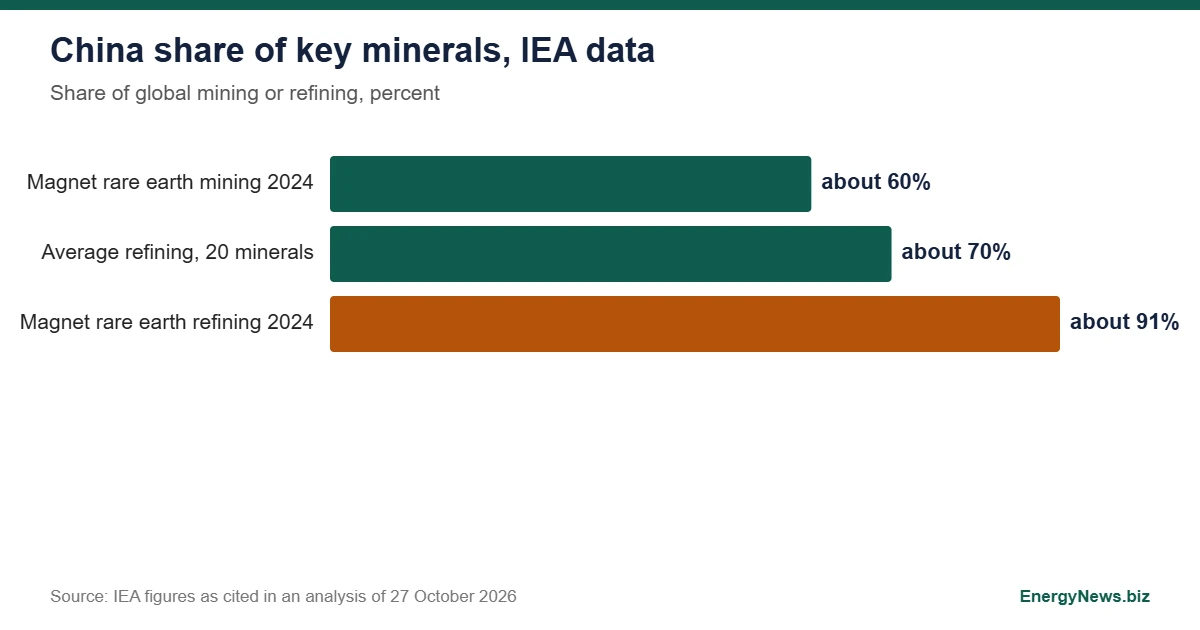
China is the leading refiner for 19 of the 20 strategic minerals tracked by the International Energy Agency, with an average share of about 70%. An analysis published on 27 October 2026 by Bob Savic of the Global Policy Institute argues that the battery supply chain of Western economies can be made resilient to China by 2035, but not independent of it.
Why the battery supply chain cannot decouple by 2035
The analysis calls the achievable goal selective risk reduction, meaning that a Chinese export cutoff would cause disruption and not a shutdown. Its reasoning rests on refining. For magnet rare earths China held about 60% of global mining in 2024 but about 91% of refining. Outside China, planned magnet capacity by 2035 equals about one third of expected mine output, and current and announced projects would meet less than one fifth of non Chinese magnet demand. Even if every planned project is completed, the IEA outlook has China’s share falling to about 70% at most, and under current policy China keeps more than 60% of refined lithium and cobalt and close to 80% of battery grade graphite and magnet rare earths.
The cost of closing the magnet gap in the battery supply chain alone could be roughly $60 billion over the next decade, an IEA estimate quoted in the analysis. It adds that non Chinese projects may be uncompetitive when prices are low, so governments would need concessional finance and binding procurement commitments to keep them running.
Three weak points in the battery supply chain
The analysis identifies three vulnerabilities. The first is securing minerals without enough refining capacity. The second is cell factories that still depend on Chinese components, equipment or process licences. The third is diversified suppliers that keep Chinese ownership, technology or feedstock links, which can look like diversification on paper while leaving the exposure in place.
China’s 2025 export controls on medium and heavy rare earths showed the stakes, sharply cutting exports and forcing some European and North American automakers to cut or suspend production, according to the IEA. The analysis expects any future retaliation to be mostly administrative and calibrated, for example tighter licensing, broader dual use definitions and price competition. The largest risk it names is rules of origin claims over foreign made products that contain Chinese materials or technology.
Technology substitution and the timeline
Sodium ion batteries are described as the most plausible near term alternative, but they have lower energy density, limited scale and a supply chain that is itself concentrated in China, a point also visible in our coverage of hard carbon anodes for sodium ion cells. Solid state batteries could shift the balance later, but the IEA expects deployment to stay concentrated in premium vehicles in the first half of the 2030s. Neither is expected to settle the battery supply chain contest by 2035.
The analysis proposes a phased path: foundations to 2030 through permitting, financing, stockpiles, recycling and long term buyers, then commercial scale, cost reduction and automaker qualification from 2030 to 2035. The most likely outcome for the battery supply chain in its three scenarios is managed risk reduction with China still dominant in lithium iron phosphate cathodes, anode materials and rare earth magnets. An accelerated separation after a crisis such as a Taiwan Strait confrontation is rated less likely, and a fully China free battery supply chain least likely.
The European Union’s Critical Raw Materials Act sets 2030 benchmarks of 10% of strategic material consumption from domestic extraction, 40% from domestic processing, 25% from recycling and no more than 65% from any single third country. Measured against the figures above, the processing and single country limits are the hardest to meet. The underlying data are published by the International Energy Agency.
For policymakers the message is to prioritise refining and cell manufacturing independence over mine openings alone, because the figures show that mining share is the smaller problem. A battery supply chain that adds mines but still sends concentrate to China for processing keeps the main exposure intact. Governments that want a resilient battery supply chain by 2035 will have to pair concessional finance with long term offtake, so that refining projects outside China can survive years of low prices.
Add EnergyNews.biz as a preferred source on Google


