




The Lydian 600 MWh Utah battery has reached commercial operation, built to support a Meta data center. The project adds a large block of storage to a grid that is absorbing fast-growing computing demand, and it is one more case of a battery sized around a single large load rather than a general grid need.
The pattern behind the Lydian 600 MWh Utah battery is now familiar. Data centers want firm, around-the-clock power, but the clean generation near them is often variable. A battery between the two smooths the mismatch: it stores cheap or surplus energy and discharges it when the data center’s draw outruns local supply, or when the grid is stressed.
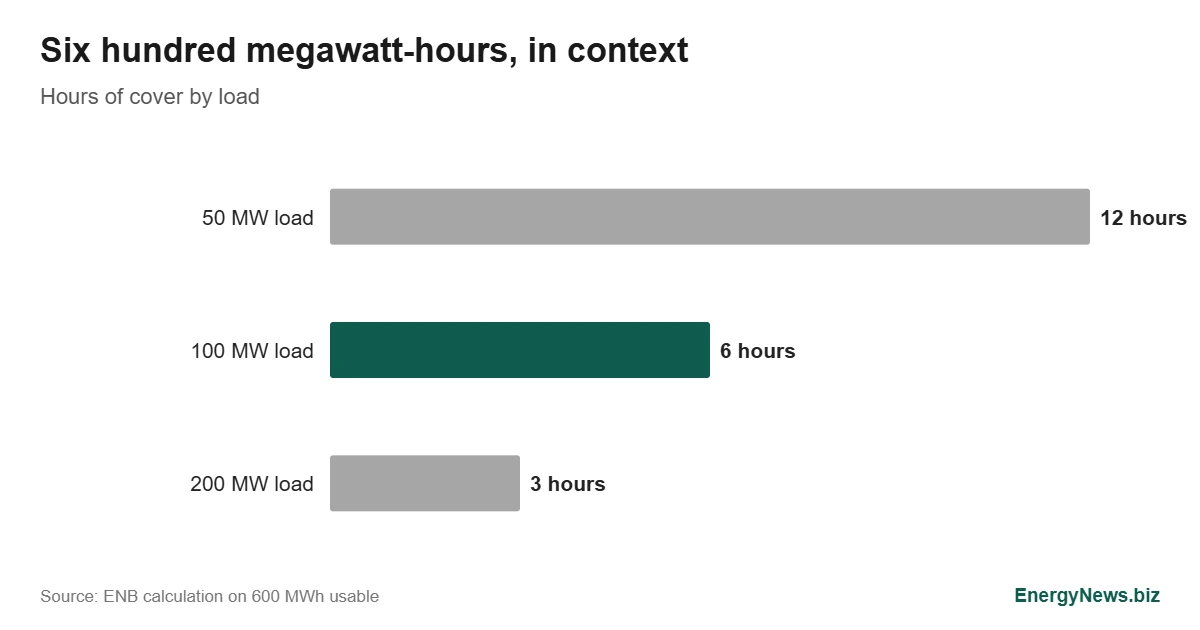
An ENB calculation of the Lydian 600 MWh Utah battery
Energy capacity only means something against a load. An ENB calculation shows what 600 MWh covers: about 12 hours at a constant 50 MW, about 6 hours at 100 MW, and about 3 hours at 200 MW. A hyperscale data center can draw well over 100 MW, so the battery is best understood as a bridge of a few hours, enough to ride through a supply gap or a price spike, not a substitute for firm generation.
Why data centers pull storage onto the grid
Computing load is the fastest-growing demand on many US grids, and it arrives faster than new firm supply can be built, the same pressure behind PJM’s fast-track connection rules. Storage is the quickest capacity to deploy, so developers pair it with data-center projects to hold the load steady while slower generation and transmission catch up. Utah, with cheap land and growing renewable build-out, has become a target for both data centers and the storage that firms them.
The Meta link is the signal. When a hyperscaler underwrites a battery, it turns a merchant storage project into a contracted asset with a known customer, which is easier to finance. That is the same move visible across the sector, from the Khavda battery in India to new US sites, and it is pulling storage toward the biggest loads on the system.
The figure to follow
Utah has become a magnet for both data centers and the storage that firms them. Cheap land, a growing renewable build-out and proximity to Western load have pulled hyperscalers into the state, and each large computing load needs capacity that arrives faster than new generation can. Storage is the quickest answer, so batteries are being sized directly against the data-center demand rather than the general grid.
The financing is what the Meta link enables. A battery with a named, creditworthy offtaker is far easier to fund than a merchant project exposed to volatile market prices, because lenders can see the revenue. That is why hyperscaler-backed storage is multiplying: the technology is ready, and a data-center contract turns it into a bankable asset. The open question is how much of the data center’s load any single battery is actually contracted to carry, and for how long.
The Lydian 600 MWh Utah battery is one project, but it is a template. As more computing load lands on Western grids, the size and duration of the batteries built to serve it will show how serious the firming really is, and whether storage can keep pace with demand that arrives faster than generation can be built.
The number that matters is how much of the data center’s load the battery is contracted to firm, and for how many hours. A few hours of cover at full load changes how a data center rides through stress; a few minutes does not. As more computing load lands on US grids, the size and duration of the batteries built to serve it will show how serious the firming is. Industry deployment data is tracked by the US Energy Information Administration.
Add EnergyNews.biz as a preferred source on Google


