


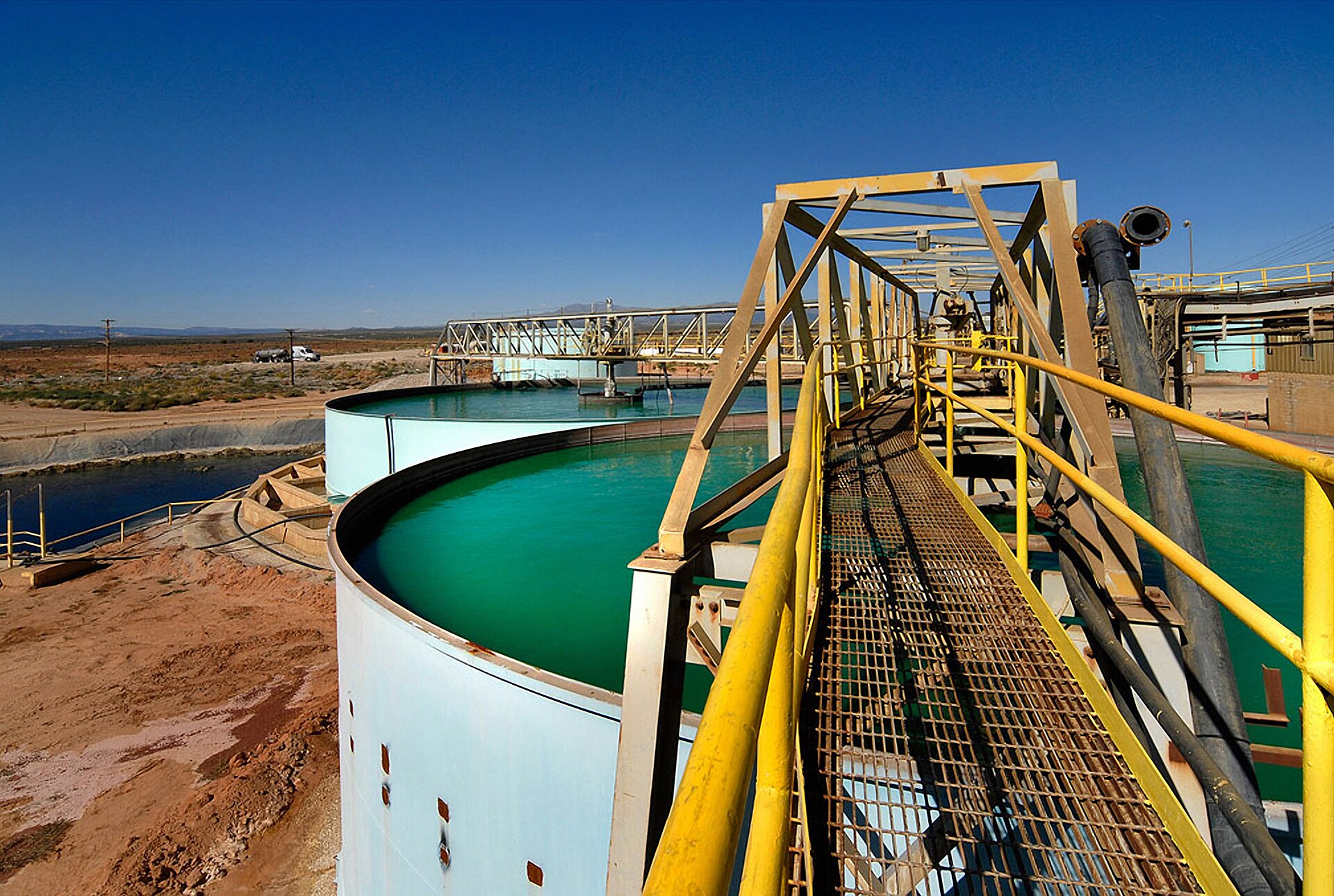


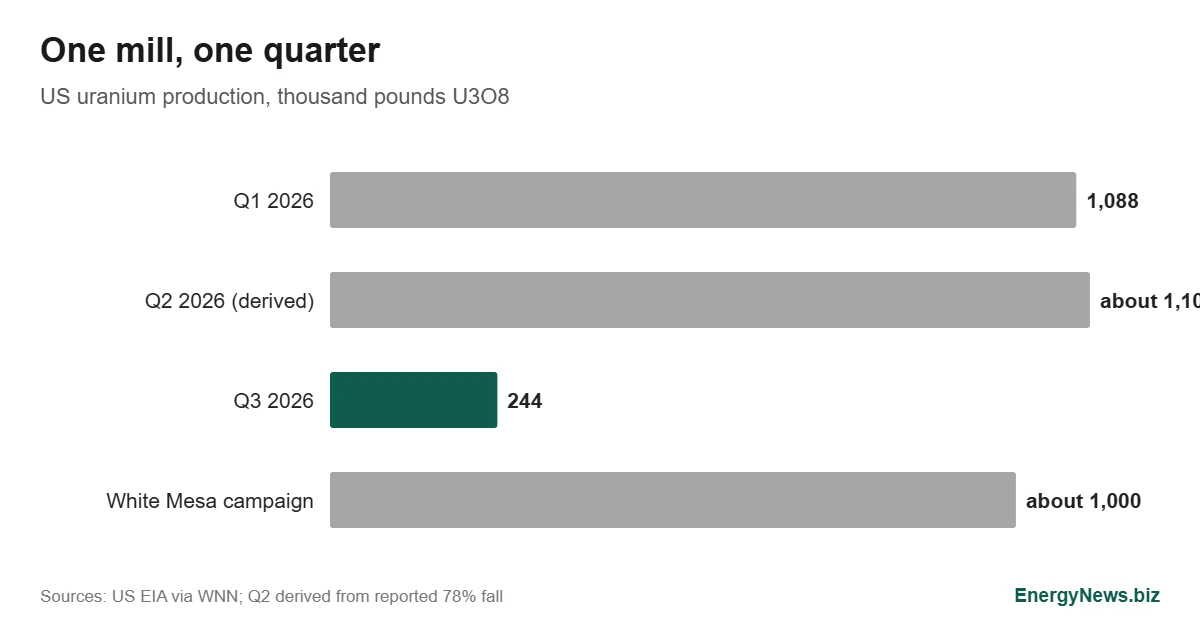
US uranium production fell to 243,673 pounds of U3O8 in the third quarter of 2026, down 78% from the previous quarter, according to US Energy Information Administration figures reported by World Nuclear News. The reason was not a market shock. One facility, the White Mesa mill in Utah, stopped processing uranium.
That single fact says more about US uranium production than any policy speech. Domestic supply is still small enough that one plant’s schedule can move the national total by three quarters.
US uranium production by quarter
In the first quarter of 2026, US uranium production reached 1,087,504 pounds. A 78% fall to 243,673 pounds in the third quarter implies that second quarter output was about 1.1 million pounds. Over the first nine months, the total comes to roughly 2.4 million pounds.
In the third quarter, eight facilities produced uranium, all of them in-situ recovery operations: four in Wyoming, three in Texas and one in Nebraska. White Mesa, owned by Energy Fuels, is the only conventional uranium mill operating in the United States. It stopped processing uranium in June after the company met its production guidance for the year, and switched to rare earth elements while it rebuilds ore stocks.
The White Mesa calculation
Energy Fuels plans a new processing campaign of about 1 million pounds. The report gives two timings, December 2026 in one place and the first quarter of 2027 in another. Either way, that single campaign would equal about four quarters of US uranium production at the third quarter rate.
The company expects 2026 output of 1.6 to 2.0 million pounds of mined and produced uranium. Its Pinyon Plain mine in Arizona is expected to wind down in the coming years. New projects, including Whirlwind on the Colorado and Utah border, Energy Queen and Bullfrog in Utah, and a restart of the Nichols Ranch ISR site in Wyoming, could together add about 1.25 million pounds a year.
Set against reactor demand
US utilities buy roughly 50 million pounds of U3O8 a year for their reactors, most of it from Canada, Kazakhstan, Australia and other suppliers. At the third quarter rate, domestic output covers about 2% of that demand on an annual basis. Even the best quarter of 2026, annualised, covers less than 10%. Supply from the US is a strategic hedge, not a replacement for imports.
That matters as new nuclear plans grow. New York alone wants 5 GW of advanced nuclear, and many advanced designs will need high-assay fuel that does not yet exist at scale. A domestic supply that swings by 78% when one mill pauses is not a base on which buyers can plan long contracts.
Policy support is growing. Washington has tried to rebuild domestic fuel supply through strategic reserve purchases and import limits on Russian uranium. Those steps raise demand for US uranium production, but they do not add processing capacity. Only new mines and mills can do that, and those take years to permit and build.
What fuel buyers should take from it
For utilities, the lesson is to read US uranium production figures with care. Quarterly swings reflect the campaign schedule of a few companies more than any trend. For investors, the useful signal is the permitting timeline of new mines, because that decides whether US output can grow beyond a few million pounds a year.
The number to watch
The number to watch is fourth quarter US uranium production in the next EIA report. If the White Mesa campaign starts in December as planned, output should rise sharply again. If it slips into 2027, the full year total will land at the low end of the company’s guidance.
Add EnergyNews.biz as a preferred source on Google


