




New York has published its Master Plan for Responsible Advanced Nuclear Development, a roadmap for 5 GW of new advanced nuclear generation in upstate New York. Governor Kathy Hochul presented the plan in Rochester on 18 November. It was written by the New York State Energy Research and Development Authority (NYSERDA) and the Department of Public Service, and it contains 30 recommendations backed by 12 technical studies and more than 1,000 pages of research.
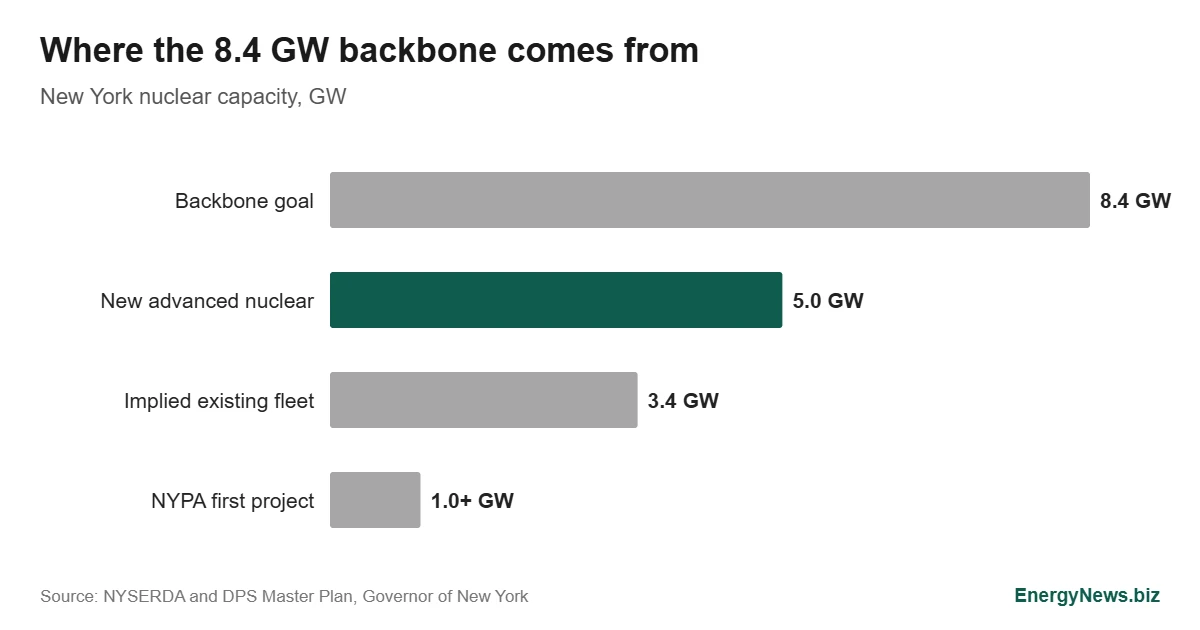
The plan sits inside a larger goal: an 8.4 GW “Nuclear Reliability Backbone” for the state. The New York Power Authority (NYPA) has been asked to develop at least 1 GW itself, and in November it qualified ten developer and integrator firms as potential partners.
What 5 GW of advanced nuclear means in energy
Capacity numbers are easy to announce. Energy is what customers pay for. Nuclear plants in the United States typically run at capacity factors around 90%. At that rate, 5 GW of new advanced nuclear would generate about 39 TWh a year (5 GW multiplied by 8,760 hours and 0.9). That is large enough to replace a significant share of the state’s fossil generation and to supply new industrial and data centre load upstate, where the plan places the reactors.
The 8.4 GW backbone figure also tells a story. If 5 GW is new, the remaining 3.4 GW has to come from somewhere, and the obvious source is the existing upstate fleet. The plan therefore assumes that today’s reactors keep running for decades while new units are licensed and built. Any early retirement would leave a hole that new projects cannot fill quickly.
Advanced nuclear also brings costs that the plan cannot fully control. First units of any new reactor design have historically come in late and over budget, and the plan’s financing recommendations are meant to spread that risk between the state, federal programmes and private partners rather than leave it with ratepayers alone.
The timing gap
That is the weakest point of the plan, and local reporting has already raised it. Upstate electricity demand is growing now, while the first advanced nuclear unit is unlikely to deliver power before the 2030s, even under optimistic schedules. Licensing, site preparation, supply chain build-out and first-of-a-kind construction all take time. In the meantime, the state needs other firm capacity, storage and transmission to carry the load.
The plan addresses this partly by recommending early state actions: financing support that builds on federal programmes, workforce training, and coordination with other states to share first-mover risk. Other governments are taking similar steps, as seen in South Africa’s 5.2 GW procurement and in Poland’s AP1000 project. New York’s difference is that it is planning a fleet, not a single plant.
Who can win advanced nuclear work in New York
For vendors, the ten firms qualified by NYPA are the first filter. The plan does not pick a reactor technology, which leaves room for light water small modular reactors and for advanced designs. Suppliers of forgings, instrumentation, civil works and fuel services should watch which developer teams NYPA selects for its first project, because those teams will set the supply chain for the units that follow.
Utilities and large buyers should look at the financing recommendations. If the state takes on part of the cost overrun risk, power purchase agreements for advanced nuclear could become available to industrial customers at fixed prices, which would change how data centre operators plan their sites in the state.
The number to watch
The milestone to watch is NYPA’s choice of a technology and site for its first 1 GW project, together with the date of its first licence application to the Nuclear Regulatory Commission. Without that, 5 GW remains a target. The full plan and its supporting studies are available from NYSERDA.
Add EnergyNews.biz as a preferred source on Google


