


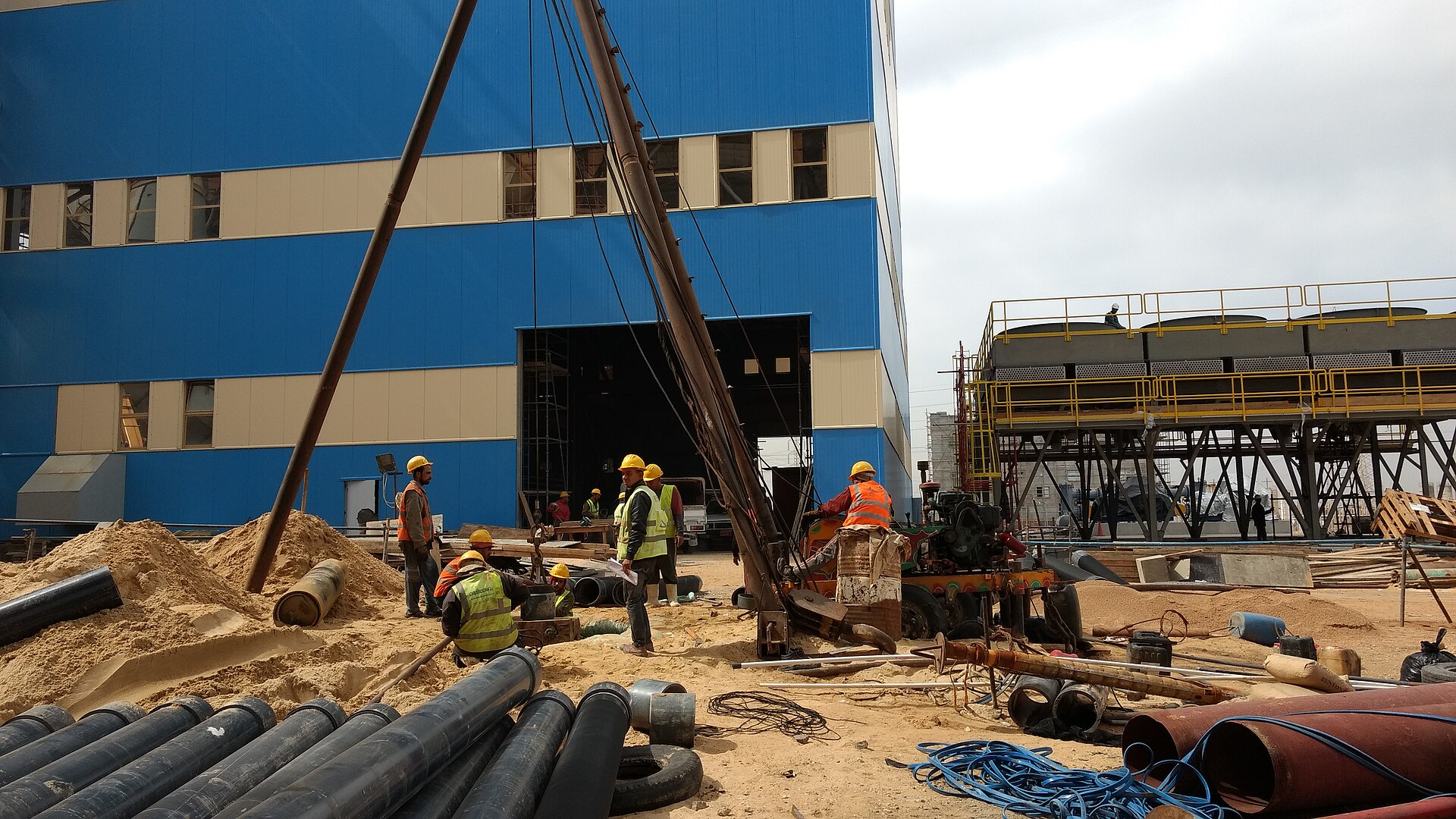


Taweelah C, a 2.6 GW combined cycle gas plant in Abu Dhabi, has reached financial close. The project costs AED7.76 billion, about $2.1 billion, according to the state offtaker EWEC as reported by Enerdata. Divided by capacity, that is about $813 per kW, a low figure for a new plant with the latest turbine class.
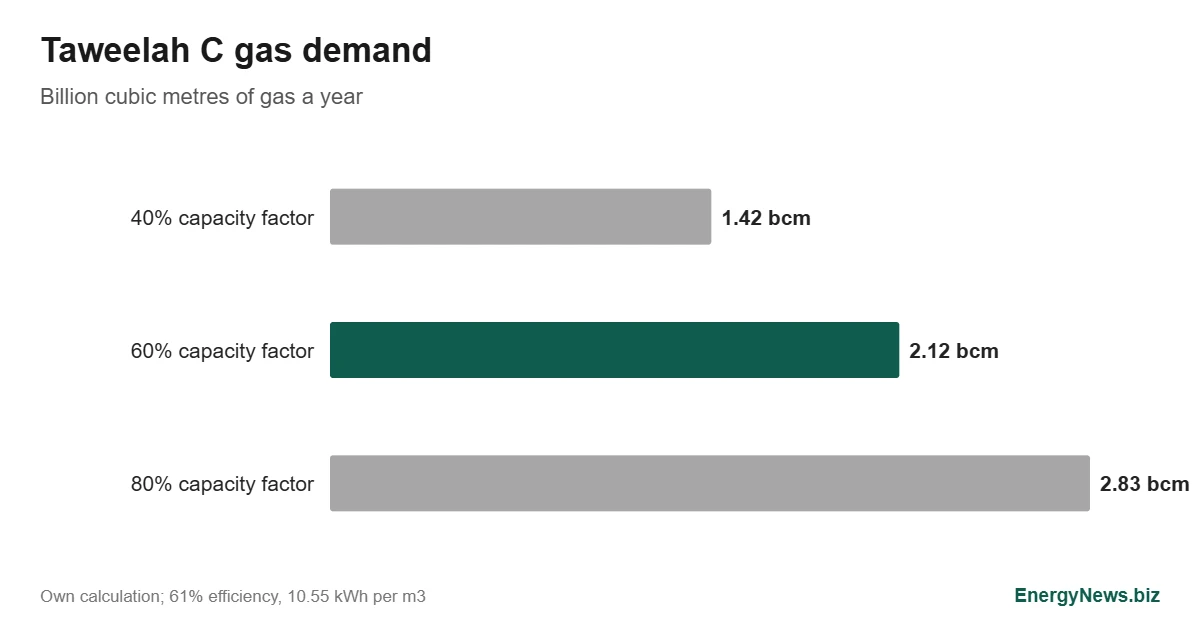
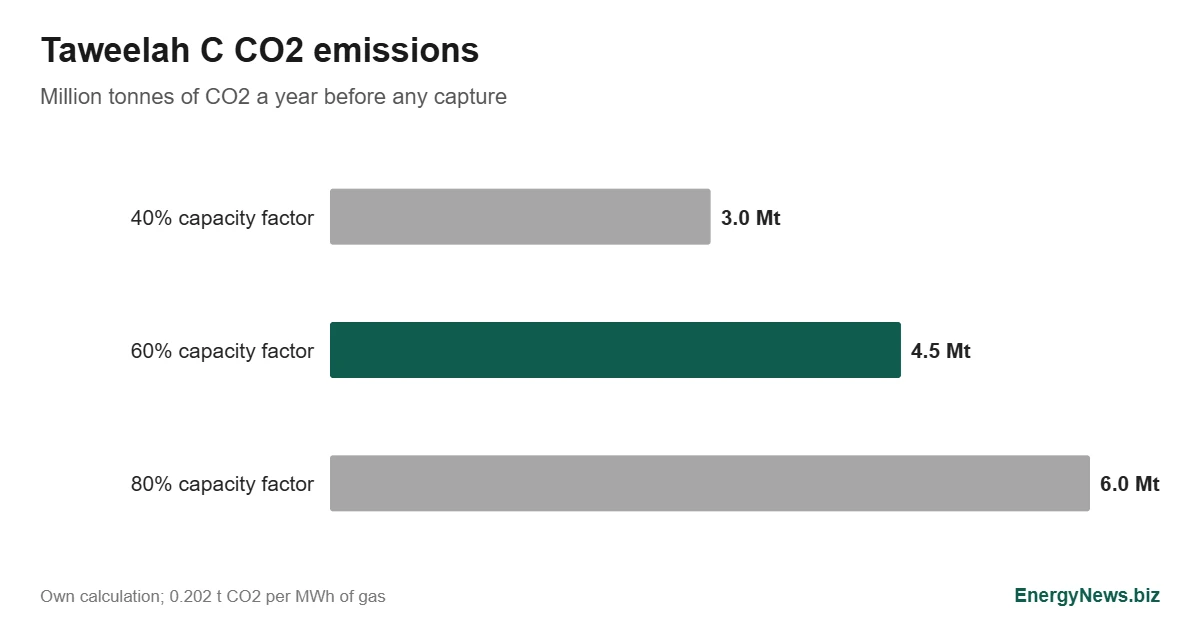
The cheap capital cost comes with a long fuel commitment. At a 60% capacity factor, Taweelah C would burn roughly 2.1 billion cubic metres of gas a year and emit about 4.5 million tonnes of CO2, and its power purchase agreement runs to the end of 2050.
Taweelah C: who owns and builds what
The project company is 60% owned by Abu Dhabi National Energy Company (TAQA) and 40% by a consortium of Saudi Arabia’s Aljomaih Energy and Water Company and Singapore’s Sembcorp Industries. In the operations and maintenance company the split is reversed: 40% TAQA, 60% consortium. EWEC buys the full net output and is the sole electricity procurer.
China Energy Engineering Corporation (Energy China) is the EPC contractor. Siemens Energy supplies three gas turbines, two steam turbines and five generators, including what it describes as the first HL-class gas turbine in the UAE. Commercial operation is planned for 2029. The PPA, signed in June 2026, runs through the end of 2050, about 21 to 22 years of operation.
| Item | Value |
|---|---|
| Capacity | 2.6 GW combined cycle |
| Project cost | AED7.76bn (about $2.11bn) |
| Cost per kW (own calculation) | about $813 |
| Owners | TAQA 60%, Aljomaih and Sembcorp 40% |
| EPC | Energy China |
| Turbines | Siemens Energy, 3 gas (HL-class), 2 steam |
| Commercial operation | 2029 |
| PPA | EWEC, to end of 2050 |
| Carbon capture | Designed for possible later integration |
Why $813 per kW is cheap
The AED7.76 billion figure is a project cost; the release does not break it into EPC, financing and development costs, so the per kW number is an approximation. Even so, it compares well with recent European projects. RWE’s three hydrogen-ready gas plants in Germany carry about €610 per kW for EPC alone, before grid, financing and owner costs, as calculated in this analysis of RWE’s plants.
Three factors explain the Gulf advantage: a large single site at an existing power and desalination complex, a Chinese EPC contractor, and a creditworthy state offtaker that lowers the cost of debt. EWEC has described Taweelah C as having one of the region’s lowest capital costs and levelised costs of electricity.
How much gas Taweelah C will burn
The Taweelah C release gives no efficiency or load figures. The calculation therefore states its assumptions: a net efficiency of 61%, which is realistic for an H-class combined cycle in hot ambient conditions, and gas with an energy content of 10.55 kWh per cubic metre.
- At 40% capacity factor: 9.1 TWh of electricity, 14.9 TWh of gas, about 1.4 bcm a year.
- At 60%: 13.7 TWh of electricity, 22.4 TWh of gas, about 2.1 bcm a year.
- At 80%: 18.2 TWh of electricity, 29.9 TWh of gas, about 2.8 bcm a year.
Over 22 years at 60% load, the plant would consume roughly 46 bcm of gas. The capacity factor is the key unknown. As Abu Dhabi adds solar, a flexible combined cycle plant may run less at midday and more in the evening and in summer peaks, which lowers average load and raises the value of fast ramping.
Emissions and the carbon capture question
Natural gas emits about 0.202 tonnes of CO2 per MWh of fuel burned. At 61% efficiency, that is about 0.33 tonnes per MWh of electricity. At 60% load, Taweelah C would emit about 4.5 million tonnes of CO2 a year.
The plant is designed to allow carbon capture to be integrated later, but no technology, timing or cost has been published. Capturing 90% of the flue gas CO2 at 60% load would mean about 4.1 million tonnes a year, several times the roughly 0.8 million tonnes a year that ADNOC’s Al Reyadah facility was built to capture from a steel plant. Capture would also cost energy: a typical post-combustion system takes 7 to 10 percentage points of net efficiency, which would raise gas use per MWh by roughly 15%.
In practice, capture readiness usually means space on the site and a layout that does not block a future unit. It does not commit anyone to build one.
Gas power as the partner to 30 GW of solar
EWEC frames Taweelah C as a bridge. Its chief assets officer, Mohamed Almarzooqi, linked the plant to an expected solar PV capacity above 30 GW by 2035. In that system, a large efficient gas fleet supplies evening, night and summer peak demand, and desalination load, while solar covers the day.
The open question for the Gulf is how quickly batteries take over part of that role. A 2.6 GW plant contracted to 2050 locks in a share of evening supply for gas. If battery costs keep falling at the pace seen in recent European and Australian auctions, later projects may combine solar with four to eight hours of storage and leave gas for longer, rarer peaks.
Taweelah C and the regional gas balance
The UAE is both a gas producer and a gas importer. It imports pipeline gas from Qatar through the Dolphin system and has developed its own sour gas fields to reduce that dependence. A new 2.6 GW plant adds demand at a time when the country also wants to raise LNG exports and supply growing industrial and data centre loads. At 2.1 bcm a year, Taweelah C alone would need a meaningful share of new domestic supply.
Efficiency helps. An H-class combined cycle needs noticeably less gas per MWh than the older units it may displace on the Taweelah site, some of which were built as cogeneration plants for desalination. If the new plant runs instead of older, less efficient units rather than on top of them, the net increase in gas use will be smaller than the gross figures above. EWEC has not published a retirement schedule that would allow that net effect to be calculated.
The second variable is desalination. Abu Dhabi has been shifting from thermal desalination, which needs steam from power plants, to reverse osmosis powered by electricity. That change frees combined cycle plants to follow power demand instead of water demand, and it makes solar plus storage a more direct competitor in the hours when water is now produced by electricity.
For turbine makers and EPC contractors, Taweelah C confirms that the Gulf remains one of the few regions still ordering large combined cycle plants on long contracts. For lenders, it shows a structure that works: a state offtaker, a 21-year PPA and a sponsor with a large existing portfolio.
What to check as construction starts
- Lender names and debt terms, not yet published, which will show how far export credit agencies or regional banks carried the risk.
- The gas supply contract behind the PPA and its price formula.
- Any carbon capture feasibility study commissioned before 2029.
- Actual capacity factors at Abu Dhabi’s existing combined cycle plants as solar grows.
The number to watch
The number to watch is the capacity factor of Taweelah C in its first full year after 2029. At 60% it burns about 2.1 bcm of gas a year; at 40% it burns about 1.4 bcm. That gap of 0.7 bcm a year is the measure of how much solar and storage in Abu Dhabi are displacing gas in the evening hours.
Add EnergyNews.biz as a preferred source on Google


