




The South Africa battery tender planned for next year and a new LNG-to-power project in Durban point the same way: the country is buying flexibility for a grid that still runs mostly on coal. The Independent Power Producer Office aims to launch Bid Window 4 of its battery programme, with 2,200 MW and 8,800 MWh of four-hour storage, in the fourth quarter of the 2027 financial year, according to an Engineering News report dated 25 November and summarised by Kenya Today.
In parallel, a consortium led by Engen with VTTI, Vitol and Saudi Arabia’s ACWA Power expects to start building a ZAR40 billion (about $2.3 billion) integrated LNG-to-power project in late 2028, subject to a final investment decision. It pairs a 1.9 GW combined cycle plant with an LNG terminal in the Port of Durban. Together the two programmes would add about 4.1 GW of dispatchable capacity.
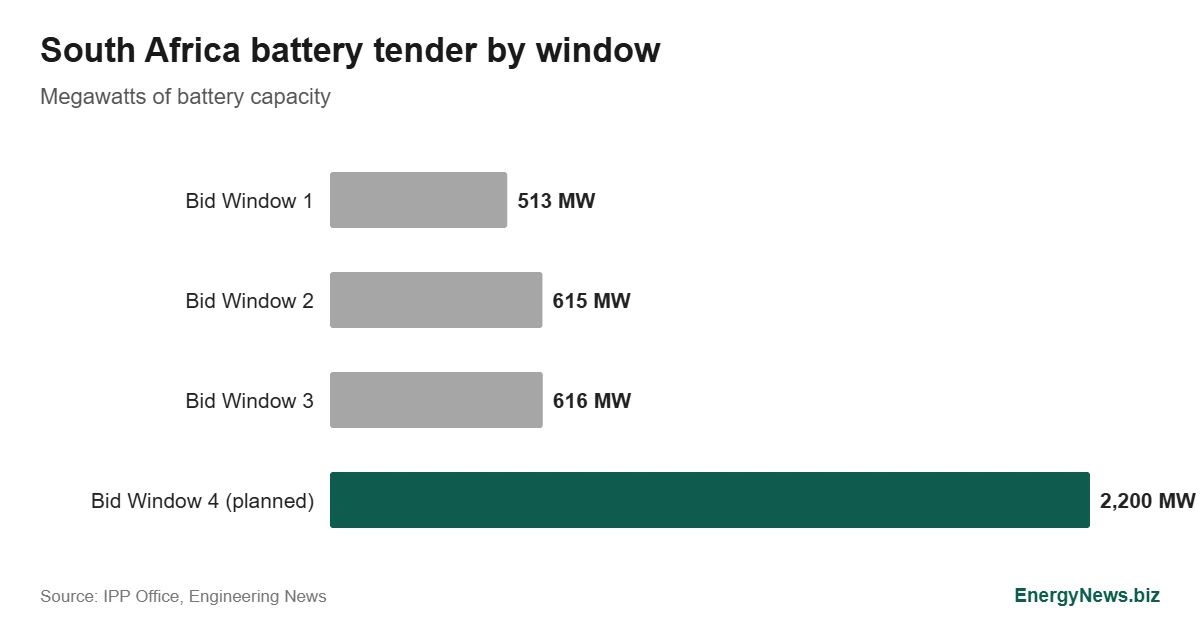
South Africa battery tender: from 1.7 GW to 3.9 GW
The first three South Africa battery bid windows secured a combined 1,744 MW: 513 MW in Window 1, 615 MW in Window 2 and 616 MW in Window 3. Window 4 alone would be larger than all three together. It is part of a Section 34 determination announced on 7 October by Energy Minister Kgosientsho Ramokgopa, which prioritises 4,600 MW of battery storage and 5,000 MW of gas-to-power.
The earlier South Africa battery rounds attracted roughly R16.8 billion of investment. Assuming they were also four-hour systems, that is about 6,976 MWh, or about R2.4 million per MWh (about $138,000 at R17.4 per dollar). At the same unit cost, Window 4 would represent about R21 billion of investment. Because battery prices have fallen since the first windows, that figure is an upper bound; actual bids are likely to be lower.
| Programme | Capacity | Investment | Timing |
|---|---|---|---|
| Battery Windows 1 to 3 | 1,744 MW | about R16.8bn | Awarded |
| Battery Window 4 | 2,200 MW, 8,800 MWh | Not disclosed; about R21bn at earlier unit cost | Launch Q4 of FY2027 |
| Durban LNG-to-power | 1.9 GW CCGT plus about 5 bcm/yr terminal | ZAR40bn (about $2.3bn) | Construction late 2028, power plant online H2 2031 |
For South Africa battery projects, the grid constraint comes first
The National Transmission Company South Africa (NTCSA) will assess suitable connection points and network capacity for Window 4. That is not a formality. Grid access has slowed renewable procurement in South Africa for years, particularly in the Northern Cape where solar resources are best and transmission is weakest. Batteries can be placed near load centres or at congested nodes, which is one of their advantages, but each site still needs a connection study.
Technical specifications, including performance, safety and grid service requirements, will come with the request for proposals. Battery chemistry and supplier lists have not been confirmed.
The Durban LNG project in numbers
According to Enerdata, citing a Vitol release of 23 November, the terminal will sit in the Port of Durban and the power plant on the site of the former Engen refinery, which is being converted into a fuel import and storage facility. Peak regasification capacity is about 5 bcm a year. Vitol says the plant could supply electricity for about 3.9 million households and that the terminal would give KwaZulu-Natal industry a dependable gas supply.
Spread over the 1.9 GW plant, ZAR40 billion is about $1.2 million per MW. That figure includes the LNG terminal and pipeline infrastructure, so it is not comparable with a stand-alone gas plant, which would cost well under $1 million per MW in most markets.
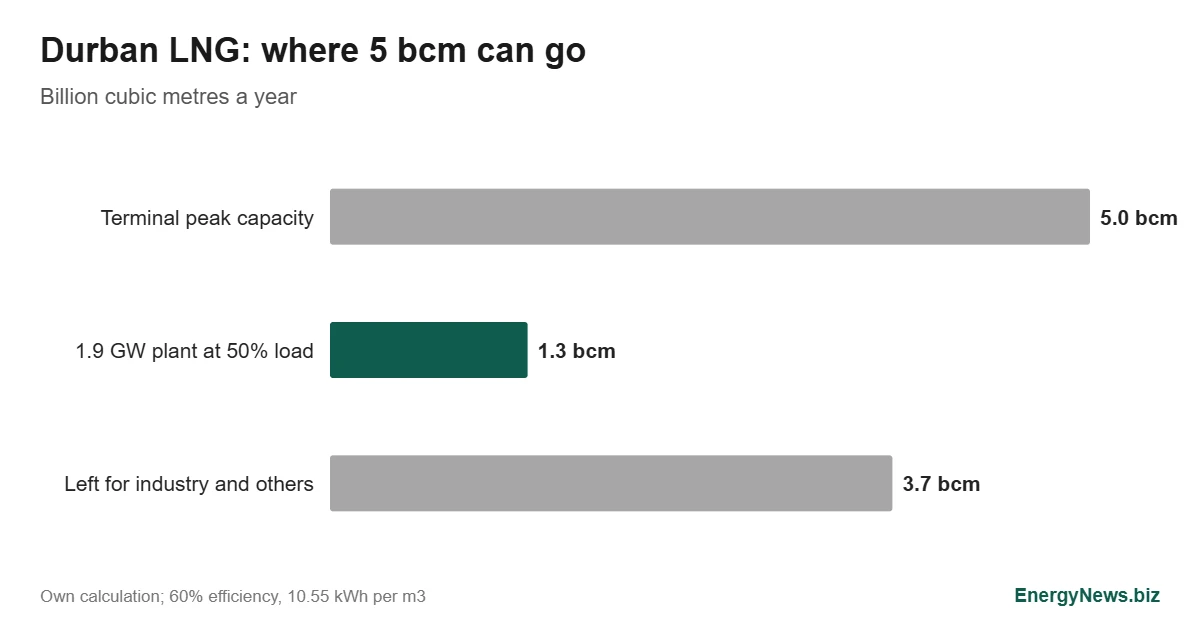
How much of the 5 bcm the power plant needs
The calculation uses two assumptions: a 50% capacity factor, reasonable for a plant that follows demand and solar output, and 60% net efficiency.
- Electricity: 1.9 GW × 8,760 hours × 50% = about 8.3 TWh a year.
- Gas: 8.3 TWh ÷ 0.60 = about 13.9 TWh, or about 1.3 bcm a year.
- Left in the terminal for industry and other users: about 3.7 bcm a year at peak capacity.
That split explains the industrial case. Gas from Mozambique, delivered by pipeline to South Africa for two decades, is declining as the existing fields age. Without a new supply source, refineries, chemical plants and manufacturers in KwaZulu-Natal and Gauteng face shortages. The power plant anchors the terminal, but industry may end up the larger customer.
What South Africa battery suppliers should prepare
For suppliers, Window 4 is the largest single South Africa battery procurement so far, and it arrives when global system prices are low. Local content rules have shaped earlier rounds and are likely to appear again. Suppliers with assembly partners in South Africa, or with a credible plan to add one, will have an advantage in scoring.
Safety and grid service requirements will also matter. Earlier South Africa battery projects were specified mainly for energy shifting and frequency support. With far more solar on the grid, the system operator may ask for grid-forming inverters and stronger fault ride through capabilities, which affect both cost and supplier choice.
Financing will depend on the offtake structure. If Window 4 follows earlier rounds, the buyer will be a state entity backed by government support. Lenders will look at the track record of Windows 1 to 3, how many projects reached commercial operation on time, and how payments have flowed.
Why batteries and gas together
Coal still generated 83% of South Africa’s power in 2025, according to Enerdata. Nuclear supplied 5%, solar 3% and hydro 3%. The coal fleet is old and unreliable, and the country has lived through years of rolling blackouts. Renewables are growing, but they need firming.
Batteries and gas plants answer different parts of that need. Four-hour batteries shift solar output into the evening peak and provide fast frequency response. A combined cycle plant covers long periods of low renewable output and supplies energy for days, not hours. The Section 34 determination, with 4,600 MW of batteries and 5,000 MW of gas, reflects that division. A similar debate over LNG-fired power for data centres is under way in Kenya, as reported in this report on Mombasa.
The two tools also compete for the same money. Every rand spent on a terminal and a gas plant is a rand not spent on batteries, and the reverse. The Section 34 split will be tested by prices: if batteries keep getting cheaper and gas imports stay exposed to global LNG prices, the balance between the two allocations is likely to shift in later rounds.
Risks for each programme
- Batteries: grid connection capacity, local content rules, and the time between bid window launch and financial close, which has stretched in earlier rounds.
- LNG-to-power: the final investment decision, local authorisations, and LNG price exposure for a power system whose tariffs are politically sensitive.
- Both: the creditworthiness of the offtaker and the progress of unbundling and market reform at Eskom.
The number to watch
The number to watch is the average South Africa battery bid price per MWh in tender Window 4. If it lands well below the R2.4 million per MWh implied by earlier South Africa battery rounds, batteries will look like the cheaper half of the flexibility plan, and the pressure on the 5,000 MW gas allocation will grow before the Durban project even reaches its investment decision.
Add EnergyNews.biz as a preferred source on Google


